Korea Enterprises Federation releases youth employment trend survey
Share fearing new hiring cuts if retirement age rises up from last year
Salary tops job-selection criteria at 66.6%
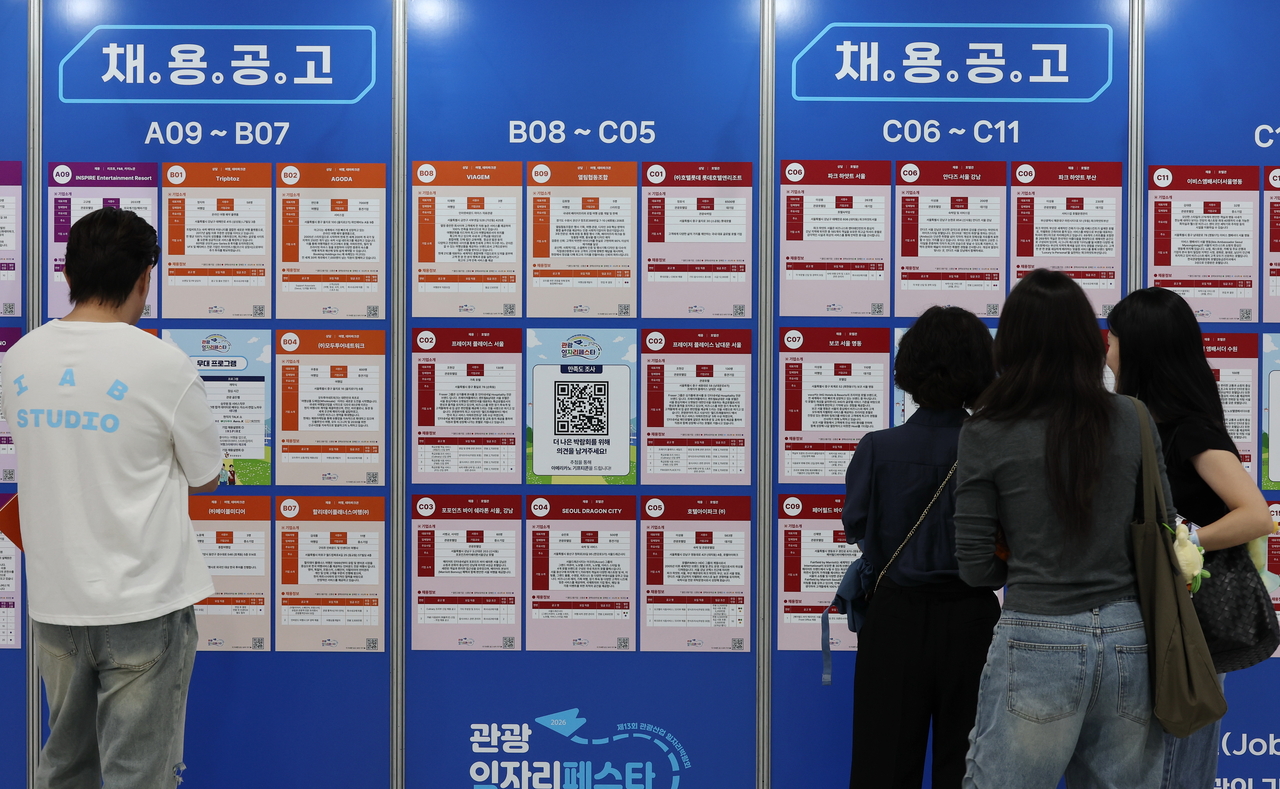
Six in 10 young Koreans say the job market is "generally difficult," and concern is growing that a legally mandated extension of the retirement age would reduce new hiring, a survey showed Tuesday.
The Korea Enterprises Federation released the results of its "Youth Employment Trend Survey," conducted among 1,052 people between the ages of 20 and 34 — 526 job seekers and 526 employed workers.
Among respondents, 62.9 percent said the youth job market is "generally difficult" — 31.9 percent said "somewhat difficult" and 31.0 percent said "very difficult." Those assessments were followed by "average" at 22.2 percent, "somewhat favorable" at 10.8 percent and "very good" at 4.0 percent.
Among those who said the market is difficult, the top reasons cited were an accelerating shift toward experienced-hire recruitment (49.5 percent), a decline in overall hiring compared with last year (49.2 percent) and reduced demand for workers due to AI adoption (49.1 percent).
Asked how a legally mandated retirement age extension would affect corporate hiring, 81.0 percent of respondents said it would reduce the scale of new recruitment — up 10.2 percentage points from 70.8 percent in last year's survey.
The most common job-preparation activity among young people was participation in internship or work-experience programs, cited by 47.4 percent of respondents. That was followed, in order, by obtaining language scores or certifications, attending job fairs and recruitment events, taking employment-related hagwon courses or classes, and building a portfolio through competitions.
![[Provided by Korea Enterprises Federation]](https://wimg.heraldcorp.com/news/cms/2026/09/29/news-p.v1.20260929.42fea17932654434999cb8738e26a0cd_P1.png)
When it came to job-selection criteria, "salary level" ranked first at 66.6 percent, followed by "employment stability" at 46.0 percent and "fit with one's job function or major" at 34.7 percent.
In terms of preferred employer type, "civil servant or public institution" (30.2 percent) and "large or mid-sized company" (29.3 percent) were the top two choices. Young people in the Greater Seoul area preferred large or mid-sized companies over civil service or public institutions, while those outside the metropolitan area showed the opposite preference.
The most commonly cited difficulties in the job-search process were "a shortage of quality jobs" (50.9 percent) and "a lack of work experience or career history" (49.0 percent). Those in the Greater Seoul area were more likely to cite a shortage of quality jobs (53.3 percent), while those outside the metropolitan area more frequently pointed to a lack of work experience or career history (53.6 percent).
Respondents identified "expanding employment infrastructure" (49.6 percent) and "strengthening support for companies that hire young workers" (49.2 percent) as the top priorities for boosting youth employment. Job seekers placed greater weight on expanding employment infrastructure (51.3 percent), while those already employed prioritized stronger support for companies that hire young people (50.6 percent).
Ryu Ki-jung, executive managing director of the Korea Enterprises Federation, said young people are aware of the trend toward ad hoc and experienced-hire recruitment but face a double burden — a shortage of jobs that match their expectations and limited opportunities to build the skills needed for those jobs. He called for a two-track strategy: expanding employment infrastructure to raise job seekers' competencies, and strengthening incentives for companies that voluntarily offer youth employment support programs to address the mismatch and help young workers build careers.
He added that "given the very strong concern that youth hiring will decline if the statutory retirement age is extended, a cautious approach to pursuing such an extension is necessary."
eyre@heraldcorp.com