Ceremony honors customs house established after Ganghwa Treaty to defend Korea's economic sovereignty
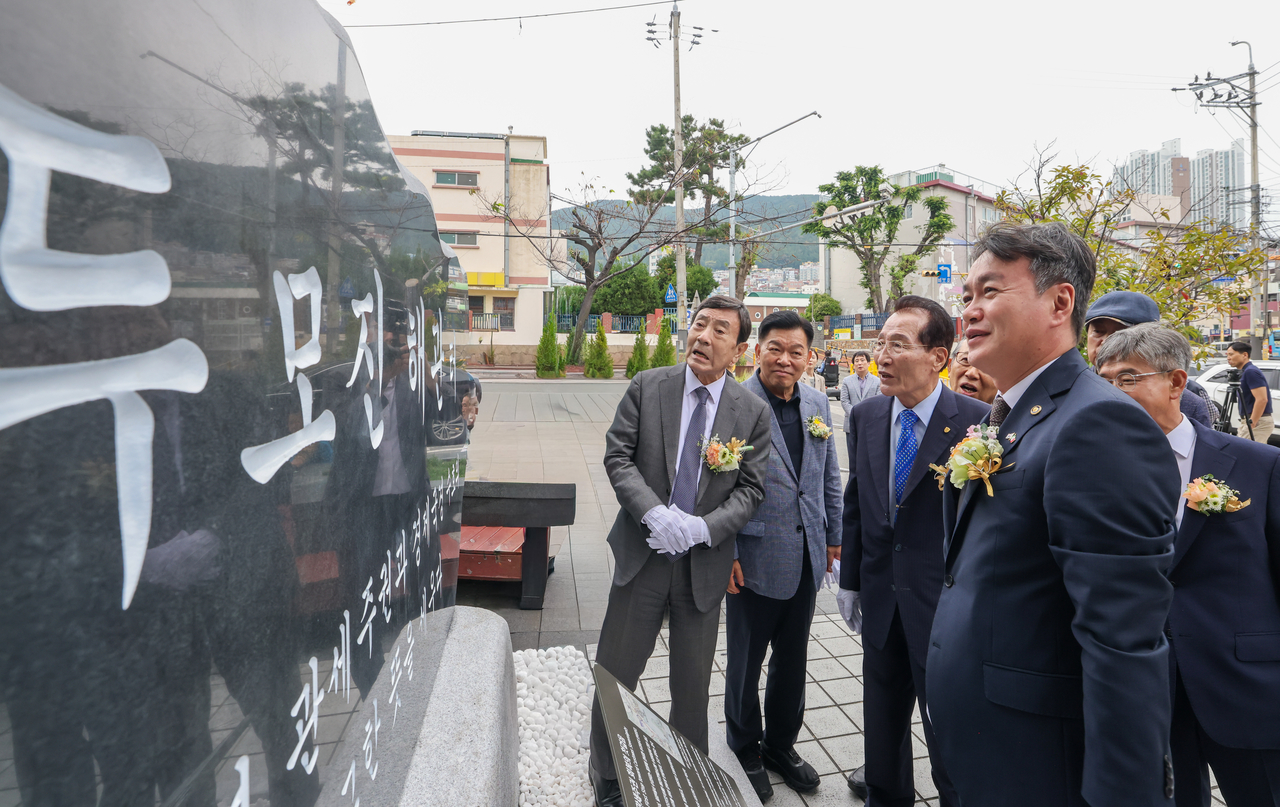
A ceremony was held Monday to reflect on the historical significance of the Dumojin Customs House — established Sept. 28, 1878, in the wake of the Ganghwa Treaty — and to carry forward the mission and dedication of those who defended Korea's economic borders and customs sovereignty.
The Korea Customs Service held the unveiling ceremony for the Dumojin Customs House memorial stone at the historic site in Sujeong-dong, Dong-gu, Busan, in front of the Busanjin Tax Office.
The ceremony was attended by Korea Customs Service Commissioner Lee Jong-wook, along with Korea Customs Alumni Association President Jeong Un-gi, Busan Port Revitalization Citizens Network Chairman Kim Chang-seok, Korean Customs History Research Society President Lee Dae-bok, Dong-gu District Mayor Gang Cheol-ho, and other guests and customs service officials.
National Assembly Finance and Economy Planning Committee Chairman Cho Seung-rae, along with lawmakers Kwak Gyu-taek, Park Soo-young and Cho Seung-hwan, also sent video messages to congratulate the ceremony.
In 1876, Joseon signed the unequal Ganghwa Treaty and its supplementary agreements with Japan, leaving the kingdom unable to impose tariffs on goods imported from Japan. On Sept. 28, 1878, the Dumojin Customs House was established at Dumopo in Busan to protect the nation's economic interests and customs sovereignty, and tariffs were levied on Japanese imports.
The so-called "Dumojin Customs House Incident" is regarded as a landmark event in the defense of national economic rights and customs sovereignty, and is considered the spiritual foundation of Korea's modern customs administration.
The Korea Customs Service has traditionally marked its institutional history around its founding in 1970, but has long recognized 1878 as a pivotal starting point for modern customs administration in Korea.
The restoration of the memorial stone was undertaken to inform customs civil servants and the public of the historical significance of the Dumojin Customs House and to reaffirm the origins of Korea's customs history.
The existing memorial stone, which had deteriorated over time, was restored and its inscription revised based on historical research. The original text — "Site of Korea's first customs house" — was replaced with a new inscription reading: "Site of the Dumojin Customs House: In 1878, the noble resolve to defend customs sovereignty and the economic border was established here."
The Korea Customs Service said it will use the unveiling as the starting point for a full-scale "Rediscovering Customs History" project. As part of the effort, it plans to designate Sept. 28 each year as "Customs Day," commemorating the date in 1878 when the Dumojin Customs House first collected tariffs on Japanese imports, in order to pass on the mission and pride of customs civil servants who guard the nation's economic borders.
The agency also plans to strengthen mission-awareness education for new recruits and managers, promote research and academic activities on customs history, and reorganize the historical materials and exhibition content at the existing Customs Museum.
Today, customs authorities do more than collect tariffs — they also block dangerous goods such as narcotics from entering the country and work to uphold a fair trade order. While the role of customs has evolved over time, its core mission of protecting the economic border and safeguarding the public has remained unchanged.
Commissioner Lee said at the ceremony that the agency would "carry forward the mission and dedication of customs civil servants who protect public safety and economic order at the economic border, by reflecting on the noble resolve and historical significance of the Dumojin Customs House, established in 1878 to restore the sovereignty that had been lost." He added that the agency would "inherit that noble spirit through today's customs administration and organizational culture, and pass it on proudly to future generations through the 'Rediscovering Customs History' project."
kwonhl@heraldcorp.com