Korea Financial Consumer Protection Foundation survey and research report
24.8% of investors in their 60s access exchanges twice or more daily
About 70% of investors with 30 million won or more use value-added services
High CEX dependence underscores need for stronger investor protection
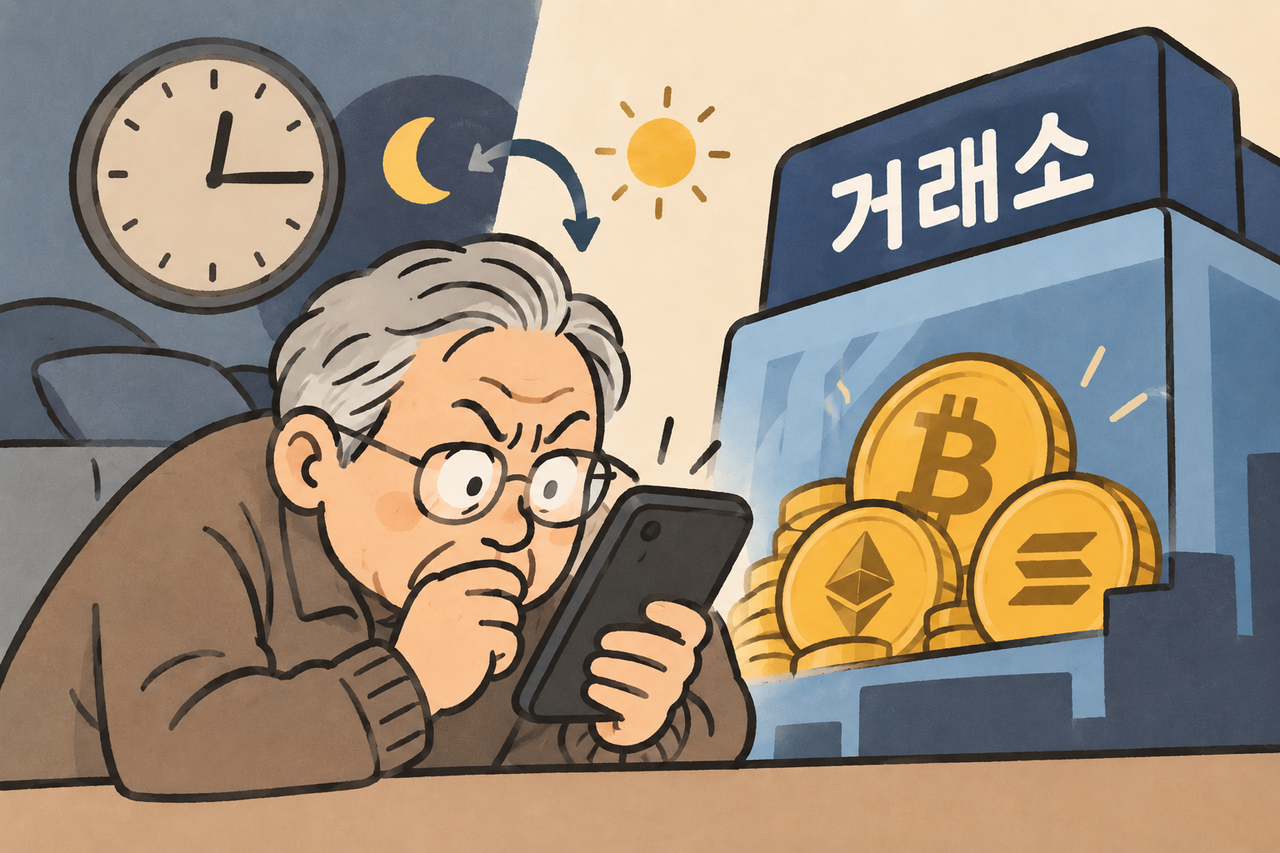
More than nine in 10 domestic digital asset investors keep their holdings on domestic exchanges, a new report shows, highlighting heavy reliance on centralized exchange custody. One in four investors in their 60s checked exchange apps or websites at least twice a day, and the use of value-added services such as staking and automatic purchases rose with investment size. Industry observers say investor protection frameworks need to be strengthened to reflect users' age and behavior.
The Korea Financial Consumer Protection Foundation published a report on Sept. 11 titled "Analysis of Virtual Asset Investors in Korea and Canada, and Trends in Major Countries' Virtual Asset Policies," according to financial industry sources.
The foundation compared results from its own "Virtual Asset Usage Survey," conducted last year among 2,500 adults aged 19 to 69 living in Seoul, Gyeonggi Province and six major metropolitan cities, against a comparable survey by Canada's Ontario Securities Commission.
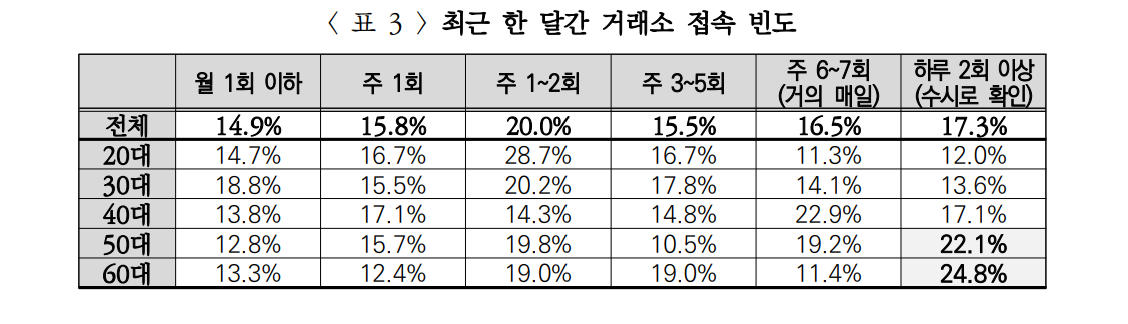
One in two digital asset investors visited an exchange at least three times a week. The survey found that 49.3% of all investors used an exchange three or more times per week over the preceding month. In addition, 17.3% said they checked exchanges at least twice a day, while 16.5% said they accessed them almost every day.
Usage frequency was notably higher among middle-aged and older investors. Those in their 60s recorded the highest rate of checking exchanges twice or more daily, at 24.8%, followed by those in their 50s at 22.1%. Both figures were nearly double the rates seen among investors in their 20s (12%) and 30s (13.6%).
The foundation said investors in their 50s and 60s showed more active usage patterns than other age groups, adding that education was needed to help them fully recognize the risks of frequent price-checking and short-term trading.
The industry has also been expanding financial fraud prevention education targeting older investors. The Digital Asset Exchange Alliance has been running education programs for older adults since last year. In August, it held a fraud prevention session for 100 local residents in Busanjin-gu, Busan, drawing on real cases of financial harm.
However, observers note that such preventive measures alone have limits when it comes to investor protection. Many investors rely heavily on informal channels for investment decisions and have limited understanding of digital assets. About half of domestic investors said they obtained investment information through family or friends, and 46.3% said they used online video platforms such as YouTube. By contrast, only 34.2% said they used objective sources such as exchange websites, apps or news articles.
In Canada, friends, family and colleagues were also the top source of information at 34%, but more than 20% said they consulted industry specialists or financial advisers. The foundation noted that in Canada, digital assets are increasingly being incorporated into asset management and portfolio consultations within an institutionalized investment advisory environment.
Knowledge of the trading structure and technical characteristics of digital assets was also found to be lacking. Even the question with the highest correct-answer rate fell below 50%, at 49.9%, and some questions involving technical terminology saw correct-answer rates drop below 20%. The foundation said there is a need to strengthen the provision of information not only on price volatility risks but also on whether transactions can be confirmed or reversed, the responsibilities associated with asset custody, and whether government guarantees or compensation for losses exist.
Domestic investors' dependence on exchanges was even more pronounced when it came to asset custody. Some 94.8% of investors said they currently store their assets on domestic exchanges. The share using overseas exchanges stood at 16.6%, while hot wallets — personal wallets based online — were used by 13.9% and cold wallets such as hardware wallets by just 6.5%.
Canada presented a markedly different picture. Among Canadian digital asset holders, 49% kept their assets on the exchange where they made their purchases, but 35% said they used hot wallets.
The low rate of personal wallet use among domestic investors reflects the characteristics of the Korean market, where participation in on-chain finance is limited. According to blockchain analytics firm Chainalysis, South Korea ranked 11th globally in centralized exchange usage last year but only 48th in decentralized finance inflows.
Using personal wallets also carries security risks. A suspected hacking incident recently occurred at D'CENT, a digital asset wallet service operated by domestic firm IoTrust. On-chain data analytics platform XRPL.to estimated that approximately 12.4 million XRP tokens were drained from 7,393 wallets believed to be linked to the D'CENT app wallet between Sept. 15 and Friday.
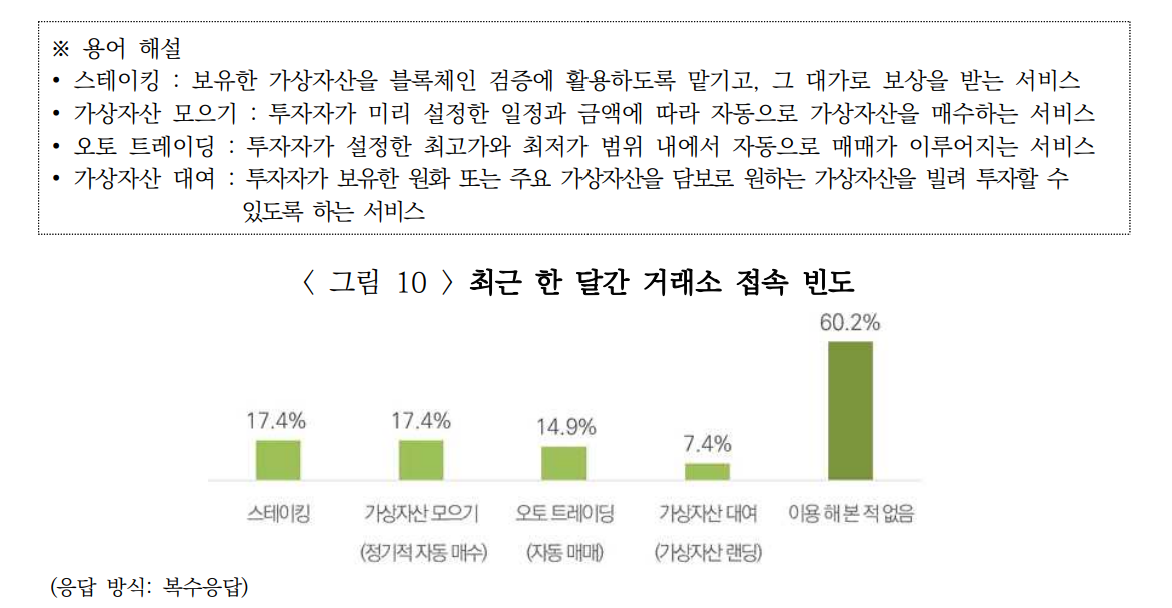
Won-denominated exchanges have also evolved beyond simple trading venues into platforms offering a range of investment services. Some 39.8% of investors with digital asset experience said they had used exchange services beyond standard buying and selling. Staking and "digital asset accumulation" — a service that automatically purchases digital assets at regular intervals — were the most commonly used at 17.4% each, followed by automated trading at 14.9% and digital asset lending at 7.4%.
The larger the investment, the broader the range of services used. Among investors with 30 million won ($22,100) or more, 69.6% said they had used such value-added services. Even among investors who rely on outside experts for investment decisions, 62.7% said they had used related services. The foundation said the findings suggest that investors with larger portfolios or those who depend on external advisers are more likely to actively engage with services beyond basic trading.
The range of services that won-denominated exchanges can currently offer remains more limited than their overseas counterparts. South Korea has yet to open an investment market for listed companies' digital assets, and derivative products such as spot ETFs and perpetual futures have not been introduced. Compared with overseas exchanges expanding into tokenized equities and stablecoin-based products, domestic exchanges face a constrained path to revenue diversification.
Should second-phase legislation broaden the range of services available in the market, the foundation said protection frameworks tailored to the financial literacy and trading behavior of consumers will be essential. It particularly stressed that South Korea must put in place robust management systems covering the segregation of customer assets held by exchanges, internal controls, and security and operational resilience.
The foundation also called for the prompt advancement of legislation on a basic digital assets act, adding that it would be important to design effective investor protection mechanisms that reflect the actual usage patterns of domestic investors — including their high dependence on exchanges, information-gathering channels and experiences of financial harm.
kyoung@heraldcorp.com