Orientation for elementary school English mentors held Tuesday; outstanding instructors from the Hankuk University English Bridge program honored
Dongdaemun-gu in Seoul is expanding its locally tailored education model in partnership with Hankuk University of Foreign Studies, connecting the university's educational resources to students in the district.
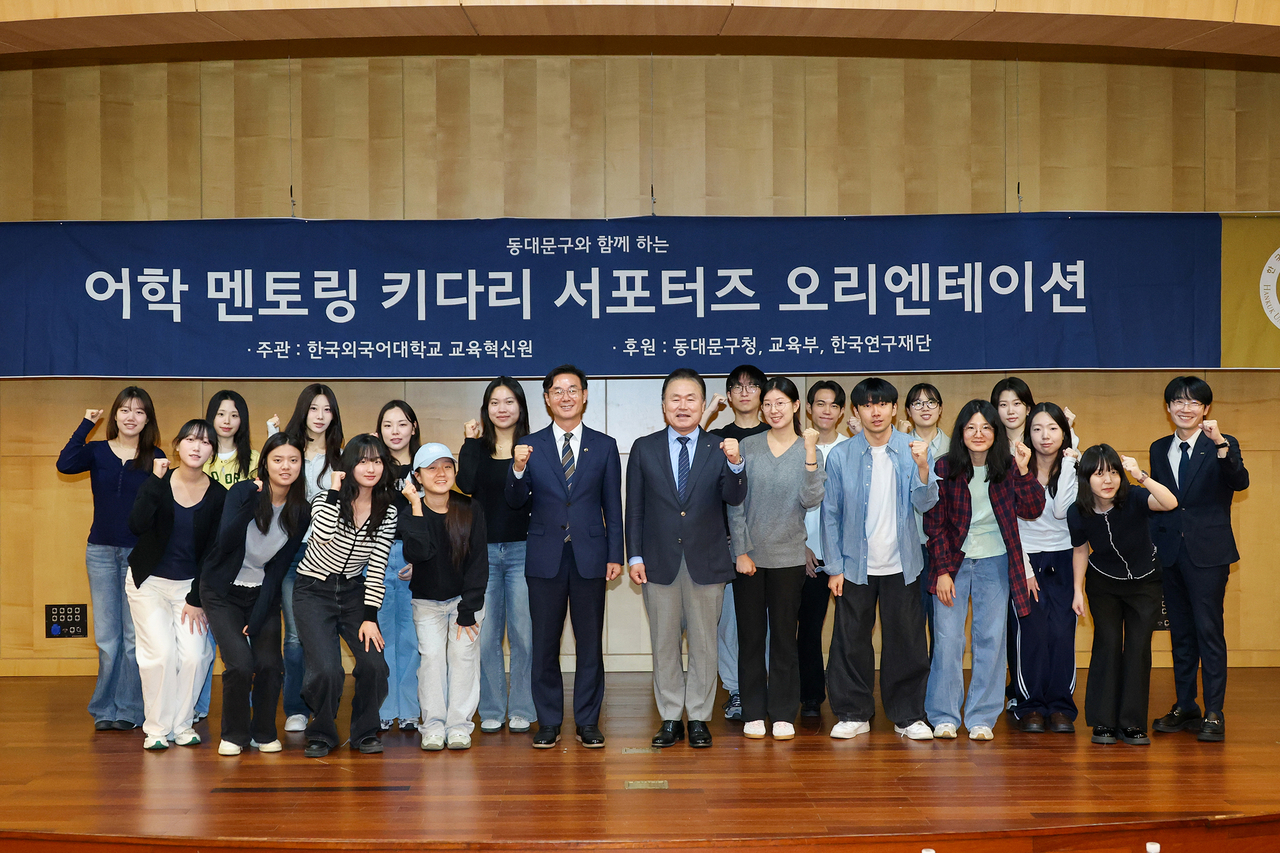
The district held two consecutive events at Hankuk University of Foreign Studies on Tuesday: an orientation for the eighth cohort of the language mentoring Kidari Supporters program and a commendation ceremony for outstanding instructors from the 2026 summer English Bridge program.
Dongdaemun-gu District Mayor Choi Dong-min, Hankuk University of Foreign Studies President Kang Ki-hoon, officials from both institutions, university student mentors and program instructors attended the events, sharing the significance of the education partnership between the university and the local community.
At the orientation for the eighth cohort of the Kidari Supporters program, mentors aligned on their roles and reaffirmed their commitment to supporting the growth of their elementary school mentees.
The Kidari Supporters program has been run on a biannual basis since Dongdaemun-gu and Hankuk University of Foreign Studies signed an MOU in March 2023, and is now in its eighth cohort.
Twenty currently enrolled students from Hankuk University of Foreign Studies will serve as mentors in the eighth cohort. Each mentor will be paired with one or two elementary school students from the district who are eligible for educational welfare support, conducting 20 English lessons of two hours each — once a week from October 2026 through February 2027.
Beyond simple English tutoring, the program gives welfare-eligible students a stable learning environment and a positive role model, as university mentors engage with them at their level and discuss topics such as career paths and school life.
The district plans to support students in building confidence in English and developing a positive attitude toward learning through sustained interaction with their university mentors.
At the commendation ceremony that followed, five outstanding instructors who taught English to incoming middle school students during the summer break received citations from Dongdaemun-gu District Mayor Choi in recognition of their efforts.
The Hankuk University English Bridge program is a Dongdaemun-specific English education initiative jointly developed by the district and Hankuk University of Foreign Studies to help fifth- and sixth-grade elementary school students make a smooth transition from elementary to middle school English. Since its launch in August 2025, the program has run three times, including during the winter break and this summer.
This summer's program enrolled 116 fifth- and sixth-graders, with 10 Hankuk University students teaching across 10 classrooms. Of those, 100 completed the program, a completion rate of 86 percent.
Lessons focused on reading, grammar and writing skills in preparation for middle school English, and incorporated education technology tools including the vocabulary learning app ClassCard and reading activities via Microsoft Teams. Instructors also received pre-program training and in-class consultations to maintain teaching quality.
This year, the district revised the existing lesson plans and workbooks to better align the curriculum with incoming middle school students' proficiency levels, and worked with professional researchers to standardize and strengthen instruction.
A parent satisfaction survey conducted after this year's program returned positive results. Ninety-seven percent of respondents said they were satisfied with the program overall — 75 percent "very satisfied" and 22 percent "satisfied." Asked whether the program helped prepare their children for middle school English, 99 percent said it did — 71 percent "strongly agree" and 28 percent "agree." Instructor expertise and teaching methods were also cited as key strengths.
Parents said they appreciated that instructors assessed each child's level and provided appropriate guidance, and that the school setting allowed children to participate safely and without pressure. The free, high-quality instruction and the opportunity for children to interact with Hankuk University students — gaining new experiences and motivation — were also highlighted as positives.
The survey also captured suggestions for improvement. Some parents said the 10-session, two-week program was too short, while others called for ability-based class groupings, differentiated learning materials and an expansion to more schools.
The district said it will incorporate this feedback into future planning, reviewing the program's duration and curriculum, and expanding personalized instruction and participation opportunities. It also plans to continue using neighborhood educational facilities such as schools to reduce travel burdens on students and allow more children to take part.
President Kang said at the event that universities have an important role not only in training talent to serve the nation, but also in engaging with and contributing to the communities around them, underscoring the value of the ongoing education partnership with Dongdaemun-gu.
District Mayor Choi said the Hankuk University English Bridge instructors and the Kidari language mentoring program are shaping up to be a strong model of university-community collaboration. "We will continue to actively support this kind of education partnership so that it can take root as a locally distinctive program unique to Dongdaemun-gu," he said.
Building on its partnership with Hankuk University of Foreign Studies, Dongdaemun-gu has been running a range of programs that connect the university's human and educational resources to expand learning opportunities for local students and narrow the education gap. A representative example is the English Experience Classroom, offered to elementary and middle school students in the district during school breaks.
The district also runs a learning mentorship program twice a year, pairing students with mentors enrolled at universities in Seoul.
Dongdaemun-gu said it will continue to identify and expand collaborative programs that link the expertise and human resources of local universities to the growth of students in the community, creating educational value together with those universities.
seouldream01@heraldcorp.com