2016: diesel 872,000 units vs. gasoline 748,000 units
2016: 872,000 units → Jan.–Aug. this year: 35,000 units — diesel collapses
Gasoline car sales now 12 times those of diesel
US diesel hits record $6.53 per gallon
Diesel share of commercial vehicles: 94% → 15%
Construction slump compounds fuel-cost burden
Diesel is effectively on its way out of South Korea's new-car market, even as fuel prices surge. Sales of diesel vehicles, which outsold gasoline cars a decade ago, have fallen to less than one-tenth of gasoline car sales this year. Meanwhile, large trucks and construction equipment still run predominantly on diesel engines, and record-high global diesel prices are now squeezing the commercial vehicle segment — the last stronghold of the fuel.
According to Carisyou Data Research Institute, diesel cars outsold gasoline cars in the domestic market a decade ago. In 2016, new diesel vehicle registrations reached 872,871 units, surpassing gasoline cars at 748,303 units. Diesel held a 48.1 percent share of new-car sales that year, compared with 41.3 percent for gasoline.
That trend continued through 2018 before reversing for the first time in 2019, when gasoline car registrations reached 851,999 units — about 200,000 more than diesel's 657,081.
The decline of diesel has grown more pronounced of late. Last year, diesel registrations totaled 97,664 units, accounting for just 5.8 percent of all new cars, while gasoline vehicles reached 767,915 units, or 45.6 percent. Gasoline cars outsold diesel by roughly eight to one — a dramatic reversal from 2016, when diesel accounted for nearly half of all new-car sales. That share has now fallen below 6 percent in a decade.
In the first eight months of this year, diesel registrations stood at 35,441 units, or 3.2 percent of all new cars, while gasoline vehicles reached 421,948 units, representing 38.1 percent. The sales gap has widened to roughly 12 to one.
![Gasoline and diesel prices are displayed at a gas station in Newark, New Jersey, on Thursday (local time). The national average price of regular gasoline in the United States stood at $4.36 per gallon, while diesel climbed to $6.30 per gallon — near a record high. [AFP]](https://wimg.heraldcorp.com/news/cms/2026/09/23/rcv.YNA.20260918.PGT20260918000501009_P1.jpg)
Last month alone, newly registered diesel vehicles in South Korea totaled 3,532 units, down 51.0 percent from the same month a year earlier. Gasoline car registrations fell 28.7 percent over the same period to 37,698 units, and hybrid vehicles declined 11.6 percent to 27,973 units. Electric vehicles, by contrast, rose 29.3 percent to 30,081 units.
The decline in diesel cars is not a sudden development triggered by recent fuel price increases. As emissions regulations tightened and hybrid and electric vehicle options expanded, automakers also trimmed their diesel lineups, particularly for passenger cars. In the first eight months of this year, new hybrid registrations reached 294,861 units and electric vehicles 265,917 units — each roughly eight times the diesel total.
Change is also visible in the commercial vehicle segment, which was once almost entirely diesel. Among commercial vehicles excluding trailers, diesel accounted for 232,667 of the 247,632 units registered in 2016, a share of 94.0 percent. That share fell to 27.6 percent last year and dropped further to 14.9 percent in the first eight months of this year, when diesel commercial vehicle registrations totaled 16,980 units.
LPG and electric vehicles are filling the gap left by diesel. In the first eight months of this year, LPG commercial vehicles totaled 54,907 units, representing 48.2 percent of the segment, while electric vehicles reached 29,794 units, or 26.2 percent.

Diesel price shock accelerates the fuel's retreat
As diesel vehicles rapidly disappear from the domestic market, a recent spike in diesel prices is expected to hasten the trend further. With the fuel-cost advantage that once made diesel cars attractive now eroding, consumers have even fewer reasons to choose one.
According to the American Automobile Association, the national average diesel price in the United States hit a record high of $6.5276 per gallon on Tuesday — about 17 percent above the $5.5947 recorded a month earlier and roughly 77 percent above the $3.6880 seen a year ago. On the same day, the average price of regular gasoline stood at $4.4750 per gallon, meaning diesel cost about 46 percent more than gasoline.
The surge reflects a combination of refining and export disruptions in Russia and the Middle East that has created a shortage not just of crude oil but of refined petroleum products, including diesel. Reuters reported that exports from major producers including Russia, Saudi Arabia and the UAE have declined in the wake of the Iran conflict and the war in Ukraine, driving diesel prices in the United States and Europe to record levels.
![Tata Daewoo Mobility's diesel-powered midsize truck, the Hixen, is on display at one of the company's company-owned service centers. [Provided by Tata Daewoo Mobility]](https://wimg.heraldcorp.com/news/cms/2026/09/23/news-p.v1.20260909.e7a66ceb490642a6850bb3cbfc8f87c4_P1.jpg)
The surge in diesel prices has prompted the US government to consider export restrictions. US President Donald Trump said Tuesday he supports a ban on diesel exports, while Treasury Secretary Scott Bessent said the administration is examining whether full or partial export restrictions are feasible given the country's refining capacity. Any US export curbs could affect diesel supply in other regions as well.
South Korea has so far been relatively insulated from the shock of surging international diesel prices, as the government has been capping domestic price increases through a maximum petroleum price system and fuel tax cuts.
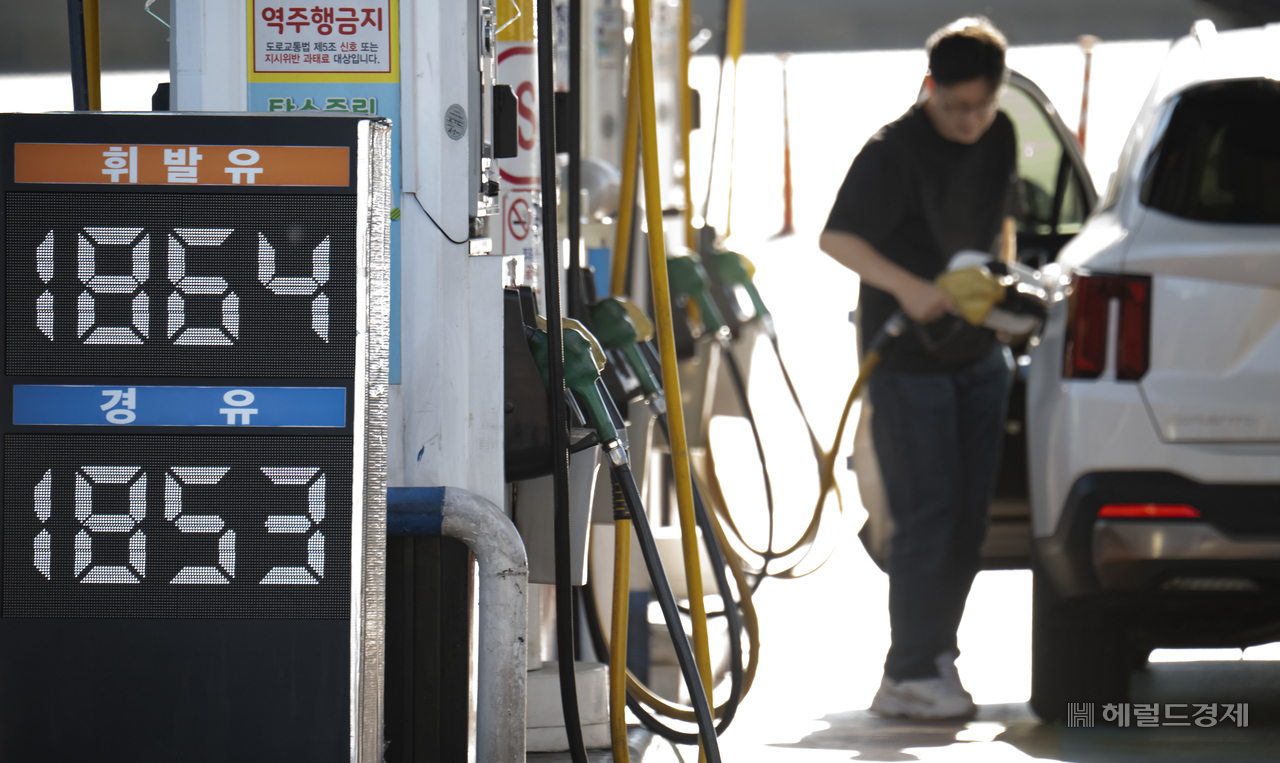
The government froze the 10th round of maximum petroleum prices, effective Saturday, at 1,784 won per liter for gasoline and 1,773 won for diesel. The maximum price system sets a ceiling on the prices refiners charge gas stations and distributors, rather than the retail prices consumers pay. Although the international price of automotive diesel jumped $20.9 per barrel in the third week of September to $195.6 per barrel, the national average retail diesel price at domestic gas stations actually edged down 0.1 won per liter over the same period to 1,843.9 won.
Even so, diesel's long-standing reputation as the cheaper fuel has largely faded. Data from Korea National Oil Corp.'s Opinet show that in 2016, the national average retail price of regular gasoline was 1,402.52 won per liter while automotive diesel was 1,182.36 won — a gap of about 220 won in diesel's favor. In the first eight months of this year, however, the averages were 1,872.13 won for gasoline and 1,839.30 won for diesel, narrowing the difference to just about 33 won.
![Fuel price information is displayed at a gas station in Seoul as international oil prices surpass $100 per barrel amid heightened geopolitical tensions between the United States and Iran. [Yonhap]](https://wimg.heraldcorp.com/news/cms/2026/09/23/rcv.YNA.20260910.PYH2026091004550001300_P1.jpg)
Heavy trucks can't quit diesel — and that's a growing burden for the commercial vehicle market
Not all commercial vehicles can switch to LPG or electric power as quickly as light trucks. Long-haul heavy trucks and some construction equipment remain heavily dependent on diesel when range, payload capacity and charging infrastructure are taken into account.
The commercial vehicle market is already struggling with sluggish sales amid a construction sector downturn. Domestic commercial vehicle registrations in August totaled 12,279 units, down 8.5 percent from the same month a year earlier. Imported commercial vehicle registrations fell 49.0 percent to 290 units. Hyundai's Porter 2 saw registrations drop 9.5 percent to 3,590 units, while the Porter 2 Electric fell 64.2 percent to 435 units.
Rising diesel prices are adding to the burden on vehicle owners. Commercial vehicles travel far greater distances than passenger cars, making fuel costs a larger share of total operating expenses. With operators already deferring vehicle replacements due to the economic slowdown, higher fuel costs could further dampen appetite for new purchases.
"The higher diesel prices go, the more interest there will be in electric trucks — but particularly in the midsize segment, the options are limited and vehicle prices are considerably higher than for internal combustion engine models," an official at an imported commercial vehicle company said. "Commercial vehicles involve more than just upfront purchase costs — you have to weigh payload capacity, range and charging conditions all together, which makes electrification much harder to achieve as quickly as in the passenger car market."
kwater@heraldcorp.com