Forecast lifted 0.6 percentage points from July outlook, marking second consecutive upgrade since April; next year's projection also raised to 2.3%; tariff and geopolitical risks flagged
![South Korea's exports surpassed last year's full-year record ahead of schedule, with cumulative export value reaching $709.4 billion as of 1 p.m. on Friday, according to the Ministry of Trade, Industry and Energy and the Korea Customs Service. The milestone was reached 117 days earlier than last year's record of $709.3 billion. Pictured are containers stacked at Pyeongtaek Port in Gyeonggi Province on Saturday. [Yonhap]](https://wimg.heraldcorp.com/news/cms/2026/09/23/rcv.YNA.20260906.PYH2026090603570006100_P1.jpg)
The Asian Development Bank has sharply raised its growth forecast for South Korea this year to 3.2%, citing a surge in semiconductor exports driven by global AI investment as well as expansionary fiscal policy and a recovery in construction investment that it expects to support domestic demand.
The ADB projected South Korea's economic growth rate at 3.2% for this year in its Asian Development Outlook released Wednesday, up 0.6 percentage points from its July forecast of 2.6%.
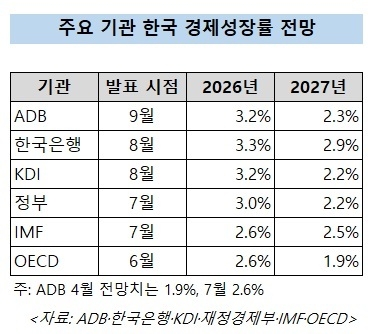
The ADB has now raised its South Korea growth forecast twice in a row since setting it at 1.9% in April — lifting it to 2.6% in July and to 3.2% this week, a cumulative increase of 1.3 percentage points in just five months. The July revision had already reflected stronger-than-expected first-quarter growth and rising semiconductor exports on the back of AI demand.
The bank also raised its growth forecast for next year to 2.3% from 2.0%, a 0.3 percentage point upgrade and 0.4 percentage points above its April projection of 1.9%.
The ADB noted that manufacturing purchasing managers' index and business sentiment index readings for July and August remained solid. It said continued growth in global demand for AI semiconductors would sustain export momentum, while expansionary fiscal policy and a rebound in construction investment would translate into a gradual improvement in domestic demand.
The ADB's 3.2% forecast for this year matches that of the Korea Development Institute and sits 0.1 percentage points below the Bank of Korea's projection of 3.3%. It exceeds the government's forecast of 3.0% and the 2.6% projections from the OECD and the IMF. Both KDI and the Bank of Korea recently revised their own forecasts upward — to 3.2% and 3.3%, respectively — to reflect the semiconductor sector's strong performance.
Forecasts for next year diverge more widely across institutions. The Bank of Korea projects 2.9% and the IMF 2.5%, both above the ADB's outlook. KDI and the government each forecast 2.2%, while the OECD projects 1.9%, all below the ADB's 2.3%.
The ADB identified escalating geopolitical tensions, heightened volatility in global financial markets, and the possibility of further US tariff increases as the main downside risks. It warned that a deterioration in external conditions could weigh on South Korea's exports and investment, leaving growth weaker than currently projected.
The ADB kept its consumer price inflation forecast for South Korea unchanged at 2.7% for this year, in line with its July projection. It said rising international energy prices and expanding domestic demand would push prices higher, but that government price-stabilization measures would partly offset the upward pressure. The inflation forecast for next year was also held at 2.2%, with the bank expecting energy price pressures to ease and the effects of tighter monetary policy to gradually feed through the broader economy.
For advanced economies in the Asia-Pacific region, including South Korea, the ADB raised its 2026 growth forecast by 0.5 percentage points from July to 3.1%, and lifted next year's projection from 1.7% to 2.0%.
China's economy is forecast to grow 4.6% this year and 4.5% next year, both unchanged from the April and July projections. China's inflation rate is expected to hold at 0.9% in both years.
Growth among developing economies in the Asia-Pacific region was revised up 0.1 percentage points from July to 5.0% for this year, supported by expanding private investment, government stimulus measures, and strong exports from AI-related industries. Next year's growth forecast was kept at 5.1%.
fact0514@heraldcorp.com