- Lee Young-geon, a neurology professor at Ilsan Paik Hospital, confirms link between behavioral and psychiatric symptoms of Alzheimer's disease and tau and Lewy body pathology
- Different brain pathologies tied to different behavioral and psychiatric symptoms, pointing to potential for more precise dementia diagnosis

Among patients with dementia or Alzheimer's disease, some display particularly pronounced anxiety, delusions and severe aggression. Physicians often warn the families of such patients that caregiving will be especially demanding. Managing patients who exhibit intense delusions, anxiety or violent behavior requires considerable patience and attentiveness from caregivers.
A new study has found that behavioral and psychiatric symptoms in Alzheimer's patients — including delusions, anxiety, apathy, agitation, aggression and sleep disturbances — manifest differently depending on which pathological substances accumulate in the brain.
Lee Young-geon, a neurology professor at Inje University Ilsan Paik Hospital, analyzed brain imaging data, clinical symptoms and cerebrospinal fluid test results from Alzheimer's patients using the Alzheimer's Disease Neuroimaging Initiative (ADNI), an international open-access brain imaging platform. The analysis confirmed that tau protein and alpha-synuclein accumulating in the brain are associated with behavioral and psychiatric symptoms such as delusions, anxiety, apathy and sleep disturbances.
The study drew on data from 336 individuals in whom Alzheimer's-related proteins had been confirmed, ranging from cognitively normal adults to those with mild cognitive impairment and early-stage dementia. Of those, 238 also underwent cerebrospinal fluid testing to detect abnormal changes in alpha-synuclein protein, which is associated with Lewy body dementia and Parkinson's disease dementia.
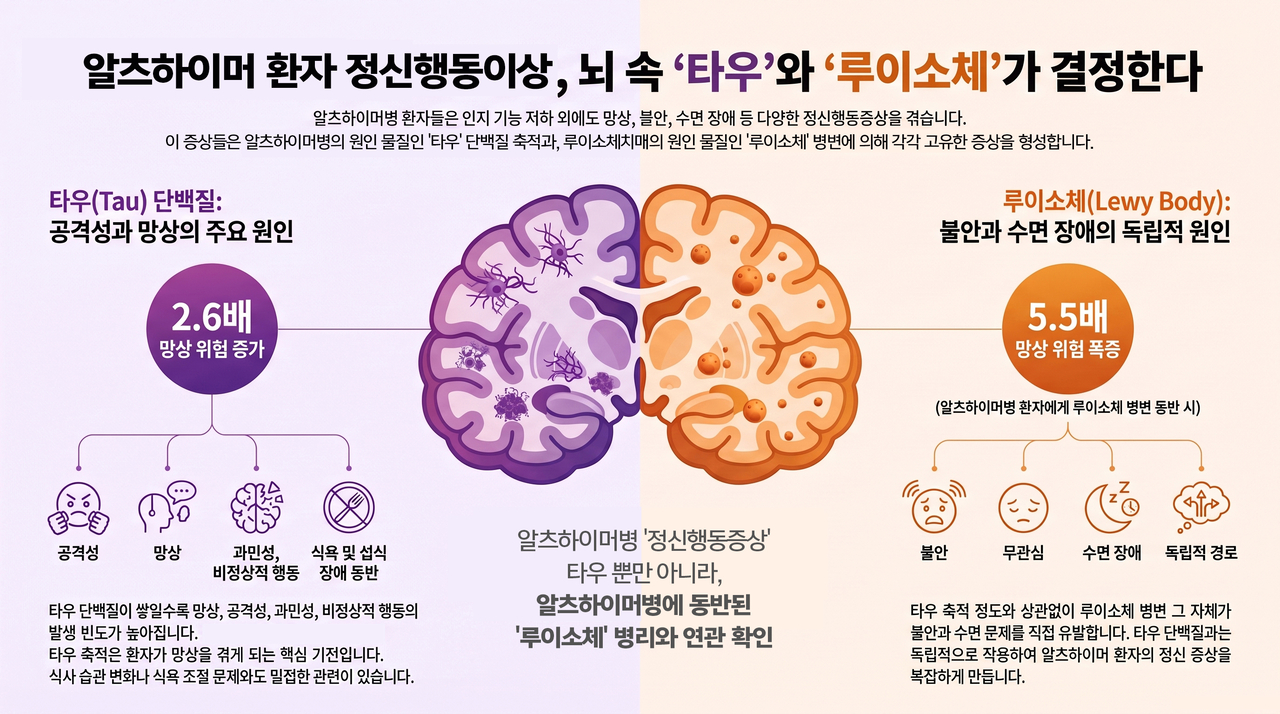
Higher tau levels in the brain were associated with a greater likelihood of delusions, agitation, aggression, abnormal motor behavior, and eating and appetite disturbances, the study found.
The risk of delusions was approximately 2.6 times higher in patients with greater tau accumulation. Agitation and aggression were about 1.6 times more likely, excessive repetitive behavior about 1.8 times more likely, and eating and appetite disturbances about 1.6 times more likely. A region-by-region brain analysis showed that tau accumulation in the frontal lobe, temporal lobe and limbic system was linked to delusions.
Delusions — in which patients hold false beliefs such as "someone stole my belongings" or "people are trying to harm me" — are among the most common behavioral and psychiatric symptoms in Alzheimer's disease and can place a heavy burden on patients, their families and caregivers alike.
Beyond tau, the study also found that alpha-synuclein pathology — associated with Lewy body dementia — was linked to specific behavioral and psychiatric symptoms in Alzheimer's patients.
The research team analyzed 238 participants who underwent a cerebrospinal fluid seed amplification assay for alpha-synuclein. Patients with alpha-synuclein pathology were more likely to experience delusions, anxiety, apathy and sleep disturbances. The risk of delusions was 5.5 times higher, anxiety 2.3 times higher, apathy 3.5 times higher and sleep disturbances 2.1 times higher. These associations held even after accounting for the effects of tau and amyloid beta.
The findings highlight the importance of both the extent of tau spread — which reflects the stage of Alzheimer's disease — and co-occurring Lewy body pathology in understanding the behavioral and psychiatric symptoms of Alzheimer's.
"Rather than viewing behavioral and psychiatric symptoms in Alzheimer's patients merely as secondary manifestations of cognitive decline, we need to understand them in the context of underlying pathological changes in the brain," Lee said. "Future research should integrate various biomarkers to enable precise, individualized assessment and management of each patient's symptoms."

Lee added that it is particularly important to carefully assess each patient's symptoms with the understanding that other neurodegenerative pathologies may coexist alongside Alzheimer's disease. The study was published in the latest issue of Alzheimer's & Dementia, a leading international journal in the Alzheimer's disease and dementia field, with an impact factor of 12.8.
kty@heraldcorp.com