Eleven ordinance proposals drafted by sixth graders — from school safety to climate change — debated and voted on in the full council hall
How can students be made safer on their way home at night? Where should bicycles and electric scooters be parked? What can be done to reduce the malicious complaints that burden schools?
Questions like these, drawn from the daily lives of elementary school students, made their way to the floor of the Seoul Metropolitan Council's main chamber.
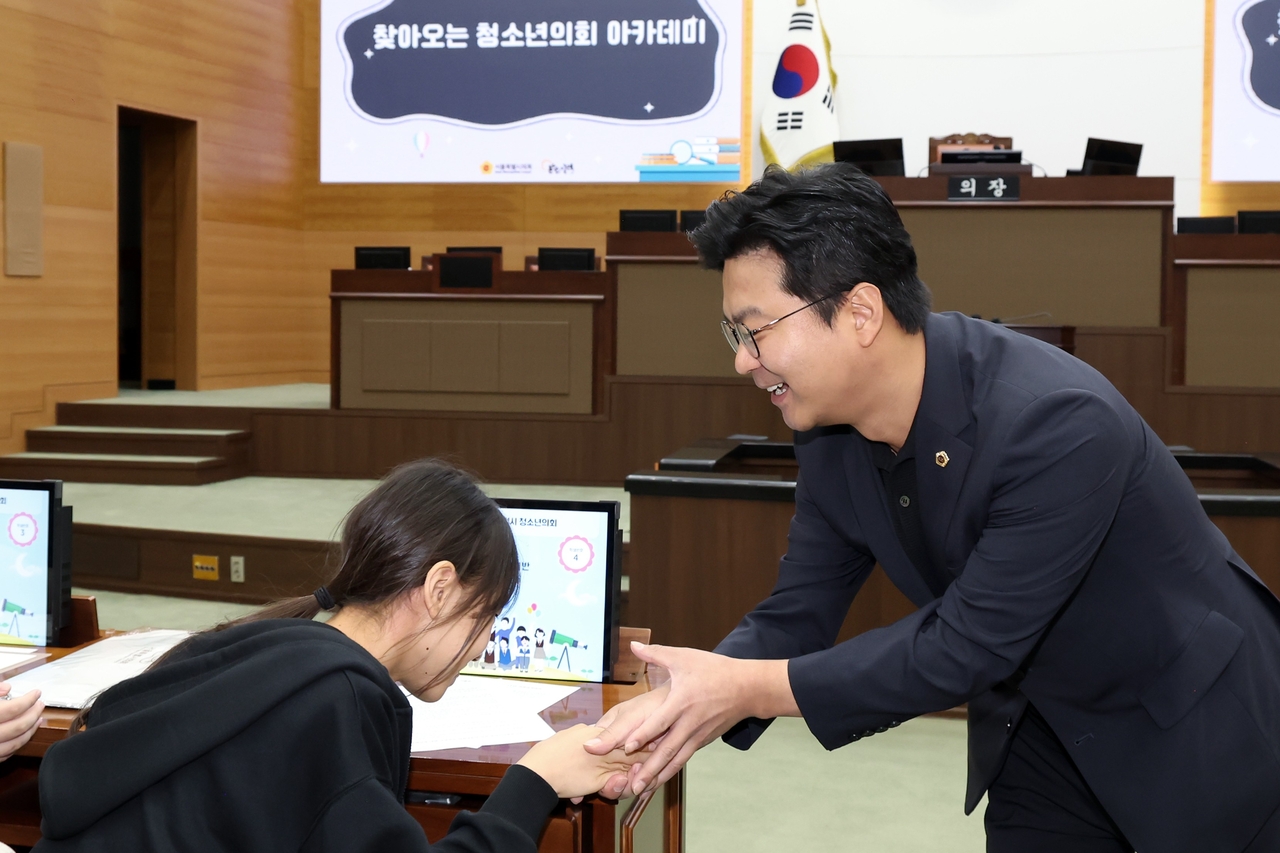
Forty-two sixth graders from Hansan Elementary School in Dunchon-dong, Gangdong-gu spent Friday as city council members at the 2026 Youth Parliament Academy hosted by the Seoul Metropolitan Council. Going beyond a simple tour of the building, the students proposed policies, took part in debate and cast votes, experiencing firsthand how decisions are made in local government.
The students brought 11 ordinance proposals in all. Their ideas addressed problems encountered at school and in everyday life — among them measures to prevent youth smoking and support cessation, improve safety for students returning home late at night, and protect teachers' educational activities by blocking malicious complaints.
Their attention extended beyond the schoolyard to broader urban issues. Proposals ranged from restricting short-distance car use to combat climate change, to expanding low-floor buses for people with disabilities, designating parking spaces for bicycles and electric scooters, and supporting the installation of closed-circuit television cameras in alleyways — covering transportation, the environment, mobility rights and public safety.
The policy agenda was not so different from what adult lawmakers typically take up. The starting point, however, was different. Rather than grand urban planning schemes or budget debates, the students traced their proposals back to inconveniences they had personally seen and experienced on their commutes, in alleyways and around their school.
In the main chamber, those ideas moved through an actual decision-making process. After taking a temporary oath of office, the students delivered proposal explanations and gave five-minute floor speeches. They then used the electronic voting system installed at each council seat to register their positions, following the same procedures as a real local council session.
Seoul Metropolitan Council Member Jang Tae-yong of the People Power Party, who represents Gangdong District 6, met with the students that day and connected their experience to the broader meaning of democracy and local self-governance.
"Democracy is not some distant political conversation — it begins right in your daily lives, when you speak your own mind, listen to each other and debate," Jang said. "In the ordinance proposals the students put together, I could see deep thought about issues that touch real life: safety on the way to school, transportation, the environment."
He added that identifying community problems, thinking through solutions and turning them into policy is a core role of local councils and city lawmakers. "I will work to create diverse hands-on opportunities so that young people can take an interest in policy and civic affairs and make their voices heard, and I will listen carefully to what students have to say," he said.
Over the course of the 90-minute academy, the students did more than learn about policy. They went through the full arc of civic participation — identifying a problem in the city where they live, proposing a solution, and working it through debate and a vote into a collective decision.
The Youth Parliament Academy, run by the Seoul Metropolitan Council, is a civic-experience program designed to help young people understand local government and democratic decision-making by visiting the actual council building, participating in a mock plenary session and meeting with sitting council members.
7toy7@heraldcorp.com