Voluntary separate collection at apartment complexes to begin in October; mandatory rules take effect Jan. 1, 2027
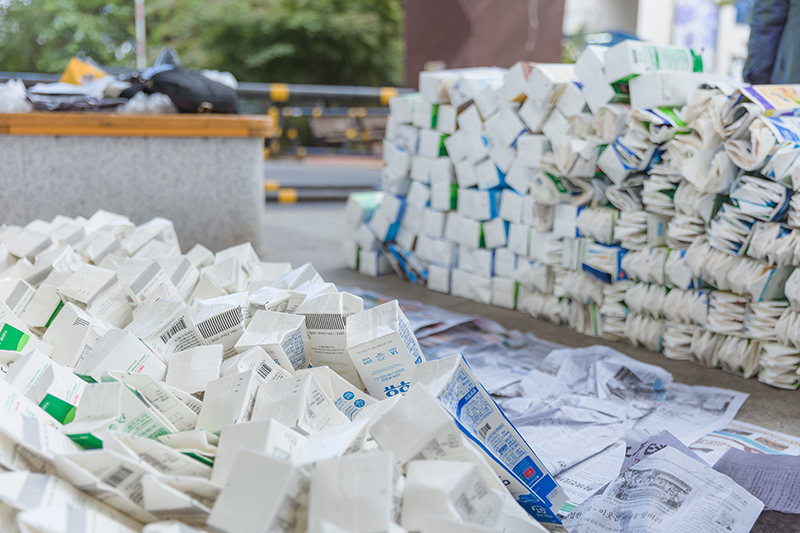
The Ministry of Climate, Environment and Energy said Monday it will sign a memorandum of understanding with industry players and related organizations to improve the paper carton recycling system, at Hansol Paper's Daejeon factory in Daedeok-gu.
The MOU brings together producers legally required to recycle — Seoul Milk and Maeil Dairies — along with recycling industry bodies including the Paper Carton Recycling Council, Hansol Paper and KGM C&B; carton manufacturers SIG Combibloc Korea and Tetra Pak; and affiliated organizations, the Korea Packaging Material Recycling Business Cooperative and the Korea Circular Resource Distribution Support Center.
The agreement was drawn up to address a systemic failure: large volumes of paper cartons — made from high-quality natural pulp and carrying significant resource value — are being discarded in standard garbage bags or mixed with ordinary waste paper, leaving them to be incinerated as residue rather than recycled.
Under the MOU, producers with recycling obligations will share the costs of collecting, sorting and recycling paper cartons, and will expand purchases of recycled carton products to help create market demand.
Carton manufacturers will develop technology that factors in recyclability from the design stage and support the upgrading of sorting infrastructure — including the installation of optical sorters — to secure a reliable supply of high-quality recovered material.
The recycling industry will generate tangible results in resource circulation through high-quality sorting and the production of recycled carton products.
The Korea Packaging Material Recycling Business Cooperative and the Korea Circular Resource Distribution Support Center will strengthen public awareness campaigns and drive industry participation through administrative and fiscal support, including managing recycling performance data and disbursing recycling subsidies.
The ministry said it will reinforce institutional support to ensure that voluntary private-sector efforts translate into real gains in resource circulation.
To that end, voluntary separate collection of paper cartons will begin in October at roughly 144,000 apartment buildings subject to mandatory management nationwide, ahead of a planned regulatory revision that will make the practice compulsory at those complexes starting next year.
The ministry described the agreement as more than a symbolic declaration of cooperation, calling it the starting point for building a "closed-loop" resource circulation system in which paper cartons are reliably collected after disposal and converted back into recycled raw materials and products.
"This agreement is a meaningful commitment to connecting every stage — from production to recycling — into a single circular system," Minister Kim Sung-hwan said. "We will do our utmost to lay the institutional groundwork, including establishing a separate collection framework for paper cartons, and to provide policy support so that the recycling system can take firm root on the ground."
thlee@heraldcorp.com