7,924 units in Greater Seoul, 8,643 in regions
October move-in volume fourth highest of the year
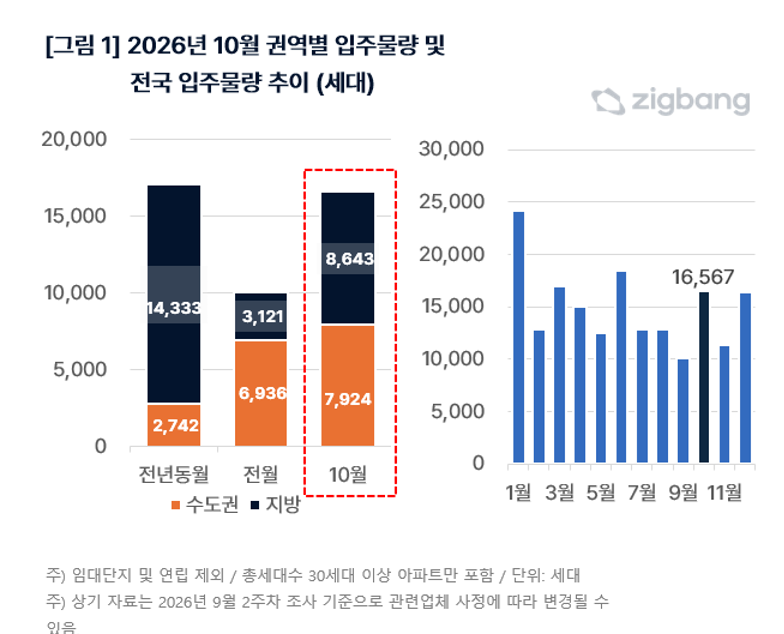
About 17,000 apartments are scheduled for move-in across South Korea in October, with volumes rising from the previous month in both the Greater Seoul area and regional cities — making it the fourth-busiest month for move-ins this year.
According to real estate platform Zigbang, 16,567 units are set for move-in in October 2026, up 65 percent from September's 10,057 units. The October figure is the fourth highest monthly total of the year, trailing only January, June and March.
By region, 7,924 units are scheduled in the Greater Seoul area and 8,643 in regional cities. The Greater Seoul figure is up 14 percent from September's 6,936 units, while regional volumes nearly tripled — from 3,121 to 8,643 units — driving the overall increase.
Within the Greater Seoul area, Seoul accounts for 3,302 units, Gyeonggi Province for 2,788 and Incheon for 1,834. In Seoul, the bulk of the supply comes from Hillstate Mediale (Daejo-dong, Eunpyeong-gu), a 2,451-unit redevelopment complex. Also opening for move-in are Hillstate Deungchon Station (543 units, Deungchon-dong, Gangseo-gu) and Raemian Leventus (308 units, Dogok-dong, Gangnam-gu).
In Gyeonggi Province, seven complexes across six cities are set for move-in: Uiwang with 733 units, Osan with 730, Anyang with 458, Paju with 383, Bucheon with 266 and Siheung with 218. The leading complexes are Uiwang Centraline Desiang (733 units, Ojeon-dong, Uiwang) and Osan Station Kumkang Pentarium Central Park (730 units, Gasu-dong, Osan).
In Incheon, all 1,834 units are concentrated in the Geomdan area — Singeomdan Jungang Station Centreville (1,224 units, Bullo-dong, Geomdan-gu) and Geomdan Lake Park Station Punggyeongchae Urbanity (610 units, Bullo-dong, Geomdan-gu).
Among regional cities, the Jeonnam-Gwangju integrated special city leads with 5,671 units — accounting for 66 percent of all regional supply — followed by South Chungcheong Province with 776 units, Daejeon with 749, Busan with 400, Daegu with 299, Gangwon Province with 264, South Gyeongsang Province with 232, Ulsan with 158 and Jeju with 94.
"The October increase in move-in volume reflects a concentration of supply in specific areas rather than a broad, nationwide uptick," said Kim Eun-seon, head of Zigbang's big data lab. "Monthly move-in figures have been showing wide swings depending on which regions and complexes happen to reach their move-in timing."
Kim also noted that whether scheduled units actually complete move-in on time is equally important. Delays can reduce the supply of jeonse and monthly-rent listings from new apartments, and if developers are slow to collect final payments, it can affect financing conditions for their next projects — linking move-in performance to the broader supply-demand dynamics of the housing market.
Occupancy rates have been declining. A survey by the Korea Housing Institute found that the national apartment occupancy rate in August fell 8.6 percentage points from July's 68.1 percent to 59.5 percent, slipping into the 50-percent range. The Greater Seoul area posted an occupancy rate of 80.8 percent, compared with 55.5 percent in metropolitan cities — a gap of more than 25 percentage points. The most common reason cited for not moving in was failure to secure a final-payment loan, at 37.2 percent, pointing to financing difficulties as the primary cause of move-in delays.
Regional strain is also visible in the September move-in outlook index. South Jeolla Province saw its index drop 22.3 points — from 100 to 77.7 — the steepest decline among provincial regions, reflecting pressure from roughly 3,000 units concentrated in the Jangseong area that must be absorbed within the September–October window.
"When a large volume of move-ins is concentrated in a specific area over a short period, the financial burden can grow as buyers face overlapping deadlines for final payments and the sale of their existing homes," Kim said. "However, actual move-in conditions can vary by region depending on local supply levels, housing preferences and the ease of disposing of existing properties, so it is important to look at move-in volumes, occupancy rates and regional supply-demand conditions together."

hwshin@heraldcorp.com