Only Ethereum network supported at launch
Thin supply drew concentrated buying pressure
Arbitrage demand pushed circulation up 2.25 times in a day
Price normalizes; trading volume falls to a tenth of opening day
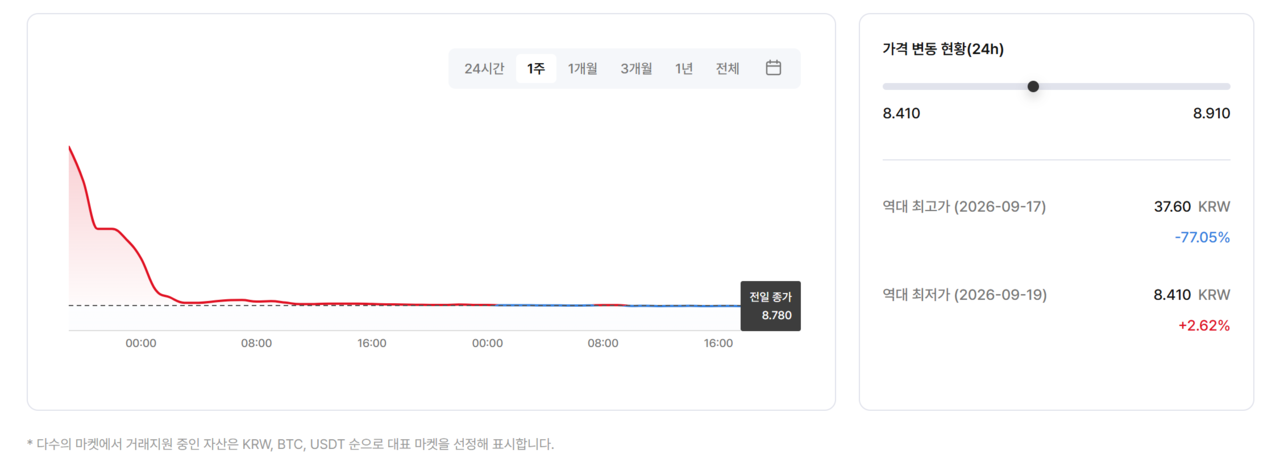
JPYC, a stablecoin pegged one-to-one to the Japanese yen, briefly traded at more than four times its implied value of 1 yen (8.8 won) on its first day of listing on South Korean digital asset exchange Upbit. The spike was driven by a surge in buy orders and arbitrage demand amid thin early supply — a situation analysts say was compounded by Upbit's decision to initially support only the Ethereum network, which holds a relatively small share of JPYC's total circulating supply.
According to Upbit Data Lab, JPYC surged immediately after trading opened Thursday afternoon, reaching an intraday high of 37.60 won. At the time, the won-yen exchange rate stood at roughly 8.85 won per yen, meaning JPYC was trading at approximately 4.2 times its target value of 1 yen.
The price has since returned to near its 1-yen peg. As of 4:49 p.m. Thursday, JPYC was trading at 8.64 won. Trading activity cooled just as quickly. The roughly 285.9 billion won ($207 million) in trading volume recorded on the first day has since shrunk to about 23.8 billion won over the most recent 24-hour period — less than a tenth of the opening-day figure.
The post-listing price spike is widely attributed to a flood of buy orders hitting the market before sufficient supply was available. Upbit had already delayed the start of JPYC trading by roughly three hours, citing a failure to secure the minimum required deposit volume ahead of the originally scheduled launch time.
Upbit said in a statement that under its virtual asset listing guidelines, it may defer the start of trading if the minimum deposit threshold is not met by the scheduled launch time, and that JPYC's trading start was adjusted accordingly.
Market observers point to Upbit's decision to support only Ethereum-based deposits at launch as a key driver of the price surge. According to JPYC Info, total JPYC circulation on Wednesday — the day before listing — stood at about 1.896 billion tokens. Of that, only about 130 million tokens, or roughly 6.9 percent, were on the Ethereum network. By network, circulation was led by Kaia, followed by Polygon, Ethereum and Avalanche.
Upbit added support for deposits via the Kaia and Polygon networks — which account for a much larger share of JPYC supply — at around 6:44 p.m. Thursday, after trading had already begun. Total JPYC circulation subsequently rose to about 4.258 billion tokens, 2.25 times the level recorded Wednesday. By Friday, it had climbed further to approximately 4.437 billion tokens.
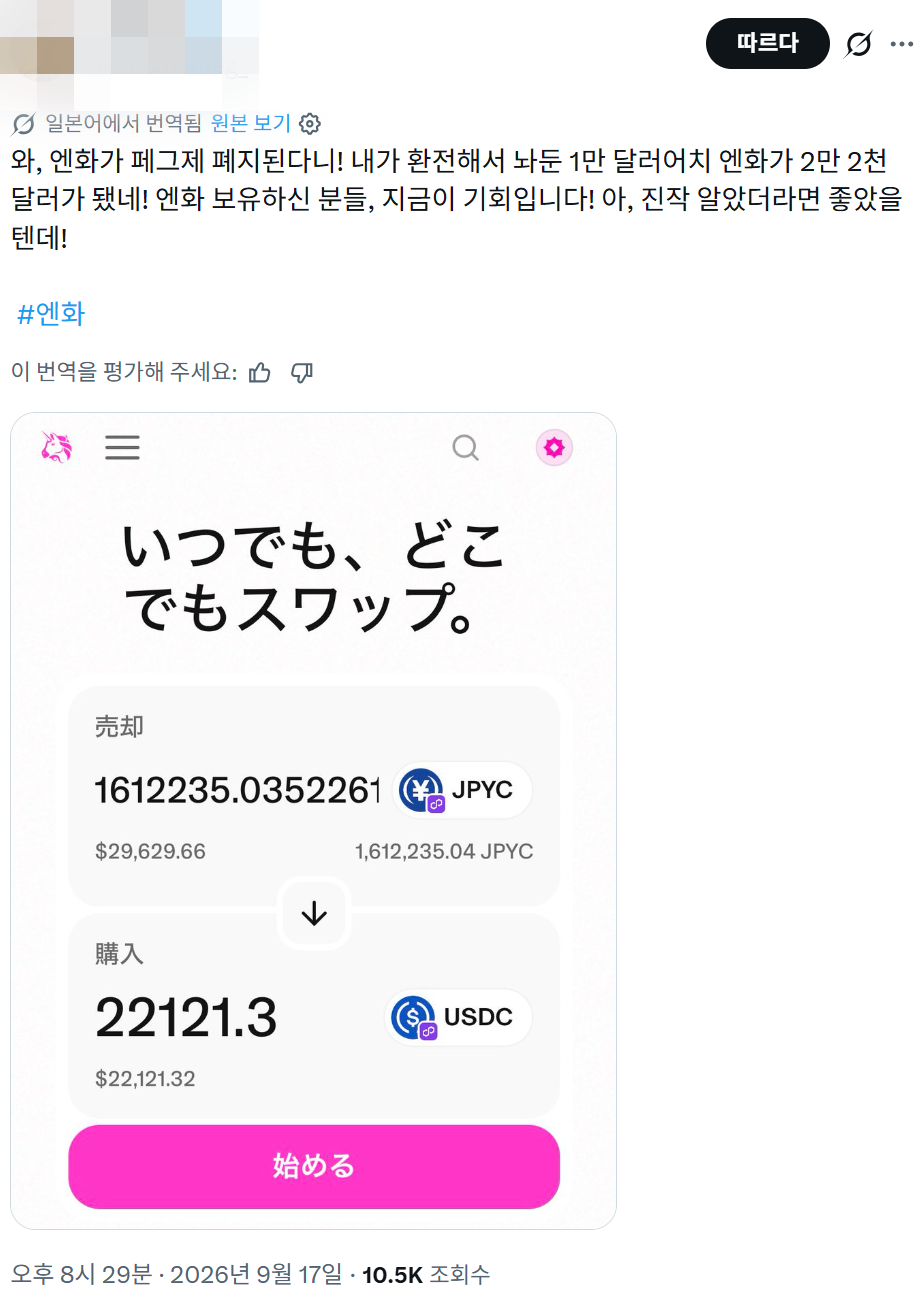
The price dislocation on Upbit quickly spilled over into on-chain markets. JPYC can be swapped for the dollar stablecoin USDC on decentralized exchanges including Uniswap, where tokens are traded through blockchain-based liquidity pools without going through a centralized exchange.
On the day of the Upbit listing, posts on X (formerly Twitter) described users pocketing two- to threefold returns using decentralized trading protocols. One user said $10,000 worth of yen exchanged in advance had grown to $22,000. Another wrote that by repeatedly minting JPYC and swapping it for USDC on Uniswap, people around them had made 1.9 million yen ($12,200) in no time.
The price gap drew attention inside JPYC as well. Kazuaki Mizuchi, an outside director at JPYC, wrote on X on Friday that he had been tempted to profit from the arbitrage opportunity but held back because it could constitute insider trading. He also cautioned that individuals who profited from the JPYC price surge are required to file tax returns, noting that even salaried workers face a mandatory filing obligation if their gains exceed 200,000 yen.
JPYC temporarily suspended new issuance on the Ethereum and Polygon networks on the day of the listing. The company said at the time that it was investigating the cause, but has yet to disclose specific details.
JPYC issuance also surged following the Upbit listing. Cumulative issuance tracked by JPYC Info rose from about 8.01 billion JPYC on Wednesday to 10.55 billion JPYC on Thursday — meaning roughly 2.54 billion JPYC tokens were newly minted in a single day.
On-chain activity subsided once JPYC's market price returned to near 1 yen. Daily on-chain trading volume had soared from about 275.26 million JPYC on Wednesday to about 31.07 billion JPYC on Thursday — a nearly 114-fold jump — before falling more than 88 percent to about 3.57 billion JPYC on Friday.
Some market participants have also raised the possibility of so-called reverse-premium trades should JPYC's price on Upbit fall below 1 yen. The token briefly dipped to 8.41 won on Saturday, roughly 5 percent below the prevailing exchange rate of 8.85 won per yen.

kyoung@heraldcorp.com