47,000 households to reshape Mokdong new town after 40 years
Complex 6 leads the race; Complex 7 commands top prices; Complex 14 is the largest
Low floor-area ratios and large land shares draw construction giants
Permits before 2030 are key — simultaneous relocation and construction costs loom large
![Apartment complexes in Mokdong, Yangcheon-gu, Seoul, on Saturday morning. [The Herald Business DB]](https://wimg.heraldcorp.com/news/cms/2026/09/18/news-p.v1.20260812.8eaf2a32fd874c2e9cb5f30860b2a627_P1.jpg)
A 30 trillion won ($21.7 billion) urban reconstruction is now underway in Mokdong, Yangcheon-gu, Seoul.
All 14 complexes of the Mokdong New Town — home to more than 26,000 households — have entered the reconstruction race simultaneously. If completed as planned, the area will be transformed into a new residential city of about 47,000 households. Among Seoul's major reconstruction projects, it is rare to find a case where 14 large complexes within a single living zone move forward all at once.
Before the Anyangcheon embankment was properly built, the Mokdong area was a mix of low-lying land and farmland. The neighborhood's name is said to derive not from the Chinese character for "wood" but from a different character meaning "to raise" or "to tend."
The area was completely transformed in the 1980s. To address housing shortages, overheated real estate speculation and regional imbalances, the Seoul Metropolitan Government unveiled a master plan in 1981 for the city's urban structure through the year 2000, pursuing a multi-core urban layout. In 1983, it announced the Mokdong New Town development plan, formalizing its vision to supply housing on a large scale while creating a new center for western Seoul.
Mokdong was designed as a self-sufficient "new town within a city," combining commercial, business and residential uses. It was laid out as a planned city with a gently S-shaped north-south central axis, a one-way road system and district heating supplied by a combined heat and power plant.
The 14 complexes were built in sequence from 1985 to 1988, and as schools, parks and commercial facilities followed, a hagwon district and strong school zone took shape. Mokdong established itself alongside Daechi-dong in Gangnam-gu as one of Seoul's premier education-oriented residential neighborhoods.
Now, roughly 40 years after being built from the same blueprint, all 14 complexes are being torn down at once. This article examines the contest that will define Mokdong's next 40 years across five dimensions: project pace, contractor, project viability, current market value and risk factors.
![Mokdong before the new town development, photographed in June 1983. [Seoul Metropolitan Archives]](https://wimg.heraldcorp.com/news/cms/2026/09/18/news-p.v1.20260918.44fe8553fe98485899101e012f0560c8_P1.jpg)
First dimension — project pace: Complex 6 leads, and the old front-back hierarchy is shifting
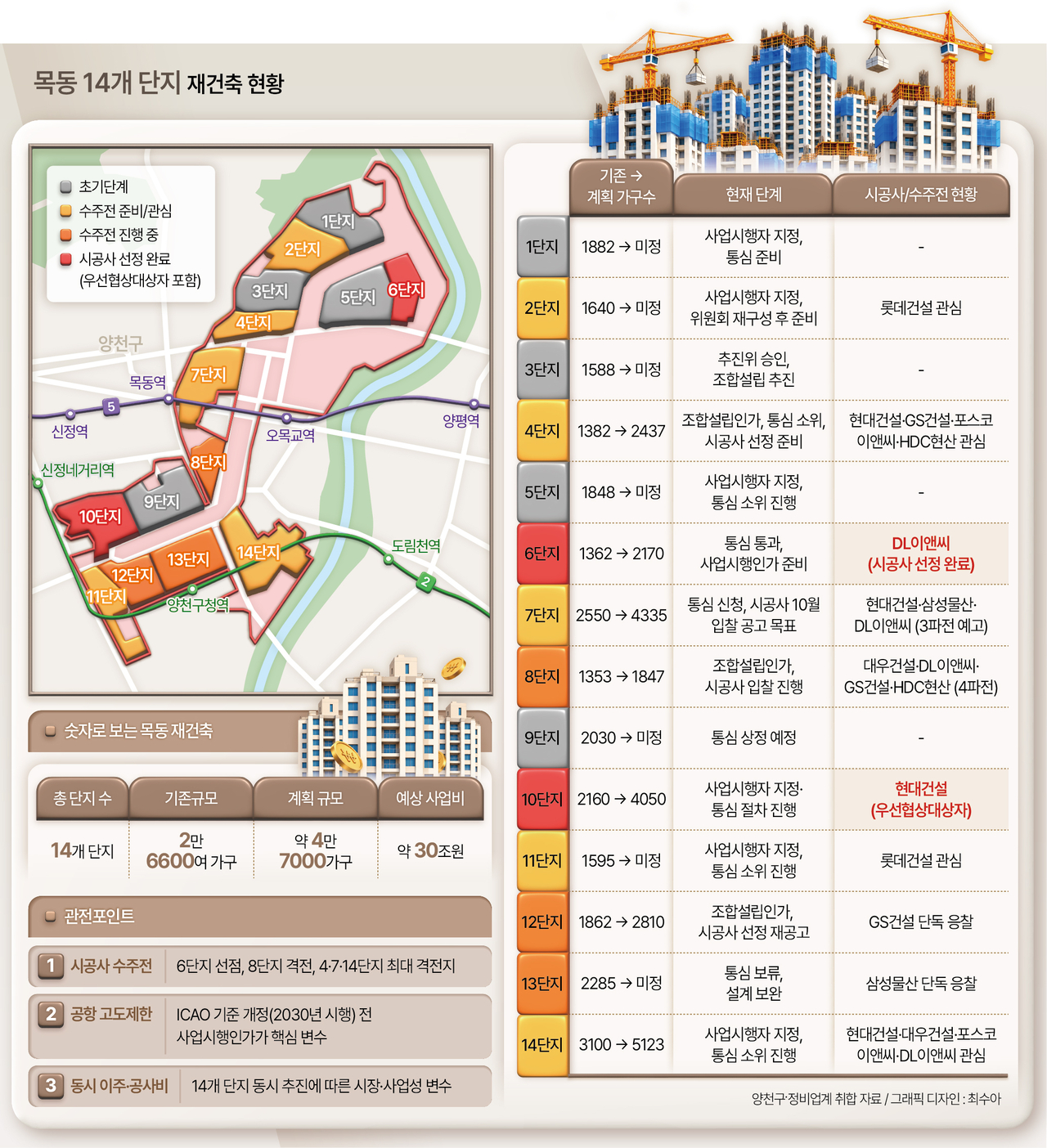
Complex 6 is currently the frontrunner in project pace. In May, it became the first of Mokdong's 14 complexes to clear Seoul's integrated review for redevelopment projects, with plans to rebuild its existing 1,362 households into up to 2,170 units across towers of up to 49 stories. DL E&C has been confirmed as the contractor, with a proposal branded "Acro Mokdong Regency."
A reconstruction association official with roots in Mokdong, identified only as A, said Complex 6 was not particularly sought-after in the past, but its fast project pace has itself become a premium. "After reconstruction, it will be able to offer views toward both the Anyangcheon and the Han River at the same time, which could earn it a very different reputation," A said.
In Mokdong, Complexes 1 through 7 are known as the "front complexes" and Complexes 8 through 14 as the "back complexes." Administratively, most front complexes fall under Mokdong while the back complexes are largely in Sinjeong-dong. A said the market price gap between the two groups had once been clear, but some back complexes have recently moved faster on reconstruction, narrowing the difference considerably.
By contrast, Complexes 1, 2 and 3 were originally designated as second-class general residential zones and took relatively longer due to the rezoning process required.
Complex 13, which had long been considered a frontrunner, hit a snag at Seoul's integrated review. It was flagged for placing too many 49-story towers without sufficient height variation between buildings, falling short of the landscape and layout guidelines for the Mokdong housing district development plan. The complex is now revising its design. Seoul did not object to the 49-story height itself, but is said to have required that the tallest towers be reduced to about 10 percent of the total, with greater height variation to create a skyline that rises gradually toward the Anyangcheon.
In the meantime, Complexes 9 and 10 are closing the gap quickly. Complex 9 is preparing to submit its case to the main integrated review committee, while Complex 10 is running the integrated review process and contractor selection in parallel after being designated as a project operator.
![A rendering of DL E&C's "Acro Mokdong Regency" proposal. [Provided by DL E&C]](https://wimg.heraldcorp.com/news/cms/2026/09/18/news-p.v1.20260629.fc16e1306186404b80b35e0254cdddcb_P1.jpeg)
Second dimension — contractors: Samsung, Hyundai, DL and GS wage a 30 trillion won territorial war
Competition among construction companies for a share of Mokdong's 30 trillion won reconstruction market is intensifying.
DL E&C planted its flag first, winning the contractor role for Complex 6 in June. Hyundai Engineering & Construction has more recently been selected as the preferred bidder for Complex 10, entering the Mokdong contest in earnest with a proposal branded "The H Mokdong Esser."
For Complex 12, the balance is tilting toward GS Engineering & Construction. GS E&C was the only bidder in the first main tender, which was voided due to the lack of competition, and it was again the only company to appear at the re-tender site briefing.
Samsung C&T is the most aggressive contender for Complex 13. It submitted the sole bid in the first tender and has partnered with an overseas design firm to prepare an alternative design, signaling its intent to deliver "Mokdong's first Raemian."
But the contest that Mokdong residents are watching most closely has not yet begun — the fight for Complexes 4, 7 and 14.
Complex 7 in particular is seen as the flashpoint where Samsung C&T and Hyundai E&C are most likely to collide.
A Complex 7 association member, identified only as B, said residents have clear brand preferences of their own. "Early on, there was talk that Samsung C&T's Raemian would take the odd-numbered complexes including Complex 7, but recently Hyundai E&C has been moving in aggressively," B said.
"Complex 7 is one where Samsung C&T has been canvassing since early on, and Hyundai E&C has also been expanding its presence lately, so residents are paying close attention," B added.
Whether the two companies will actually go head-to-head remains an open question, however.
"With 14 complexes in Mokdong, there is no reason for a construction company to bleed in a single battle," B said. "There is talk in the industry that they may end up dividing the complexes among themselves to some degree — each taking the ones they want."
Competitive bidding may also emerge from unexpected complexes.
A said that while major builders tend to lock up the most desirable complexes early — often with a single bid — less sought-after complexes could attract multiple companies that see them as winnable. "Paradoxically, the real bidding wars may break out in those places," A said.
The current landscape bears this out. DL E&C has secured Complex 6, Hyundai E&C has emerged as preferred bidder for Complex 10, and both Complex 12 and Complex 13 have so far drawn only single bids — from GS E&C and Samsung C&T, respectively.
Complex 8, by contrast, has drawn interest from Daewoo Engineering & Construction, DL E&C, GS E&C and Ipark Hyundai Development, making it the site most likely to see a multi-way contest.
Major builders including Daewoo E&C, Lotte Engineering & Construction and Hyundai E&C have also set up dedicated showrooms and lounges in the Mokdong area, presenting their brands, design concepts and financing terms to association members and residents to get ahead of the competition.
![Interior of the Summit Mokdong Lounge opened by Daewoo Engineering & Construction in Mokdong, Yangcheon-gu, Seoul. [Provided by Daewoo E&C]](https://wimg.heraldcorp.com/news/cms/2026/09/18/news-p.v1.20260617.2989159731a5473f8b3d2cb8a94620ab_P1.jpg)
Third dimension — project viability: why Complex 5 is quietly rising
The biggest asset in Mokdong's reconstruction is land. The Mokdong New Town was built at low density in the 1980s, with most existing floor-area ratios at only 116 to 125 percent — among the lowest of Seoul's major reconstruction sites.
A low floor-area ratio means more room to build new apartments. The more units available for general pre-sale after reconstruction, the greater the revenue an association can capture — and the lower the additional contributions required from existing members.
This is why some complexes are drawing attention for their project viability alone, independent of current market prices.
Complex 5 is the prime example. A said its existing floor-area ratio of about 116 percent is the lowest among Mokdong's 14 complexes. "It is also composed mainly of larger unit types, so existing members hold relatively large land shares — it is widely regarded as one of the most viable complexes from a project standpoint," A said.
In other words, while Complex 7 is the undisputed price leader today, Complex 5 is a "hidden top performer" when it comes to the reconstruction project itself.
Complex 14 also stands out for sheer scale. Its existing 3,100 households will grow to 5,123 after reconstruction — the largest of any complex in Mokdong — with a net increase of more than 2,000 units.
But size does not guarantee smooth sailing. Complex 14's project zone is divided into three blocks, and that structure has created subtle friction over how construction should be managed.
A said a contractor consortium was considered early on given the scale of the three blocks, but the trust company and the redevelopment committee settled on a single-contractor approach. "There is still a quiet internal tug-of-war over this," A said.
Fourth dimension — market value: Complex 7 is 'the undisputed leader' — but will it stay that way?
If asked to name a single price leader in Mokdong today, the answer is fairly clear: Complex 7.
A said Complex 7 is "the leader with virtually no dissent" — close to Mokdong Station, convenient to Hyundai Department Store, and home to Mongwun Elementary and Mongwun Middle School, which rank among the most sought-after school zones in Mokdong.
Its sale prices have consistently outpaced other complexes even before reconstruction. The most common unit type in Complex 7 — a 66-square-meter exclusive use area — sold in March for 2.82 billion won, already exceeding 100 million won per 3.3 square meters.
![Apartment complexes in Mokdong, Yangcheon-gu, Seoul, on Saturday morning. [The Herald Business DB]](https://wimg.heraldcorp.com/news/cms/2026/09/18/news-p.v1.20260812.3a6b1b7152734a7da6173e3302839da3_P1.jpg)
After reconstruction, however, the current hierarchy may not hold. Complex 6 — once considered relatively less desirable — has cleared the integrated review first and is now preparing for project implementation approval, drawing noticeably more market attention as a result.
Complex 5, with its concentration of large unit types, is seen as the complex with the greatest potential for upscale positioning. A 152-square-meter unit there sold for 4.1 billion won in June — the highest transaction price by absolute amount recorded within the Mokdong New Town.
Views are another variable. Complexes 6, 13 and 14 sit along the Anyangcheon and stand to gain a waterfront view premium after high-rise reconstruction. Complexes 1 and 6 are said to offer sightlines all the way to the Han River.
Some back complexes have their own individual strengths. Complex 14 will become a development of more than 5,000 households after reconstruction — large enough to offer advantages in on-site community amenities and infrastructure through economies of scale.
Complex 9 carries the image of a "legal district" residential address, given its proximity to the Seoul Southern District Court and the Seoul Southern District Prosecutors' Office. "Complex 9 is a back complex, but its closeness to the southern court and prosecutors' office makes it quite popular within Mokdong for residents who want to live near work," A said.
Some complexes have more obvious weaknesses. Complex 11 is composed mainly of small and mid-sized units and is considered one of the areas more exposed to aircraft noise from Gimpo Airport.
Final dimension — risk factors: the 2030 height restriction and the mass relocation of 26,000 households
One more major variable looms over Mokdong's reconstruction contest: a deadline.
The International Civil Aviation Organization has revised its international standards for height restrictions around airports, with the new rules set to take full effect in 2030. Mokdong, located near Gimpo Airport, falls within a flight safety zone.
Most of the 14 complexes are currently planning towers of up to 40 to 49 stories. Depending on how the new standards are incorporated into domestic law, the planned heights could be affected.
Industry insiders widely believe it is critical to secure project implementation approval before 2030 in order to lock in current design plans.
But a more immediate challenge than height restrictions may be people. When more than 26,000 households enter reconstruction, residents will need to find somewhere else to live.
Mokdong is different from a typical reconstruction area, and the reason is its school zone.
Families whose children attend schools and hagwon in Mokdong will find it difficult to leave the area even during the relocation period. If multiple complexes relocate simultaneously, the jeonse and monthly rent market in Mokdong, Sinjeong-dong, Sinwol-dong, Gangseo-gu and Yeongdeungpo-gu could face a surge in demand over a short period. That is why there is growing talk of staggering relocation schedules across complexes.
Construction costs are another risk. With 14 complexes — not just one or two — pursuing large-scale construction at the same time, the supply of construction workers, materials and contractor capacity could all come under strain.
Mokdong's distinctive education infrastructure adds yet another layer of complexity. The number of households is set to grow from about 26,000 to 47,000, and if schools, roads and commercial facilities cannot keep pace, the new apartments may be finished while the new city is not.
'The throne is still empty': Mokdong's 14 complexes and the next decade
The 14 Mokdong complexes, born simultaneously from a single blueprint 40 years ago, are now lining up again — each competing on pace, brand and project viability. Complex 6 is currently the fastest, Complex 7 commands the highest prices, and Complex 14 is the largest, but the final rankings when reconstruction is complete are far from settled.
Mokdong's next throne will not be decided by location alone. Who clears permits first, which contractor they secure, how many units they put up for general pre-sale, and whether they can weather construction costs and relocation risks — these are the factors that will determine the new order. The 14 complexes that were once part of the same new town in the 1980s could emerge in the 2030s as 14 very different properties with very different price tags.

quq@heraldcorp.com