Gyeonggi apartment prices up 4.92% so far this year
Average price in Anyang-Bundang corridor tops 1 billion won
'Northern Gyeonggi faces fundamental limits on growth potential'
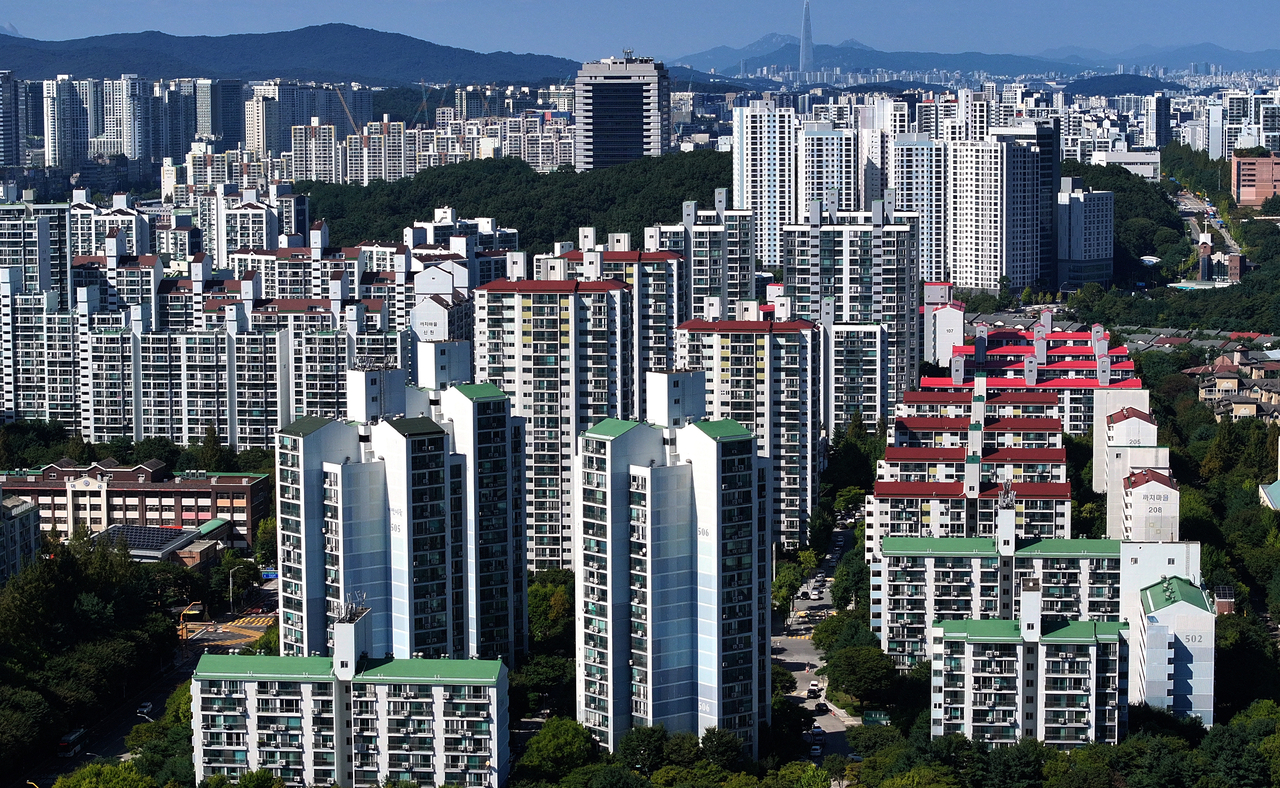
Apartment prices in Gyeonggi Province have risen about 5 percent this year, but sale prices have fallen in 15 of the province's 44 cities and districts — roughly one-third of the total. While Dongtan-gu in Hwaseong, a prime live-work area, has posted a cumulative gain of nearly 18 percent to rank first nationwide, some areas have seen deals close at half their peak prices, underscoring a sharp divide across the region.
According to the Korea Real Estate Board's weekly apartment price trend report for the second week of September (based on data through Monday), apartment prices this year have fallen in Icheon (-5.10%), Pyeongtaek (-2.81%) and Paju (-2.13%).
Transaction records from those areas confirm the steep declines. According to the Ministry of Land, Infrastructure and Transport's actual transaction price disclosure system, an 84-square-meter unit at Unjeong Hwaseong Park Dream Signature in Mokdong-dong, Paju, changed hands Tuesday for 460 million won ($333,000) — a drop of 51.6 percent from its peak of 950 million won recorded in February 2022. A 99-square-meter unit at Godeok International New Town Jeil Punggyeongchae in Godeok-dong, Pyeongtaek, sold Aug. 20 for 647 million won, down 478 million won from its previous peak of 1.12 billion won.
In Siheung, where prices have edged down 0.16 percent this year, even a large complex of about 2,700 units has yet to reclaim its peak. An 84-square-meter unit at Halla Vivaldi Campus 2 in Baegot-dong, Siheung, hit a high of 800 million won during the 2021 real estate boom but sold Wednesday for 518 million won.
![Unjeong Hwaseong Park Dream Signature apartment complex in Mokdong-dong, Paju. [Naver Street View]](https://wimg.heraldcorp.com/news/cms/2026/09/18/news-p.v1.20260918.9f1551b85d5e485b989e6ff41000c6f7_P1.png)
Icheon, which has seen the steepest apartment price decline in Gyeonggi Province this year, tells a similar story. A 74-square-meter unit at Icheon Central Prugio in Jeungpo-dong traded above 400 million won through last year but sold Friday for 355 million won — 36.6 percent below its 2022 peak of 560 million won.
Analysts attribute the polarization to a combination of Seoul accessibility and live-work demand. As non-resident landlords convert properties to owner-occupied use, those priced out of Seoul have moved to adjacent areas, while rising buying activity near industrial complexes has driven sharp price gains in select locations.
Areas close to Seoul have seen notable gains this year, including Anyang's Dongan district (up 13.89 percent) and Gwangmyeong (up 14.68 percent). Seongnam's Bundang district (up 13.69 percent) and Yongin's Suji district (up 14.44 percent), both part of the semiconductor belt alongside Dongtan, also posted strong increases.
Average sale prices have also diverged by corridor. According to the Korea Real Estate Board, the average apartment sale price in the Gyeongbu 1 corridor — which includes Anyang's Dongan-gu and Seongnam's Bundang-gu — surpassed 1 billion won in July. It reached 1.02 billion won in August, up more than 60 million won from 954.81 million won in January.
Over the same period, the Gyeongui corridor (Gimpo, Goyang and Paju) edged down from 461.61 million won to 460.54 million won, and the Eastern 2 corridor (Icheon and Yeoju) fell from 216.5 million won to 211.41 million won. The Gyeongwon corridor (Pocheon, Dongducheon, Yangju and Uijeongbu) rose by only about 2.45 million won ($1,770), from 274.6 million won to 277.05 million won.
Experts said structural differences will keep the divide in place. Park Won-gap, a senior real estate specialist at KB Kookmin Bank, said Gyeonggi Province is a prime example of live-work demand reshaping the property market. "With dual-income couples in their 30s and 40s now making up more than half of all households, couples with greater purchasing power living near industrial complexes are setting home prices," he said.
Kim Jin-yu, a professor in the department of urban and transportation engineering at Kyonggi University, said southern Gyeonggi still has advantages — including a potential National Assembly relocation — and continues to expand, while the north faces fundamental limits on growth. "The only real solution would be attracting major employers on the scale of the Yongin semiconductor cluster, but that is realistically difficult, so the gap is likely to widen," he said.
On Dongtan's sharp run-up, Kim said the current gains may be excessive but noted that the district's area — roughly twice that of Bundang — could serve as a foundation for a self-sufficient city.
shy@heraldcorp.com
hwshin@heraldcorp.com