Ministry designates Sept. 23–27 as special traffic management period
Shorter holiday than last year expected to worsen congestion; about 30.93 million people to travel
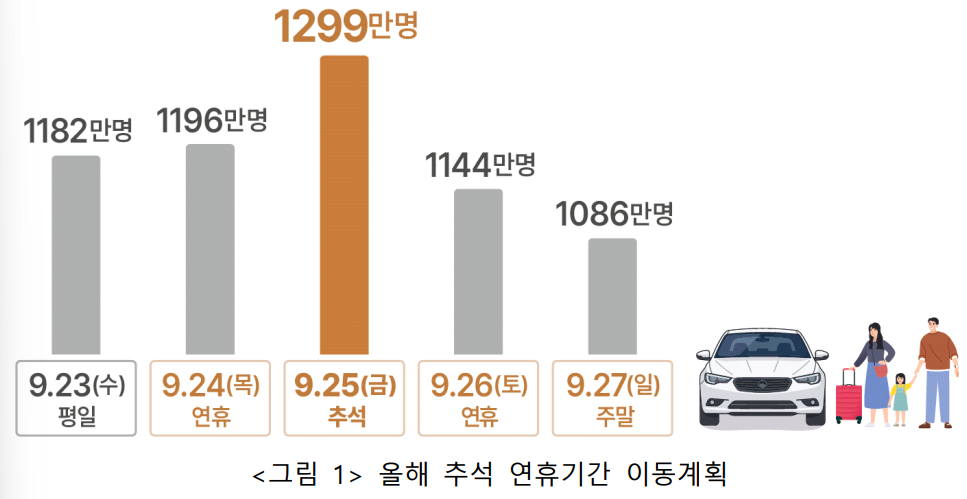
About 30.93 million people are expected to travel over the five-day Chuseok holiday period from Wednesday through Sunday.
Most travelers are expected to use private vehicles. With the holiday period shorter than last year, traffic congestion could be worse than usual. Daily traffic on Chuseok itself is forecast to reach about 6.84 million vehicles — up 6.7 percent from last year — with outbound congestion peaking Wednesday morning and inbound congestion peaking Thursday afternoon.
South Korea's Ministry of Land, Infrastructure and Transport designated Sept. 23–27 as a special traffic management period and said it would operate a special traffic control headquarters to ensure safe and convenient travel for the public.
According to the Korea Transport Institute and Korea Expressway Corporation, the shorter holiday compared to last year is expected to bring total travelers down 3.5 percent from a year ago to about 30.93 million. Private cars are expected to account for 88.4 percent of all travel. Average daily expressway traffic is forecast at about 6.05 million vehicles, up 11.8 percent from last year's 5.41 million.
On Chuseok day itself, Thursday, outbound travelers, inbound travelers and those visiting family graves are all expected to converge on the roads, pushing daily traffic to about 6.84 million vehicles — a 6.7 percent increase from last year's 6.41 million.
Travel times between major cities are expected to be longest for outbound trips on Wednesday morning and for inbound trips on Thursday afternoon.
In response, the ministry designated 299 expressway and national highway sections as congestion-prone zones, where it will focus on managing traffic and guiding vehicles to alternate routes. Shoulder lanes will also be opened on 64 expressway sections.
Eleven new national highway sections will open, including the Yeonsan–Duma stretch, the Chungju Daesowon interchange intersection, Jangsu–Janggye, Posan–Seomang and Maejeon–Geoncheon. Bus-only lanes on the Gyeongbu Line between Yangjae and Sintanjin will be extended by four hours compared to normal operations, running until 1 a.m. instead of the usual cutoff of 9 p.m.
Expressway tolls will be waived from Wednesday through Sunday, and fuel prices at expressway service stations will be cut by 100 won per liter to ease the financial burden on travelers. Congestion information for 14 major rest stops will be displayed before drivers enter, to help manage crowding.
For rail travelers, the integrated ticketing app Korail+ will allow users to search and book tickets in one place, and fares for reverse-direction holiday trips will be discounted by up to 50 percent. Both train and bus services will be expanded compared to normal operations — trains by 11.8 percent (11,567 additional runs) and bus seats by 11.1 percent (853,000 additional seats).
At airports, departure halls will open up to 30 minutes earlier than usual, and self check-in and self bag-drop services will be expanded. Temporary parking areas will also be secured to ease airport parking shortages.
To improve traffic safety, the ministry will strengthen pre-holiday safety inspections of major transportation facilities and expand AI-based accident-prone zone monitoring from 40 to 50 locations.
Park Jae-soon, director general for transport and logistics at the ministry, urged the public to obey traffic laws for a safe and smooth journey. "With the holiday period shorter than last year, traffic congestion is expected to be significant, so check traffic information before you leave, and make sure to get enough rest to prevent drowsy driving," he said.
smh@heraldcorp.com