Three representative cases involving fake workers total 1.37 billion won
Wages paid out and returned; separation reasons falsely reported
Government links 14 data types for round-the-clock monitoring
Organized schemes disguised as legitimate employment remain hard to detect

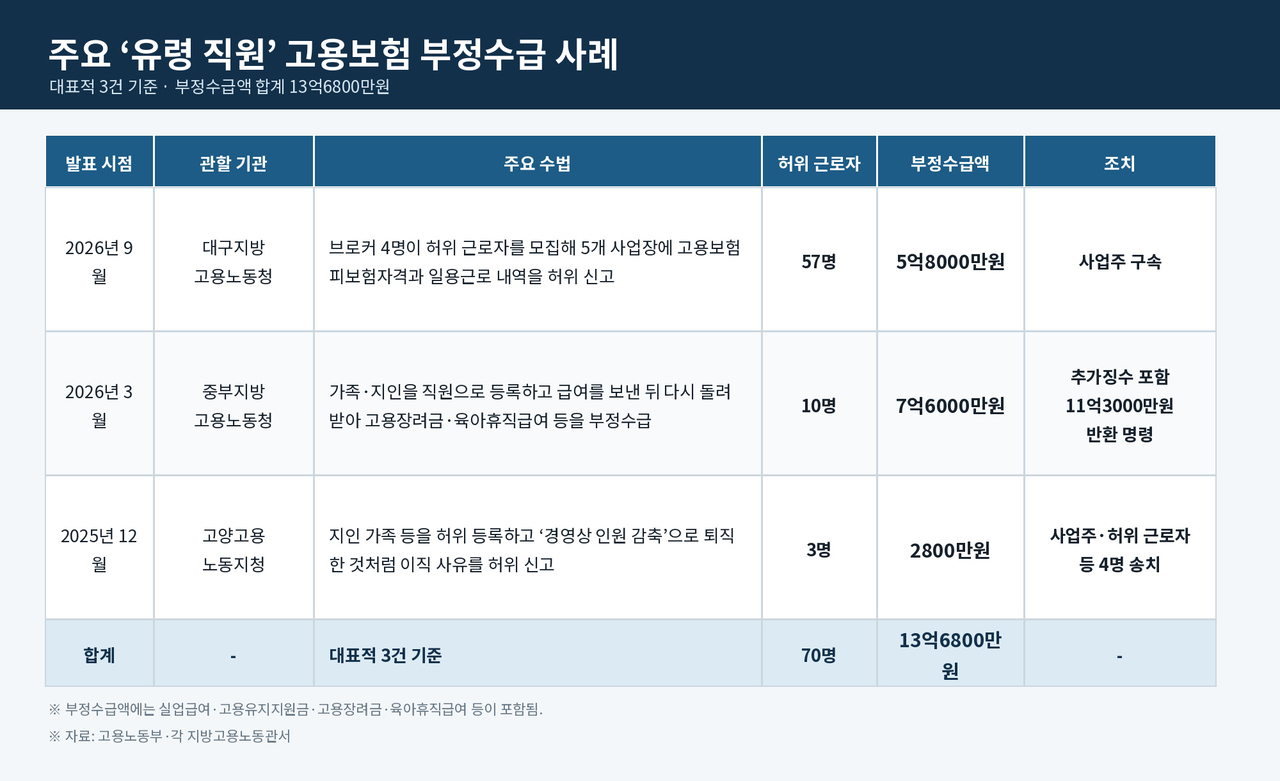
Employment insurance fraud involving "ghost workers" — fictitious employees registered at businesses to collect unemployment benefits and hiring subsidies — is becoming increasingly organized. Beyond borrowing the names of family members and acquaintances, schemes have emerged in which professional brokers recruit fake workers and build up employment insurance enrollment histories across multiple businesses. The confirmed fraud in three recently disclosed cases alone totals 1.37 billion won ($991,000).
According to the Ministry of Employment and Labor on Sunday, the Daegu Regional Employment and Labor Office arrested a business owner identified as A on Wednesday on charges of violating the Employment Insurance Act. A had recruited 57 fictitious workers through brokers to fraudulently collect unemployment benefits and other payments.
A operated five businesses in Daegu and is accused of enlisting four brokers to recruit fake workers and providing them with business information from March 2019 through February this year. The brokers falsely reported the workers' employment insurance enrollment status and daily work records to make it appear they had actually been employed.
The confirmed fraudulent amount totals 580 million won. Unemployment benefits accounted for the bulk at 540 million won, with employment retention subsidies and a special youth hiring incentive each making up about 20 million won.
Once the investigation began, A allegedly used messaging apps including Telegram and Signal to coordinate statements with accomplices and attempted to destroy evidence. The ministry determined there was a risk of flight and evidence tampering, citing A's lack of a fixed residence and unwillingness to repay the fraudulent amounts.
Ghost-worker employment insurance fraud has been uncovered across the country. In March, the Central Regional Employment and Labor Office detected two businesses that had fraudulently collected 760 million won from the employment insurance fund by falsely reporting 10 people — including family members and acquaintances — as actual employees.
The two business owners, who were in effect partners, registered each other's spouses as employees of the other's business to fabricate an employment relationship. By routing wages into employees' accounts and then reclaiming the money, they pocketed 430 million won in youth additional employment incentives and employment retention subsidies. The owners' spouses fraudulently collected more than 100 million won in parental leave benefits.
In December last year, a business owner was caught falsely registering three people — relatives of acquaintances — as employees of a food service business to collect 28 million won in unemployment benefits. The individuals, who had never actually worked there, were enrolled in the four major social insurance programs and their departures were falsely reported as workforce reductions due to management reasons. One of the fictitious workers lived in an area four hours' round trip from the business.
Fraud exploiting daily work records at construction sites was also uncovered. Through a targeted investigation last year, the Daegu office identified 125 people who had lent their names to cover labor costs at construction sites without actually working. Of those, 80 individuals — including fraudulent claimants and complicit business owners — were referred to prosecutors, and repayment orders totaling 1.46 billion won, including additional surcharges, were issued.
The core problem is that a single instance of fraudulent employment can trigger a chain of multiple benefit and subsidy payments. Once a fictitious worker accumulates a sufficient employment insurance enrollment history, they can apply for unemployment benefits after leaving. In the process, the business owner can collect hiring incentives and employment retention subsidies, and if a parental leave-eligible worker is included, maternity and paternity protection benefits can be fraudulently claimed as well.
The government has stepped up enforcement. The Ministry of Employment and Labor announced its 2026 basic plan for employment insurance fraud investigations in March and is conducting targeted probes into industries and fraud types concentrated in each region, led by seven regional employment and labor offices. A nationwide special inspection covering unemployment benefits, maternity and paternity protection benefits, and employment incentives will also run through the end of the year.
A round-the-clock monitoring system linking 14 categories of information with agencies including the National Tax Service and the Ministry of Justice is also in operation. The system cross-references business registration status during unemployment benefit receipt, immigration records, social insurance enrollment histories, and employment at businesses run by family members to flag suspected fraud cases.
Those caught must repay the fraudulent amounts and can face additional surcharges of up to five times the sum, as well as criminal prosecution. Whistleblowers are eligible for rewards — 20 percent of the fraudulent amount, up to 5 million won per year, for unemployment and parental leave benefit cases, and 30 percent, up to 30 million won per year, for employment stability and vocational skills development programs.
However, when brokers use multiple businesses to fabricate work and payroll records and make the arrangement look like a legitimate employment relationship, cross-referencing administrative data alone makes early detection difficult. Experts say the monitoring system needs to be upgraded to keep pace with organized schemes that go beyond family- and acquaintance-based fraudulent employment to systematically manufacture false enrollment histories.
The ministry plans to use automated alert systems, including the Employment 24 platform, to identify suspicious cases and conduct intensive investigations into organized, repeat and large-scale fraud. "We will pursue to the end any organized and sophisticated fraud in which business owners, brokers and others collude to abuse the employment insurance system, and take action in accordance with the law," a ministry official said.
fact0514@heraldcorp.com