Regional heads urge inclusion in 5th National Railway Network Plan, citing goal of '1-hour lifestyle zone' to complete Chungcheong megacity
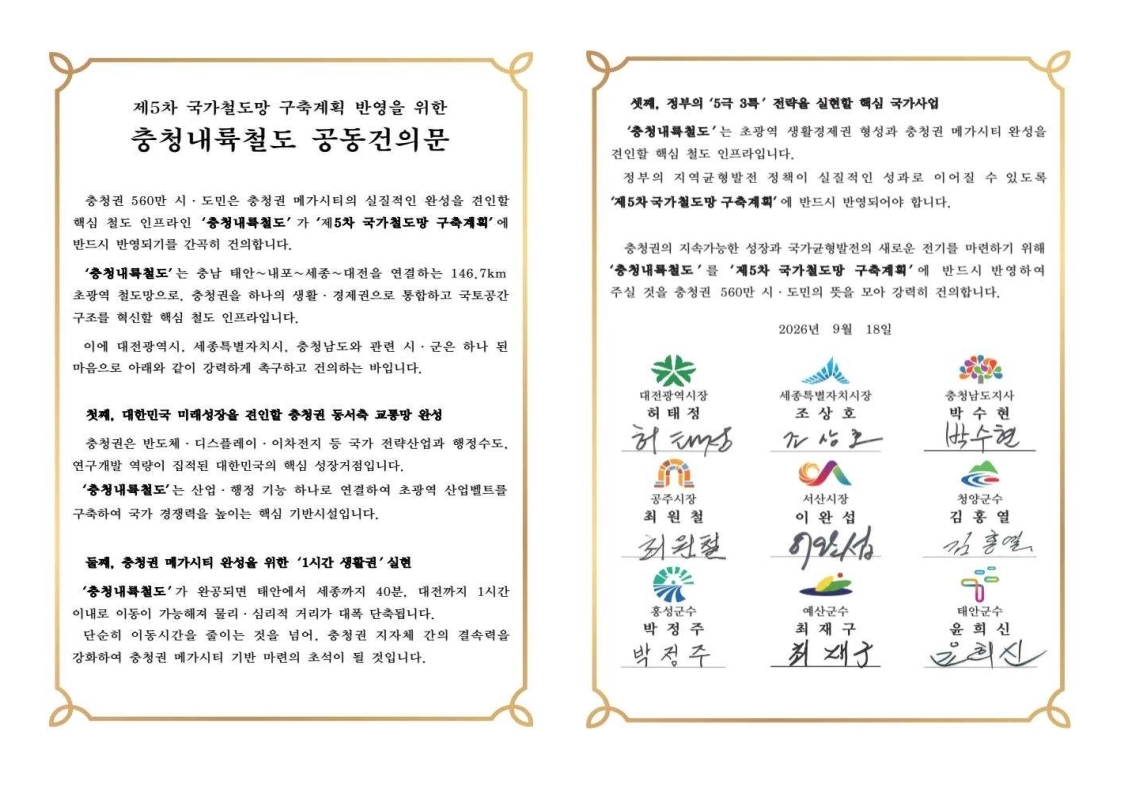
Regional government heads in the Chungcheong region have called on the central government to include the Chungcheong Inland Railway — a project they describe as essential to completing the Chungcheong megacity and supporting the government's "5 Poles, 3 Specials" regional development strategy — in the 5th National Railway Network Construction Plan.
South Chungcheong Province said Friday that Vice Governor Hong Jong-wan met with the railway bureau chief at the Ministry of Land, Infrastructure and Transport to deliver a joint petition signed by regional and local government leaders across the Chungcheong region urging inclusion of the project in the plan.
The petition was signed by the heads of the metropolitan governments of South Chungcheong Province, Daejeon and Sejong, as well as the heads of six municipal governments within South Chungcheong Province — Seosan, Gongju, Cheongyang, Hongseong, Yesan and Taean. Hong and deputy heads and senior civil servants from the six municipalities delivered the petition in person to the railway bureau chief.
The petition outlined three grounds for inclusion in the 5th National Railway Network Construction Plan: completing the east-west transport corridor in the Chungcheong region to drive future national growth, realizing a "1-hour lifestyle zone" to complete the Chungcheong megacity, and advancing a core national project underpinning the government's "5 Poles, 3 Specials" strategy.
The Chungcheong Inland Railway is a single-track electrified line stretching 146.7 kilometers from Taean through Seosan Airport, Naepо New Town and Gongju to Sejong and on to Sintanjin and Daejeon. The total project cost is estimated at 4.47 trillion won ($3.27 billion).
The line would connect the Chungcheong region's industrial and administrative hubs, cut travel times between areas and integrate the region into a single lifestyle and economic zone.
If included in the national plan, the project is expected to improve access to major urban centers from the relatively rail-poor western coastal and inland areas of South Chungcheong Province, contributing to the formation of a broader Chungcheong super-regional living zone.
Officials also expect the project to strengthen connectivity among key hubs across the Chungcheong region, improve access to the South Chungcheong Innovation City, and boost the efficiency of tourism and industrial logistics.
South Chungcheong Province said it will continue coordinating with Daejeon, Sejong and the municipalities within the province to secure the railway's inclusion in the 5th National Railway Network Construction Plan, which the Ministry of Land, Infrastructure and Transport is expected to announce by the end of the year.
South Chungcheong Province Governor Park Soo-hyun said in the petition that the Chungcheong Inland Railway "will build a super-regional industrial belt connecting industrial and administrative functions into one, raising national competitiveness — going beyond simply cutting travel times to strengthen solidarity among Chungcheong local governments and lay the cornerstone for a Chungcheong megacity." He added that the project "must be included in the 5th National Railway Network Construction Plan so that the government's regional balanced development policy can translate into tangible results."
kwonhl@heraldcorp.com