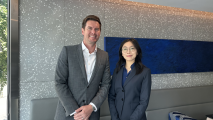
![Coway announced Thursday that it has signed a technology transfer agreement with Seoul National University for microbial food waste decomposition technology developed through an industry-academia partnership. [Coway]](https://wimg.heraldcorp.com/news/cms/2026/09/17/news-p.v1.20260917.baddbd91cd3e4b909961db34d0e946e1_P1.png)
Industry-academia partnership since 2023 — microbes sourced from traditional fermented foods
Microbial model to follow grinder launch in May, expanding food waste processor lineup
Competition heats up with Minix, Cuckoo — Coway bets on rental service edge
Coway is pushing deeper into the food waste processor market after acquiring microbial decomposition technology co-developed with Seoul National University. Having launched a dry-grind model in May, the company will add a microbial model by the end of this month, giving it a two-pronged product lineup.
Coway announced Thursday that it has signed a technology transfer agreement with Seoul National University covering microbial mixed-strain technology for food waste decomposition, developed through an industry-academia partnership.
The two sides have conducted joint research since 2023 to identify microbial strains suited for food waste processors. In the process, they developed technology to screen and evaluate microbes found in traditional fermented foods for their ability to break down organic waste.
The research was led by a team under Professor Kang Dong-hyun of Seoul National University's College of Agriculture and Life Sciences. The team analyzed factors that promote or inhibit microbial growth and selected strains capable of maintaining decomposition performance under conditions typical of Korean food waste — high salt and moisture content, with solids and liquids mixed together.
The selection criteria included enzymatic activity for breaking down proteins, carbohydrates, dietary fiber and fats. Coway said the technology transfer gives it the in-house capability to screen and cultivate decomposition strains suited to food waste processing environments.
The technology will be applied to the Zero Food Waste Processor Microbial Model, set for release by the end of this month. The product uses microbes inside the unit to continuously decompose and reduce food waste, and is designed for immediate use after installation with no waiting period for microbial cultivation. It can process up to 0.7 kilograms per day, and residual byproduct needs to be removed in small amounts every one to three months.
Coway entered the food waste processor market in May with the launch of the Zero Food Waste Processor Grinder Model in 2-liter and 3-liter capacities. That product dries and grinds food waste using high-temperature heating at 150 degrees Celsius and a four-blade mechanism. With the microbial model joining the lineup, Coway will offer both types.
Competition in the food waste processor market is intensifying as rivals expand their ranges by type and capacity. Cuckoo sells both a dry-grind model and a 12.5-liter microbial model. Minix has said it held about a 30 percent share in a 2025 nationwide online and offline sales survey by market research firm NIQ Korea, and is expanding its dry-grind lineup from 1.5 liters to 3 liters.
For Coway, an additional differentiator is its ability to extend the in-home service network it has built around water purifiers and air purifiers to cover food waste processors as well. The new microbial model will offer customers a choice between professional servicing and self-management, and rental customers will receive complimentary microbial agent refills.
"This is an industry-academia case where eco-friendly foundational technology, verified through rigorous cultivation analysis, has been transferred to Coway," Professor Kang said. "I hope it leads to a solution that addresses food waste disposal in a hygienic and environmentally responsible way."
A Coway official said the company has secured microbial development capabilities in the food waste processor segment through the transfer of Professor Kang's core technology, adding that it plans to continue introducing next-generation food waste processors incorporating the related expertise.
hong@heraldcorp.com