Nobel laureate Alvin Roth's new book tackles the debate over 'repugnant' market transactions, from prostitution and surrogacy to drugs and organ trading
![[123rf]](https://wimg.heraldcorp.com/news/cms/2026/09/17/news-p.v1.20260917.d80a1e947e5249bfb38b699fa9de574e_P1.jpg)
Markets exist to allocate scarce resources efficiently among members of society. For them to function properly, they require well-designed rules — and some transactions remain fiercely contested. Trades involving organ transplants, prostitution, drugs and assisted dying have prompted sharp debate, with some countries banning or tightly regulating them outright.
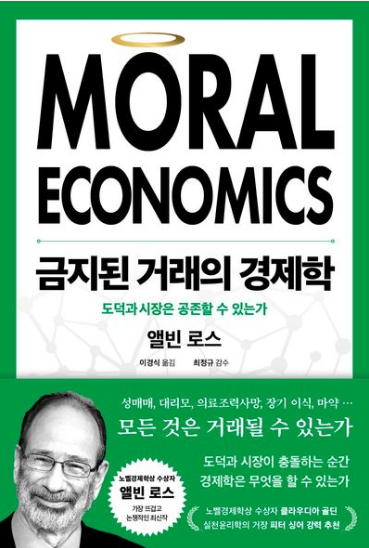
Alvin Roth, who won the Nobel Prize in economics in 2012 and is a leading authority on market design, takes on exactly these transactions in his new book, "The Economics of Forbidden Transactions." Deals touching on human life, dignity or deeply held beliefs are often treated as matters of morality or religion, where the two sides see no room for compromise. Roth calls such deals "repugnant transactions."
As Roth defines them, repugnant transactions are ones in which all the parties directly involved want to participate, yet others believe — on moral or religious grounds — that they should not take place. Opponents typically argue that such transactions harm, or are likely to harm, people beyond the immediate parties. His examples include prostitution, surrogacy, alcohol and drugs, high-interest consumer loans and price gouging during emergencies, plasma and kidney donation, and medically assisted dying.
Roth argues that while repugnant transactions are banned or regulated in many countries, prohibition alone is rarely the only answer. Banning certain trades can give rise to black markets and gray zones that effectively neutralize the measure. The United States' Prohibition era from 1920 to 1933 is a case in point: outlawing the sale and consumption of alcohol did not eliminate it. Instead, criminal organizations built black markets, and ordinary people ended up dealing with them just to have a drink.
A more productive approach, Roth suggests, might have been to legalize such markets and regulate them appropriately. He points to the United States — which has opened both the plasma and surrogacy markets — as evidence. When the US government allowed financial compensation for plasma donors under strict regulatory oversight, the supply of American-donated plasma grew enough to save lives both domestically and around the world. In the surrogacy market, he notes, many children who could not otherwise have been born have come into the world in the United States.
Roth cautions, however, against using those precedents to argue too quickly for opening other markets in human-derived materials. Offering financial compensation for kidney donation, he explains, cannot simply be assumed to work as smoothly or with as few side effects as the plasma or surrogacy markets. Because "morality in economics is not merely theoretical but also empirical," he argues, evidence must be gathered through experimentation before any such system is introduced. He also contends that even an existing ban deserves reconsideration if the targeted transactions have not declined or related crimes remain widespread.
"There are policies that allow for far more productive discussions in terms of outcomes and costs, without imposing moral views by force," Roth writes. "We need to weigh the costs between what we desire or find repugnant and what we can actually achieve — and seek a compromise between the two."
"The Economics of Forbidden Transactions" / by Alvin Roth / translated by Lee Gyeong-sik / supervised by Choe Jeong-gyu / Saenggakuihim
carrier@heraldcorp.com