Joint press conference held Thursday morning at Busan City Council
'Merging 4 port authorities is a centralist idea,' critics say
Groups demand withdrawal of unilateral push, permanent port governance body
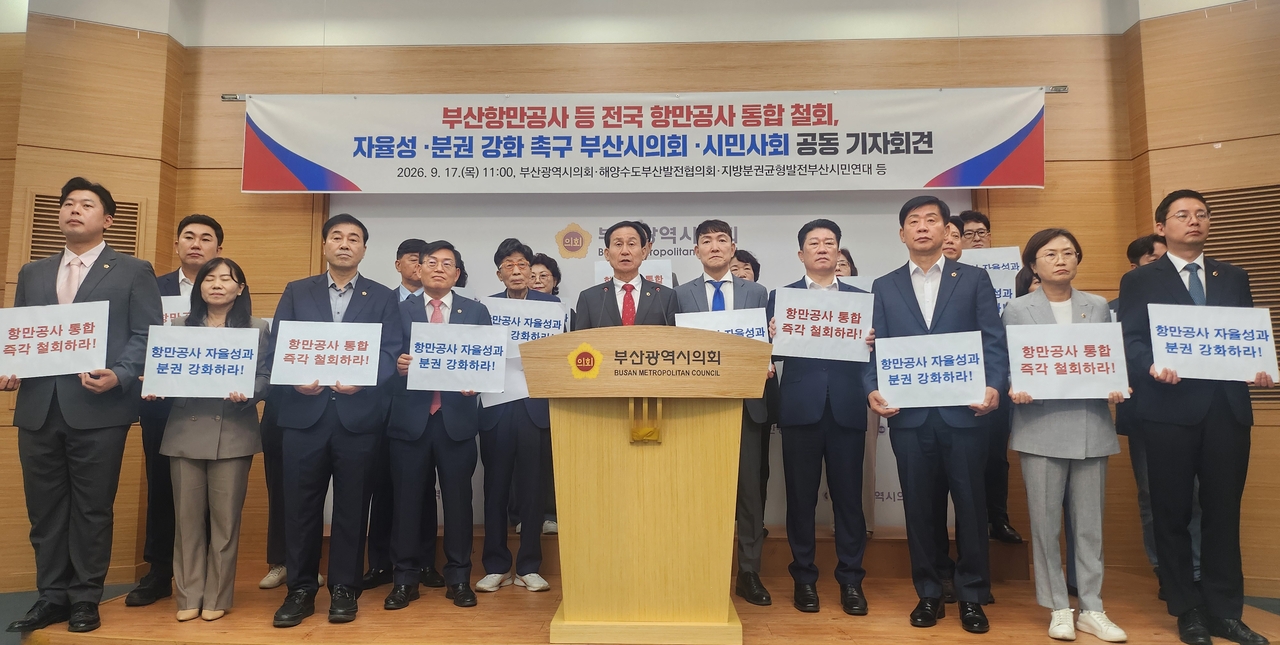
The Busan City Council and a coalition of maritime and civic organizations in the city jointly urged the government Thursday to scrap its plan to merge the country's four port authorities and to strengthen port autonomy and decentralization.
The groups — including the Maritime Capital Busan Development Council, the Busan Citizens' Solidarity for Decentralization and Balanced Development, the Citizens Together for Decentralization and Maritime Power, the Busan Port Development Council and the Busan Port Citizens' Association — held a press conference with the Busan City Council at 11 a.m. Thursday at the council's briefing room.
Speaking at the event were Busan City Council Speaker Kang Mu-gil, Deputy Speaker Song Sang-jo and Park In-ho, co-chair of the Busan Port Development Council. Participants criticized the government's plan to merge the port authorities of Busan, Incheon, Ulsan and Yeosu-Gwangyang as "a centralist idea that ignores the differences in each port's functions, industrial structure and regional economic hinterland."
Busan Port, they argued, is a world-class transshipment hub and the country's primary gateway for import and export logistics, and consolidating ports with distinct functions under a single organization would not strengthen competitiveness. They warned that delays in decision-making, conflicts over investment priorities and weakened managerial accountability could derail key projects such as the new port development and the North Port redevelopment.
The groups called for the immediate withdrawal of the government's unilateral merger push, greater autonomy over organizational structure, personnel and budgets, and the establishment of a permanent port governance body that includes the Busan city government, port authorities, industry, labor and civic society.
The government announced its public institution reform plan on Sept. 3, outlining a proposal to merge the four port authorities into a single entity tentatively named Korea Port Authority, with existing port authorities converted into regional branches. Since then, pushback has mounted: the National Federation of Maritime and Fisheries Labor Unions held a press conference calling for the plan's withdrawal, and the Busan branch of the Citizens' Coalition for Economic Justice demanded a review, also calling it a centralist approach that disregards each port's characteristics and regional economic structure.
The Busan City Council's Maritime and Urban Safety Committee unanimously adopted a resolution on Sept. 4 urging the government to drop the merger plan. People Power Party lawmakers from Busan, Incheon and Ulsan also held a joint press conference at the National Assembly last month calling for the withdrawal of merger discussions. Opposition from local politicians and civic groups continues to grow.
kaf2002@heraldcorp.com