BTL specialist Valuepoint handles everything from concept to installation under one roof
Planning, design, precision fabrication, installation and storage all kept in-house
Skilled veterans of 20 years add the details automation cannot — global brands have taken notice
MRO retail synergy fuels push for 100 billion won in sales this year
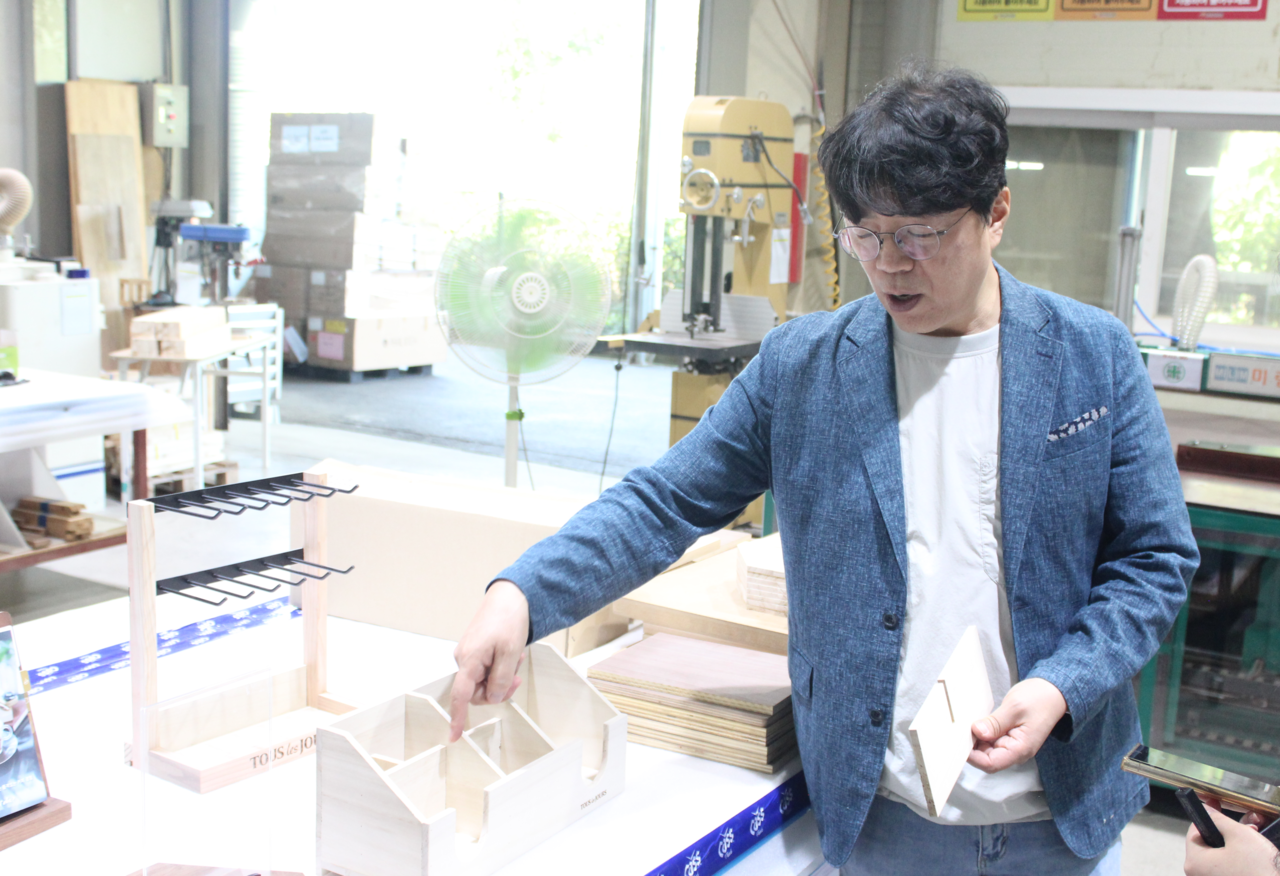
On Friday, this reporter visited the Valuefactory — the production center of BTL marketing specialist Valuepoint — nestled in the Heyri arts village in Paju, Gyeonggi Province. The facility sits close enough to the front line that the North Korean hillside beyond the Imjin River is visible to the naked eye. Carved out of a wooded hillside in 2016, the complex spans 8,250 square meters.
Inside the factory, advertising structures and props produced by Valuepoint are packed so tightly that the space resembles a transplanted shopping mall. Display fixtures from globally recognized brands and pop-up store furnishings for domestic companies fill the hall — objects consumers encounter every day, gathered in one place.
Stepping into the workshop, visitors are hit by the acrid heat of heating elements and lasers melting acrylic sheets, and the sharp smell of organic solvents drifting from the silk-screen room. Large industrial fans stationed throughout the factory run without pause, cooling the heat thrown off by wide-format flatbed printers and laser-cutting machines.
Most consumers are familiar with traditional above-the-line advertising — television, newspapers and the like — but Valuepoint's core business, BTL (below-the-line) marketing, is less well known. BTL covers the full range of offline, in-person marketing: retail shelf displays, pop-up store environments, outdoor signage and product-sampling events — anywhere consumers engage with a product through their senses. While most small operators take on only a single process — signage, large-format printing or acrylic fabrication — Valuepoint has built a one-stop total service running from in-house design and engineering at its headquarters through large-scale fabrication at the Paju factory, nationwide delivery and installation, and post-campaign storage and disposal.
On the production floor, CNC equipment and precision lasers cut sheet materials without a millimeter of error, while skilled technicians apply heat and use their fingertips to bend panels to exact angles. Silk-screen printing — where a craftsman pushes ink by hand to achieve vivid colors that machine printing struggles to match — and traditional woodworking joinery that locks pieces together with interlocking grooves rather than nails are visible throughout the floor. In a licensed spray booth equipped to automotive-paint standards, workers in respirators apply uniform coats of color to signage.
Valuepoint's edge lies in the accumulated detail of long experience. The company translates a client's management philosophy and brand identity into something consumers can grasp intuitively — and then actually builds it.
Lee Byeong-ryeol, head of the production center, said acrylic and metal fixtures have no off-the-shelf samples, so even when a client provides only a verbal description or a rough hand sketch, the team must work out the structure internally and produce a full 3D drawing. "AI can generate a solid concept rendering, but holding tolerances to 0.5 millimeters and building a frame that won't collapse on-site — that ultimately comes down to a skilled human," he said.
That level of finish has translated into long-term partnerships with demanding global clients. The company is now in the final stages of completing its Sedex Members Ethical Trade Audit (SMETA) certification, the ethical-trade audit standard required by many global corporations for their suppliers. One section of the factory is dedicated to post-campaign logistics: dismantled display units are tracked by inventory code after events end, then refurbished and reissued for the next promotion. A separate system collects clear acrylic offcuts for recycling into reclaimed sheet material.
Founded in 2002, Valuepoint became a subsidiary of Kospi-listed iMarketKorea in 2022, then expanded further last year by absorbing office-supplies distributor Cubridge. By adding an MRO (maintenance, repair and operations) business that supplies stationery and consumables to corporate clients, the company significantly broadened its existing offline marketing customer base. Now 240 employees strong, Valuepoint is targeting annual sales of 100 billion won ($73.9 million) this year through cross-selling between its BTL and MRO divisions. To defend margins against rising global raw-material costs — acrylic, fabric and other inputs — the company established a procurement strategy unit this year to source materials directly from overseas suppliers.
"Once the market recognizes that we have a large-scale production base with a genuine one-stop manufacturing solution, we will have a clear edge in competitive bidding," Lee said. "We will consolidate our leadership in this market through the manufacturing competitiveness to turn even the most complex brief into reality."
silverpaper@heraldcorp.com