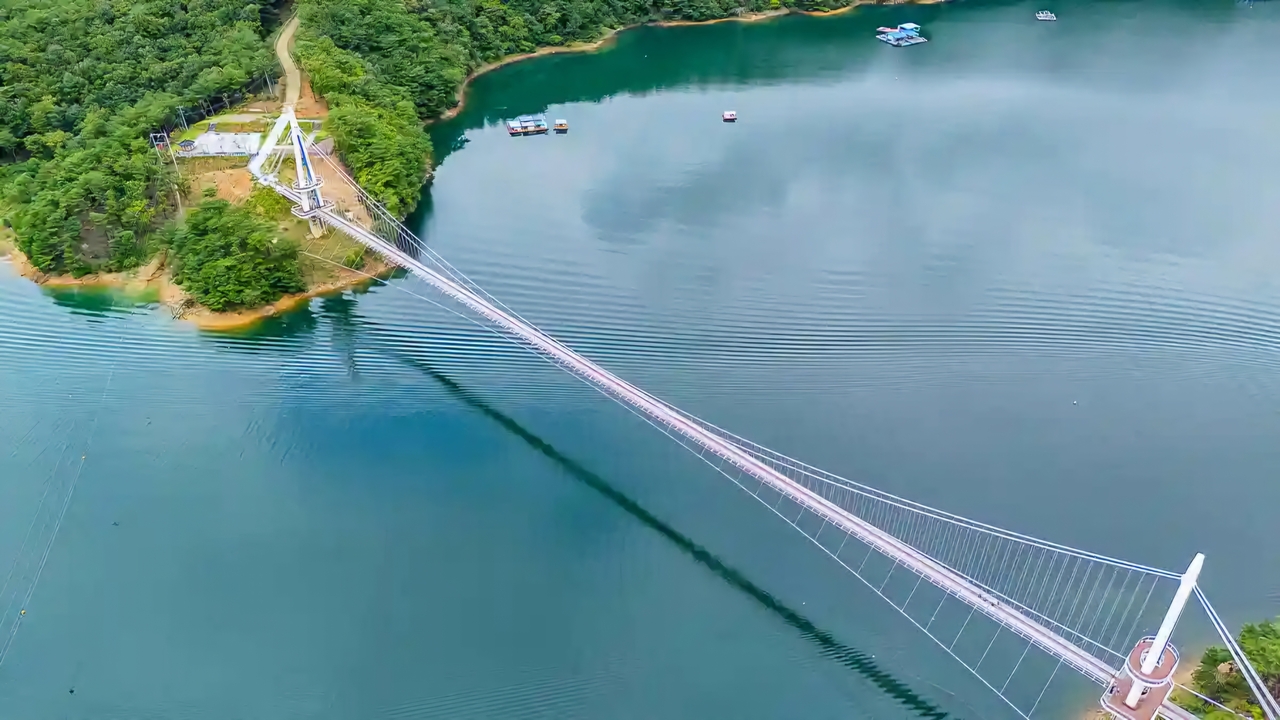
Seoho Village in Sangmuryong 2-ri, Yanggu-gun, Gangwon Province, was largely submerged and cut off from the outside world after rising water levels caused by the Hwacheon Dam flooded much of the area. For 80 years before the Sangmuryong suspension bridge was built, residents had no overland route and had to cross Paro Lake by motorboat to reach the nearest town.
A new study has found that the construction of the Hwacheon Dam and Soyang River Dam inflicted more than 3 trillion won ($2.22 billion) in cumulative damage on Yanggu-gun, while support payments for areas surrounding the dams amounted to just 2.3 billion won.
According to Yanggu-gun on Wednesday, the findings come from a research project commissioned by the Gangwon Research Institute titled "Analysis of Dam Impacts on Yanggu-gun and a Study on Returning Benefits to the Region."
Local residents and officials in Yanggu-gun called on the government to adopt policy measures that would return to the affected region the benefits generated by the Hwacheon Dam and Soyang River Dam.
They said the government must recognize that Yanggu-gun has endured more than half a century of social, economic and human hardship — including sweeping regulations, development restrictions and severed transport links — while the benefits of the dams have been concentrated in the national government and the Greater Seoul area. They called for expanded support and regulatory reform.
"Since the construction of the Soyang River Dam, Yanggu has endured more than half a century of regulations and development restrictions while contributing to national development and the stable water supply of the metropolitan area," Yanggu-gun Mayor Kim Wang-gyu said. "Based on the findings of this research, we will work to establish an institutional framework that ensures our sacrifices and contributions are met with fair compensation and that the benefits of the dams are returned in a meaningful way to local residents."
The Gangwon Research Institute found that the Hwacheon Dam caused 972 billion won in cumulative damage to Yanggu-gun over 81 years, while the Soyang River Dam caused between 2.75 trillion won and 2.95 trillion won in damage over 52 years.
Ongoing annual damage was estimated at between 8 billion won and 14.7 billion won.
The partial submersion of National Route 46 caused by the Soyang River Dam stretched travel time between Yanggu and Chuncheon from 40 minutes to two and a half hours, severing transport links that have had a prolonged negative impact on the local economy.
By contrast, annual support payments to Yanggu-gun for dam-adjacent areas amount to about 2.28 billion won ($1.68 million), of which only about 1.09 billion won — just 48 percent of the total — goes toward direct community support projects.
The study also found that a significant portion of the support funding is allocated to one-off or consumable projects, limiting its effectiveness in building a foundation for income growth and regional revitalization.
The institute proposed four policy alternatives: expanding the eligibility criteria for dam-adjacent area support; improving the standards for calculating and distributing support funds; amending the Dam Construction and Management Act to diversify support programs covering income growth and renewable energy; and reforming unreasonable regulations on natural environment conservation zones around the Soyang River Dam.
To leverage the dams and water resources as new drivers of regional growth, the institute also proposed developing an integrated waterfront tourism belt linking Paro Lake, Soyang Lake and the Peace Dam; launching a resident-invested, dividend-based floating solar power project; pursuing a pumped-storage hydropower project using Paro Lake as the lower reservoir; and building a community center along National Route 46 to serve travelers on the road.
abc@heraldcorp.com