Firms with unpaid wage violations to face strict sanctions
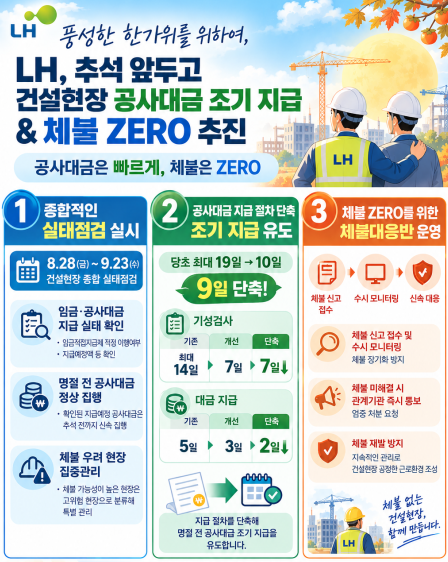
The Korea Land and Housing Corporation said Wednesday it will accelerate the payment of about 600 billion won ($443 million) in construction fees ahead of the Chuseok holiday, as part of a broader push to eliminate unpaid wages and subcontract payments.
LH said it is leading efforts to stamp out wage and payment delinquency — long identified as a chronic problem at construction sites — by tightening on-site supervision and imposing stricter penalties on companies found to be in violation.
Under the measures, prime contractors that fall behind on payments will receive a "quality deficiency notice," resulting in point deductions during future LH project bids. Subcontractors will be designated as "managed subcontractors" and barred from subcontracting work for up to three years. Delinquency deductions can reach up to 1.5 points based on the amount owed, while quality deficiency notices can accumulate to a maximum of 4.5 points depending on how many notices have been issued. The deductions apply to violations recorded within one year of a bid announcement date.
Companies that refuse to comply with corrective orders will be reported immediately to the relevant regional employment and labor offices and local governments for action under the Framework Act on the Construction Industry, the Subcontracting Act and other applicable laws.
To ensure that small and mid-sized subcontractors and workers can enjoy the holiday without worrying about unpaid wages, LH said it will conduct a comprehensive inspection of construction sites nationwide.
The inspection will cover compliance with the public client's direct wage payment system, as well as five areas: scheduled wage and subcontract payment amounts, the status of progress payment receipts and disbursements, whether construction workers have been paid, whether equipment and materials suppliers have been paid, and the status of delinquency cases and complaints.
Through the inspection, LH said it will ensure that about 591.6 billion won in scheduled payments across 361 sites is disbursed in full before the holiday. Any delinquency uncovered will prompt an immediate payment demand, and sanctions will follow if the demand is not met.
Sites where inspectors find signs of deteriorating contractor liquidity, delinquency complaints or underreported labor cost payments will be classified as high-risk and placed under intensive monitoring until the Chuseok holiday.
LH also said it will cut the payment processing period ahead of Chuseok from a maximum of 19 days to 10 days to speed up disbursements.
The progress inspection period, which previously took up to 14 days, will be halved to seven days, while the payment deadline will be shortened from five days to three, bringing the total process down to a maximum of 10 days. LH said it will also strongly encourage prime contractors to pay their subcontractors within five days.
In addition, LH will operate a dedicated "delinquency response team" over the Chuseok period to pursue its goal of zero unpaid wages and payments. The team will immediately assess any reported cases of delinquency, coordinate with relevant departments and site managers to confirm resolution, and continuously monitor payment flows to detect anomalies such as delayed or indirect disbursements and prevent prolonged delinquency.
"We will block any possibility of delinquency at the source so that construction workers and subcontractors receive fair compensation on time without difficulty, and deal with any violations swiftly through strict punishment," LH President Lee Seong-hun said. "We will continue to use round-the-clock monitoring and on-site investigations to build construction sites free of delinquency where workers can feel secure."
LH has also been pursuing the introduction of a digital wage payment system to fundamentally prevent wage delinquency at construction sites.
hss@heraldcorp.com