Seoul Metro wins top honors in Seoul Metropolitan Government's second-half 2026 proactive administration awards; public-private partnership improves signage for mobility-impaired riders
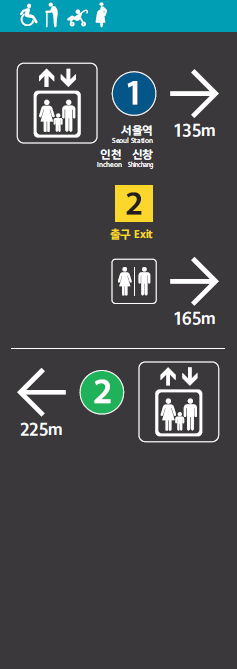
Seoul Metro announced that its "Subway Signage Improvement Project for All" has been named the top public institution initiative in the Seoul Metropolitan Government's second-half 2026 proactive administration awards competition.
The Seoul Metropolitan Government selects outstanding proactive administration cases twice a year — in the first and second halves — based on a comprehensive evaluation of regulatory improvements, creative governance and tangible benefits felt by residents.
In this round, 30 cases were selected across three categories: Seoul Metropolitan Government offices and agencies, autonomous districts, and public institutions. Results from an online public vote were also factored into the evaluation.
Seoul Metro's top-ranked project was launched to address the difficulties that mobility-impaired riders — including wheelchair users, parents with strollers and elderly passengers — face navigating complex subway stations.
The project is a three-year initiative carried out through a public-private partnership with the Seoul Metropolitan Government, Hyundai Rotem and the nonprofit Muui, moving beyond Seoul Metro's previous practice of working alone. Since signing an MOU in April 2025, the partners have secured 900 million won ($665,000) in corporate social responsibility funding from Hyundai Rotem and are rolling out accessibility-focused signage improvements in phases through 2027.
Previously, signs installed at different times and across different lines varied widely, causing confusion for mobility-impaired riders during transfers and general movement. In response, Seoul Metro directly observed the difficulties riders encountered in real-world conditions and incorporated their feedback into the redesigned signage.
Signs were enlarged to better suit the actual environment mobility-impaired riders navigate, and pictogram strips for accessibility were added to improve readability. Signs were also installed at a height of approximately 120 to 130 centimeters — eye level for wheelchair users — and the information system was restructured so that transfer-related details can be understood at a glance.
The project has shown measurable results in improving mobility and safety for riders with disabilities.
Observational research tracking 15 mobility-impaired riders before and after the signage changes found that average transfer times on high-difficulty transfer routes fell from 16 minutes and 3 seconds to 9 minutes and 37 seconds — a reduction of about 6 minutes and 26 seconds.
Survey results showed that wheelchair users gave high marks for improved navigational accuracy and reduced inconvenience after the signage upgrade, and expressed strong expectations for a decrease in accident risk.
Seoul Metro has completed signage improvements at 10 transfer stations, including City Hall Station, and plans to expand the rollout to 25 stations in the second half of this year, with full coverage across all Seoul Metro stations targeted by 2027.
The 10 pilot stations where new signs were installed in January 2026 are City Hall, Seoul Station, Express Bus Terminal, Samgakji, Konkuk University, Gyodae, Nowon, Yeonsinnae, Cheonho and Cheonggu.
Ma Hae-geun, head of Seoul Metro's operations division, said the project was an example of proactive administration in which the agency directly identified the real-world difficulties faced by mobility-impaired riders and worked with public and private partners to build solutions based on user feedback. "Going forward, we will continue to actively identify and address problems on the ground from the perspective of our riders, so that everyone can use the subway safely and conveniently," he said.
seouldream01@heraldcorp.com