Vacant units re-listed after winners walk away from contracts
Hanok living costs, lifestyle concerns cited as barriers
SH says rent adjustments under review
![Interior of the public hanok at 32-10 Gyedong, one of the Mirinaezip-linked public hanok units. [Provided by Seoul Metropolitan Government]](https://wimg.heraldcorp.com/news/cms/2026/09/15/news-p.v1.20251231.7c59e10ce0154e749ecf3516e0b67d61_P1.jpg)
Some units in Seoul's public hanok rental housing program — which drew subscription competition rates of hundreds to one — have sat vacant for nearly half a year after winners walked away from their contracts. With a re-listing drawing average odds of more than 200 to 1, confirming strong demand, attention is now focused on whether this round will finally result in actual move-ins.
According to the Seoul Housing & Communities Corporation (SH) on Tuesday, a recruitment drive held earlier this month for four remaining units of the city's public hanok rental program — marketed under the general housing category of the Mirinaezip scheme — drew 831 applicants, yielding an average competition rate of 207.8 to 1. The most sought-after unit was a hanok in Bomun-dong 6-ga, Seongbuk-gu, which attracted 574 applicants. That property had recorded a competition rate of 956 to 1 when it was first offered.
The re-listing was triggered after winners of four units from a January recruitment round declined to sign contracts. The original listing had drawn 2,093 applicants for seven public hanok units, producing an average competition rate of 299 to 1. Despite the intense interest, only three contracts were ultimately signed — with winners citing duplicate wins across other public rental programs and concerns about actually living in a traditional hanok.
An SH official said the public hanok rental is a new type of single-family rental housing introduced for the first time last year, and that some move-in cancellations were inevitable during the early stages of implementing a new system still in transition. The official added that many winners had opted instead for apartments or multi-unit housing offered at the same time under other residential options.
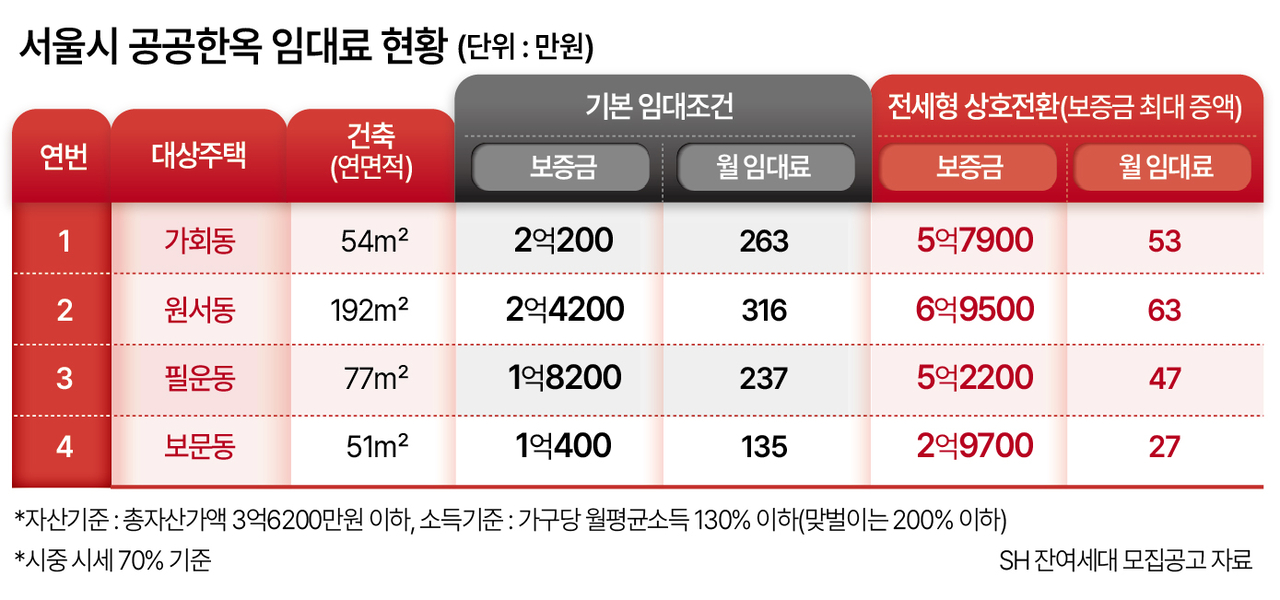
Industry observers point to two main barriers: the unique demands of hanok living and high rents. To qualify for the general housing Mirinaezip public hanok, applicants must hold total assets of no more than 362 million won ($269,000) and earn no more than 130 percent of the average monthly household income — or 200 percent for dual-income households. Yet depending on the unit, the apartment-type Mirinaezip can work out cheaper.
The Bomun-dong hanok (51 square meters), which drew the highest competition rate in the re-listing, is a three-bedroom, two-bathroom property with a courtyard. Its base rental terms require a deposit of 104 million won and monthly rent of 1.35 million won. By contrast, winners of apartment-type Mirinaezip units — the long-term jeonse housing category, open to households with assets up to 662 million won and monthly income up to 120 percent of the average, for units of 60 square meters or less — can secure cheaper housing: a 47-square-meter unit at Wangsimni mixed-use complex in Seongdong-gu carries a deposit of 262.08 million won, while a 43-square-meter unit at the Imun 3 mixed public complex in Dongdaemun-gu requires 295.62 million won.
Those seeking a 59-square-meter unit also have alternatives. Instead of the Gaehoe-dong hanok — which converts to a jeonse deposit of 579 million won or a monthly rent of 530,000 won — winners of units such as the Cheongye SK View in Seongdong-gu (537.42 million won) can live in an apartment at lower cost with no monthly rent burden.
SH attributes the structurally high rents to the hanok's single-family format and its prime locations in central districts such as Jongno-gu, where market prices are inherently elevated. "We are taking seriously the concerns raised in the field," an SH official said. "Depending on the final contract results from the re-listing, we plan to review rent adjustment measures and other improvements so that more people with genuine housing needs can benefit without financial strain."
To improve occupancy, SH and the Seoul Metropolitan Government introduced several measures for the re-listing: expanding the pool of document-screening candidates from six to 12 times the number of units, providing education on hanok living and seasonal facility management services, and offering shared storage space as a common facility.
Under administrative procedures, however, move-ins for re-listing winners are not expected until between December and February next year — meaning the units will inevitably remain vacant for more than six months compared with the originally planned move-in window of April to June.
An SH official said utility costs for the four corporation-owned vacant units run about 100,000 won per unit per quarter, making the financial burden minimal. "We will move quickly on institutional improvements to minimize prolonged vacancies and ensure the assets are used efficiently," the official said. The Seoul Metropolitan Government also plans to use the spaces for hanok-related events scheduled before the end of the year.
hope@heraldcorp.com