
Confirmation hearing for Supreme Court justice nominee
'Courts cannot stand without trust'
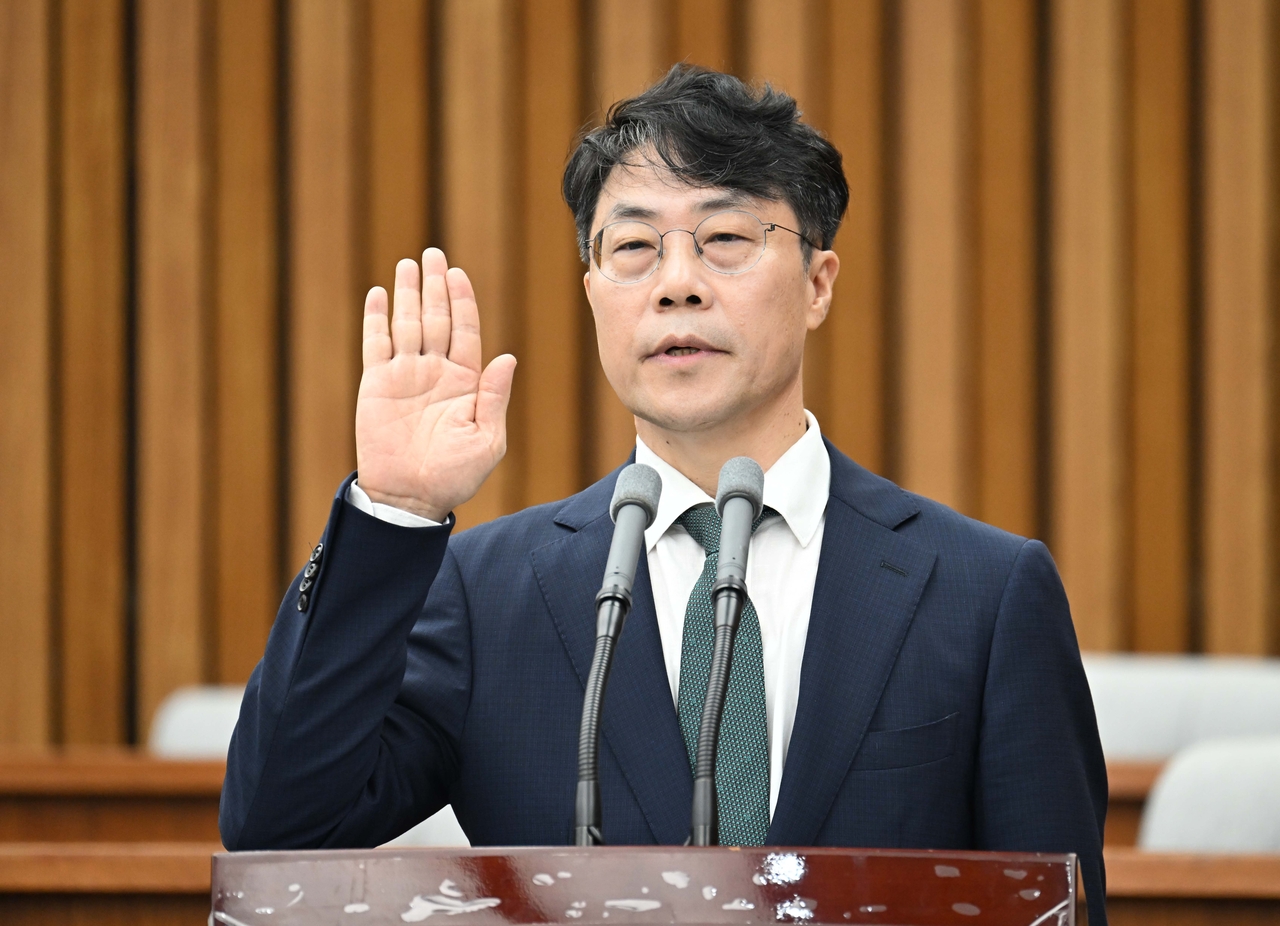
Supreme Court justice nominee Kim Sung-su said Monday that a judge linked to the new-drug lobbying allegations surrounding Ministry of Justice nominee Kim Seung-won could face "severe discipline" if the allegations prove true.
Kim made the remark at his National Assembly confirmation hearing Monday, after People Power Party lawmaker Ju Jin-woo raised the controversy surrounding Senior Judge Jeong In-jae's 2023 rejection of an arrest warrant for the founder of Genencell and asked what action Kim would have taken had he been the court's ethics inspector at the time.
Judge Jeong was photographed in 2022 alongside a broker identified only by the surname Yang, who is alleged to have facilitated the new-drug lobbying scheme, and Ministry of Justice nominee Kim Seung-won. The following year, while serving as a warrant judge at the Seoul Western District Court, Jeong rejected an arrest warrant for Kang, the founder of Genencell and a central figure in the allegations, drawing scrutiny.
It later emerged that Jeong's son had worked as a legislative aide in Kim Seung-won's Assembly office for three months.
Responding to Ju's question, Kim said he was not familiar with the full facts of the matter and that it would be difficult to comment further without them being confirmed. "That said, if what you have described is true, I believe severe discipline could be warranted," he added.
He went on to say that the phrase "musinbullip" — meaning "without trust, nothing can stand" — appears frequently in courthouses, and that it ultimately means a court cannot exist without public trust. "Every judge must be more careful and mindful of that," he said.
Kim also said he did not view calls from the political sphere for the Chief Justice to resign as appropriate.
Asked by PPP lawmaker Yun Yong-geun whether it was proper for politicians to pressure the Chief Justice to step down over the exercise of his constitutional authority, Kim said that while such criticism could be made under the principle of checks and balances in the realm of judicial administration, he personally found it difficult to regard it as appropriate as a member of the judiciary.
On proposals circulating in political circles to relocate the Supreme Court building outside Seoul, Kim said judicial accessibility could not be overlooked given that most of the population lives in the greater Seoul area. "It may be one of many factors to consider, but personally I find it difficult to say that relocation elsewhere would be the right course," he said.
He later corrected himself after hearing committee chair Kim Do-eup pointed out that it was inaccurate to say most people live in Seoul specifically. "I should have said the metropolitan area rather than Seoul," Kim said. "I apologize for the confusion caused by that imprecise wording."
When Democratic Party lawmaker Ju Cheol-hyeon said the amended Code of Criminal Procedure would increase the burden on courts, Kim said he had heard the former justice minister make a similar point, adding, "We also feel that the trial workload will not be easy to manage."
Asked whether he agreed that courts should apply the inquisitorial powers provided under the code — including the independent adoption of evidence, investigation and examination — far more actively than at present, Kim said he did. "Expanding the number of Supreme Court justices is necessary, but we have also been consistently requesting more personnel at the lower court level," he said. "We would appreciate your support on that."
hss@heraldcorp.com




