
Pay one month's premium, back-pay up to 119 months
Applications cluster near the legal maximum of 108-119 months
UK requires filing within 6 years, Japan within 10 — Korea has no limit
Calls grow to overhaul actual payment requirements and premium calculation rules
![A National Pension Service regional office [Yonhap]](https://wimg.heraldcorp.com/news/cms/2026/09/11/news-p.v1.20260828.76382d113612463ba3c1f2c0a5f993d8_P1.jpg)
The national pension's back-payment system, which allows subscribers to pay later for premiums they missed due to job loss or career breaks, is increasingly being used as a way to secure pension eligibility after the fact. A subscriber needs to pay only one month's premium before becoming eligible to back-pay up to 119 months at once, with no deadline for filing.
According to the National Pension Service and the National Assembly Research Service on Friday, the back-payment system lets subscribers pay, at a later date, for periods when they could not pay premiums because of job loss, business closure, or child care and caregiving, restoring those periods to their coverage record. It was designed to prevent gaps in coverage from denying pension eligibility or reducing pension payouts.
Under the current system, a subscriber with an eligible back-payment period can pay just one month's premium and then pay the remaining 119 months all at once, meeting the 10-year (120-month) coverage requirement needed to receive an old-age pension. Even people not subject to mandatory enrollment — such as stay-at-home spouses — can gain eligibility through voluntary enrollment and make back payments without ever having paid premiums separately.
Back-payment applications cluster in the 108-to-119-month range, close to the legal maximum. This suggests that demand is driven less by a need to fill partial coverage gaps than by a desire to restore nearly a decade of coverage all at once.
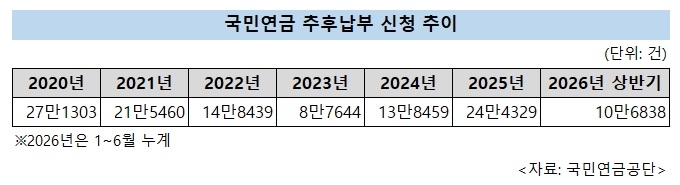
Total back-payment applications rose 2.8-fold in two years, climbing from 87,644 in 2023 to 138,459 in 2024 and 244,329 last year. Another 106,838 applications were filed between January and June this year.
When the back-payment system was first introduced, there was no cap on the recognized period. As cases grew of people paying 10 or even 20 years' worth of premiums in a single lump sum right before retirement, the National Assembly capped the maximum back-payment period at 119 months in December 2020. Applications fell in response, from 271,303 in 2020 to 87,644 in 2023, but began climbing again the following year.
Questions of fairness have also been raised between subscribers who paid premiums consistently over the long term and those who restore past coverage with a lump sum right before retirement. Diligent subscribers accept a reduction in disposable income from premium payments over 10 or 20 years, while back-payment applicants can check their expected pension amount first and then choose an advantageous moment to extend their coverage period.
Recent government measures have focused on curbing abuse of the system by foreign nationals. Back-payment applications from foreign nationals rose 17.4-fold, from 87 in 2016 to 1,517 last year. The number of foreign nationals who gained pension eligibility by using back payments to meet the 10-year coverage requirement grew 83.3-fold, from 27 in 2016 to 2,250 as of June this year.
The government is pushing to count only months in which a foreign national actually resided in Korea for at least 15 days as eligible for back payment, and to introduce a reciprocity principle — extending the option only to nationals of countries that allow Koreans to make similar back payments there. However, since Korean nationals can also gain eligibility through voluntary enrollment and make back payments over long periods, closing this loophole remains difficult.

Other countries restrict not only the reasons and length of back payments but also when applications can be filed. The UK allows back payments of up to six years but requires filing within six years of the period in question, while Japan limits back payments for premium exemption or deferral periods to within 10 years. France recognizes a combined maximum of 12 quarters for academic and incomplete coverage periods, and Germany requires back payments for academic periods to be filed before age 45. Korea, by contrast, has only a 119-month cap with no general filing deadline.
This has prompted calls to limit back payments mainly to circumstances subscribers cannot control — such as schooling, child care and caregiving, military service, and unemployment — and to require applications within a set period after those circumstances end. Experts also suggest allowing back payments for voluntary subscribers only after a certain period of actual premium payment, or setting the allowable back-payment period in proportion to the period during which premiums were actually paid.
The way premiums are calculated is also seen as needing reform. Back-payment premiums are determined based on the standard monthly income at the time of application. Because the amount owed can differ depending on enrollment type and standard monthly income at the time of filing — even for the same coverage period — applicants have room to choose the most advantageous timing. Standardizing the reference income figure, or factoring in both past and present income, has been proposed as a remedy.
However, uniformly narrowing the scope of recognized back payments could also weaken the system's role in securing retirement income for people who lost jobs or went through career breaks. As of April this year, 2.338 million people were exempted from local premium payments and 439,000 had been delinquent for 13 months or more, putting about 2.777 million people in the pension coverage blind spot.
fact0514@heraldcorp.com




