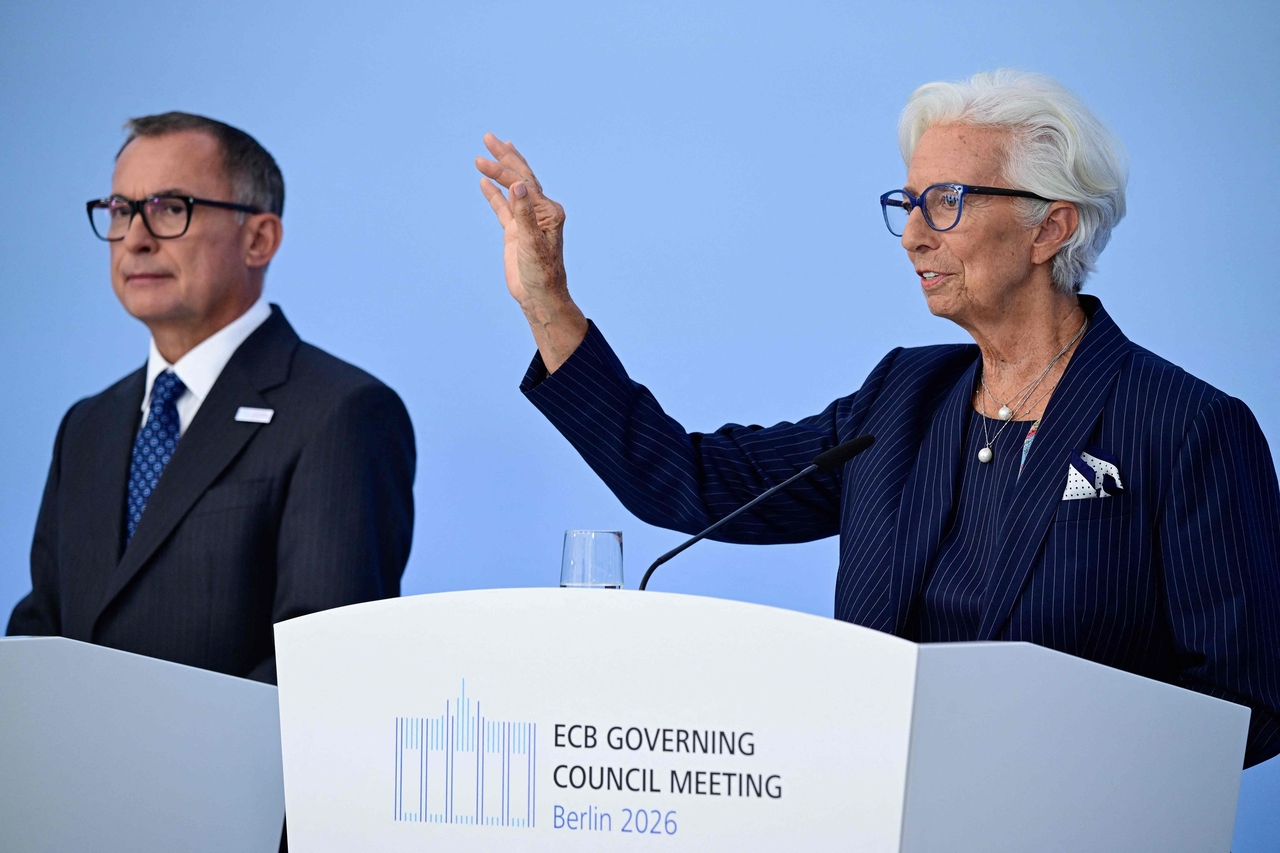
The European Central Bank on Thursday (local time) raised its three key interest rates by 0.25 percentage point each, citing the continuing rise in energy prices driven by the prolonged war and the resulting pass-through to broader inflation.
The ECB, meeting in Berlin that day, announced it would raise the deposit rate by 0.25 percentage point to 2.50 percent, and the benchmark interest rate — the main refinancing rate — and the marginal lending rate by the same margin, to 2.65 percent and 2.90 percent, respectively.
This marks the ECB's second rate hike since the Iran war broke out in late February. The central bank also raised rates in June, its first increase since September 2023. The new deposit rate of 2.50 percent is the highest since April 2025.
The decision matched market expectations. A Bloomberg survey found that market experts had also forecast a 0.25 percentage point hike at this meeting.
In a statement, the ECB said the conflict in the Middle East "continues to generate inflationary pressures, and inflation is expected to significantly exceed the target for a prolonged period." It added that "today's decision underscores our monetary policy effort to stabilize inflation at the 2 percent medium-term target." The new rates take effect Sept. 16.
The ECB also raised its eurozone growth forecasts, to 0.9 percent for this year and 1.4 percent for next year, up from June's projections of 0.8 percent and 1.2 percent. It kept its consumer price growth forecast for this year unchanged at 3.0 percent but raised next year's projection to 2.5 percent from an initial 2.3 percent. The bank struck a cautious tone, saying "the outlook remains highly uncertain, with upside risks to inflation and downside risks to growth."
With Thursday's hike, the gap between the ECB's deposit rate and South Korea's benchmark interest rate of 3.00 percent stood at 0.50 percentage point, while the gap with the US benchmark rate of 3.50 to 3.75 percent was 1.00 to 1.25 percentage points. The Federal Reserve will hold its Federal Open Market Committee meeting Monday and Tuesday (local time) to decide its own benchmark rate.
Energy prices surged because of the Iran war, pushing eurozone consumer price growth — across the 21 countries that use the euro — to 3.3 percent last month, the highest in three years. That marks the sixth consecutive month the rate has exceeded the ECB's 2 percent target. Global oil prices have continued to climb sharply since the war intensified again in July. Both Brent crude and West Texas Intermediate topped $100 per barrel on Thursday. European natural gas prices have also more than doubled from prewar levels, deepening inflation concerns across the eurozone.
ECB President Christine Lagarde told a news conference that "we believe inflation will persist longer than expected," adding that the decision to raise rates was unanimous and "a no-brainer." However, Lagarde declined to comment on the possibility of further hikes, saying, "We did not have any discussion about the path forward."
Financial markets expect one more rate hike by the end of this year and two additional increases next year.
Despite the June rate hike, bank lending did not slow in July — it actually increased. The eurozone economy has held up relatively well, with growth of 0.6 percent in the second quarter, giving the ECB room for further rate increases.
However, rising long-term bond yields and mounting debt have put considerable pressure on European fiscal conditions, a factor that could limit further hikes.
Francesco Pesole, an FX strategist at ING, told the Financial Times, "They (the ECB) explicitly said inflation would stay elevated for a prolonged period, which could be read as hawkish. At the same time, they see downside risks to growth, which dilutes the strength of that hawkish message."
As the ECB raised its benchmark rate and oil prices climbed further, selling pressure in the bond market intensified.
According to Reuters and Bloomberg, Germany's two-year government bond yield jumped as much as 0.12 percentage point from the previous session to 3.19 percent, its highest in nearly three years. The 10-year yield rose 0.05 percentage point to 3.49 percent, a new high since 2011.
French government bond yields also rose, widening the spread between German and French 10-year yields to as much as 0.91 percentage point during trading — the widest since the 2012 eurozone debt crisis. France is under fiscal strain from its massive public debt, among other factors. France's far-left camp has seized on the situation, even floating the extreme proposal that the central bank cancel the government debt it holds. Lagarde shrugged off the idea, saying it "makes no sense legally, technically or fiscally."
The UK's 10-year government bond yield rose 0.1 percentage point from the previous session to 5.36 percent, its highest since 2007. The 30-year yield climbed to 5.92 percent, the highest since 1998. Financial markets now see an increased likelihood that the Bank of England will raise its benchmark rate in November.
In equity markets, the pan-European STOXX 600 index fell 0.6 percent, while the euro weakened 0.1 percent against the dollar.
kate01@heraldcorp.com