- Event links Innopolis firms' technology and products with European cooperation demand, supports market entry
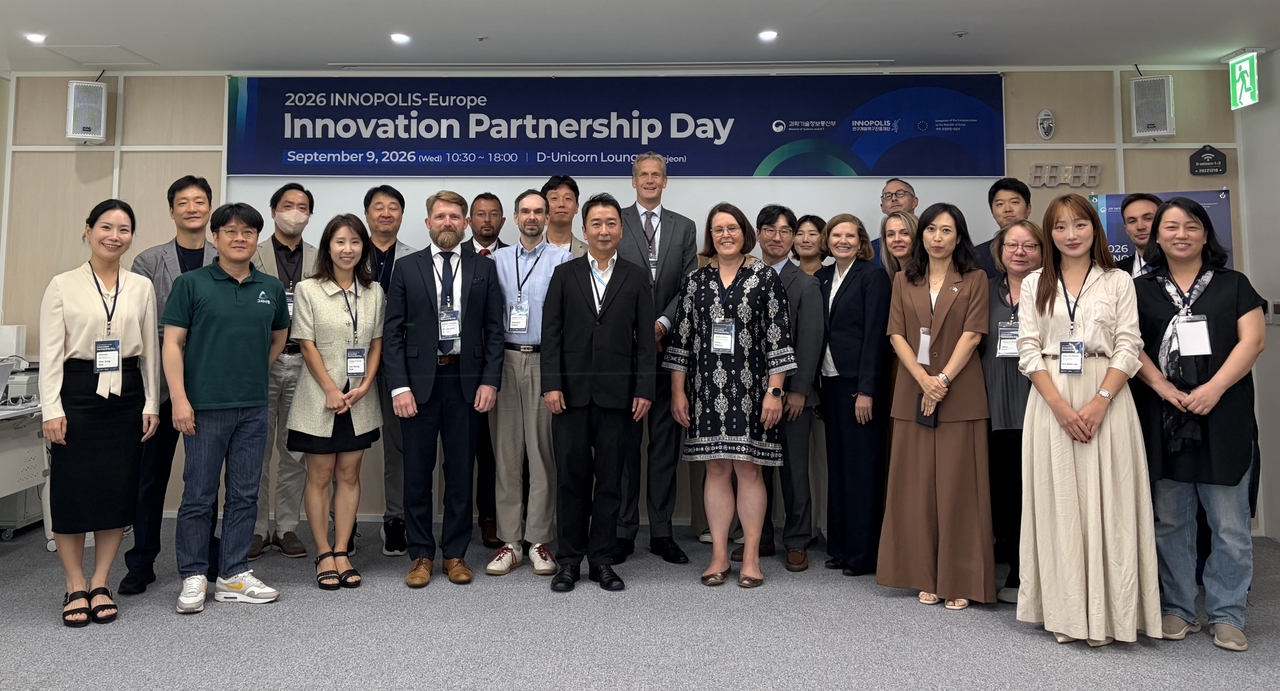
The Innopolis Foundation held the "2026 Innopolis-Europe Innovation Partnership Day" on Wednesday at the D-Unicorn Lounge in Daejeon's Science Complex, aiming to find European cooperation partners for South Korea's research and development special zones and to build a sustainable cooperation framework.
The event was designed to expand contact points between cooperation officials in the science, research and innovation fields from various European countries and Innopolis companies, and to lay the groundwork for Innopolis firms to find local partners and pursue follow-up cooperation.
About 40 people attended the event. They included the EU Delegation to Korea and science, research, innovation, higher education and technology cooperation officials from the embassies of 10 European countries, including France, Germany and Italy. Innopolis companies also took part.
European officials introduced their countries' industrial and technological cooperation needs, while Innopolis companies gave IR presentations showcasing technologies and products in fields such as energy storage, advanced materials, mobility, and environment and biotech.
Participants then visited three Daedeok Innopolis companies -- Standard Energy, Narma and Contec -- to observe their research and business operations firsthand and discuss potential cooperation.
Gwangju Innopolis company Greenerlab presented its tree environmental data management technology, built around an AI-based electronic tree history management system called TreeAiD and an internet-of-things environmental sensor called Sentinel.
Blue Magnet, a company based in the Ulsan Ulju Special Zone, unveiled a water treatment solution that uses magnetic Prussian blue material to remove and recover radioactive substances such as cesium.
Daedeok Innopolis company Standard Energy introduced ESS and large-capacity power storage technology based on vanadium ion batteries, while MCE presented technology and products that use mealworm-based bioconversion to break down waste styrofoam and convert it into organic fertilizer and protein materials.
Building on this exchange, the Innopolis Foundation plans to form a multinational council with officials from the participating countries to regularly share each country's cooperation needs and identify suitable local partners for Innopolis companies.
Through this, the foundation aims to flesh out follow-up cooperation tailored to each company's needs, ranging from technology exchange to joint research and development, demonstration projects and market entry.
Jung Hee-kwon, chairman of the Innopolis Foundation, said, "This event carries great significance in that officials from various fields across European countries and deep tech companies from Innopolis met directly to explore ways to cooperate." He added, "We will expand our overseas cooperation network so that the research and development special zones can grow into a global innovation hub connecting the world's research and industrial ecosystems, and we will support Innopolis's excellent technologies in creating new business opportunities in overseas markets."
Gwangju Innopolis company Greenerlab presented its tree environmental data management technology, built around an AI-based electronic tree history management system called TreeAiD and an internet-of-things environmental sensor called Sentinel.
Blue Magnet, a company based in the Ulsan Ulju Special Zone, unveiled a water treatment solution that uses magnetic Prussian blue material to remove and recover radioactive substances such as cesium.
Daedeok Innopolis company Standard Energy introduced ESS and large-capacity power storage technology based on vanadium ion batteries, while MCE presented technology and products that use mealworm-based bioconversion to break down waste styrofoam and convert it into organic fertilizer and protein materials.
nbgkoo@heraldcorp.com