Injection time cut from 4 hours to 5 minutes: the paradigm shift to subcutaneous formulations
As Halozyme's patents near expiry, Alteogen's protection through the 2040s stands out
Platform reach expands to next-generation ADC, AOC pipelines
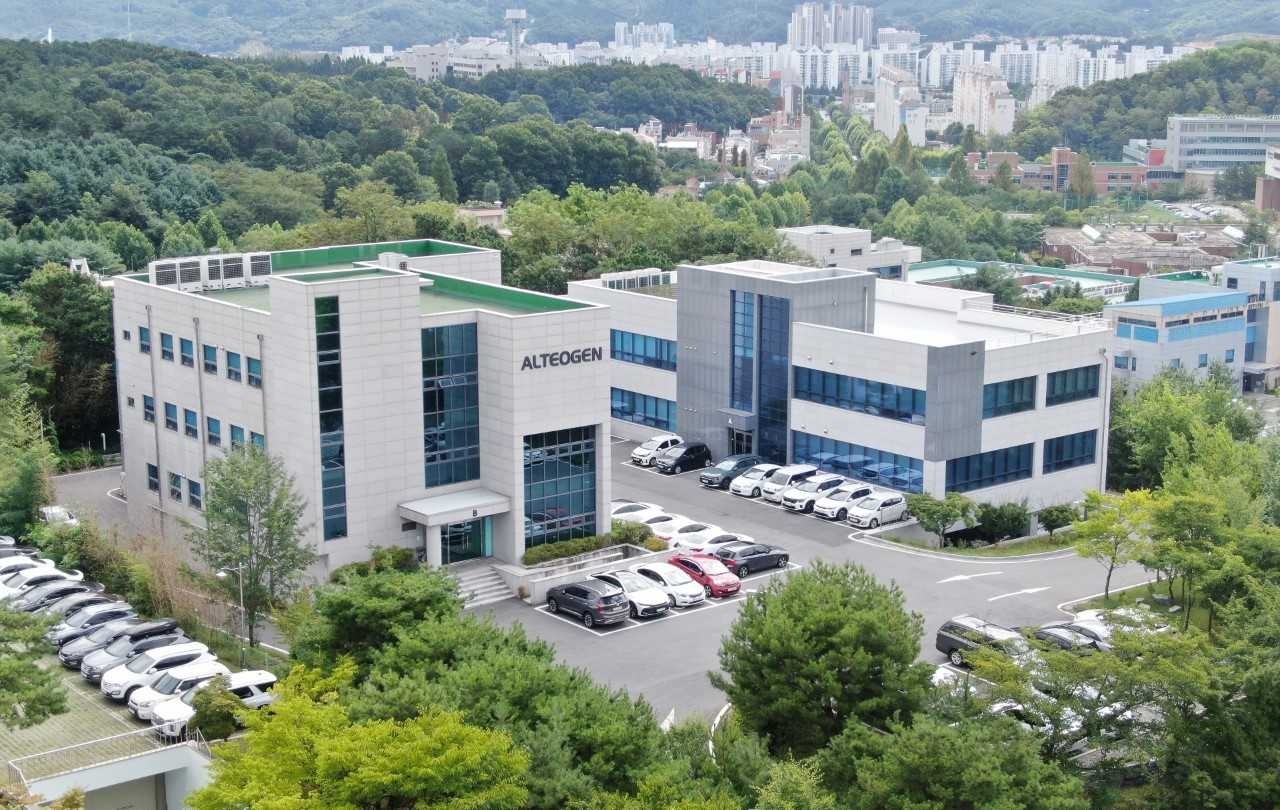
Alteogen, a biotech platform company, sealed a large technology export deal with global pharma giant Novartis worth up to 4.4 trillion won ($3.29 billion). The deal pushed its cumulative contract value this year past 6.2 trillion won. Industry observers said the deal reflects the explosive value of Alteogen's core platform. This growth is driven by the desperate need of global pharmaceutical companies to defend blockbuster drugs from patent expiration and by the growing versatility of next-generation treatment modalities.
Alteogen recently signed an option and license agreement with Novartis for the development and commercialization of ALT-B4 (ingredient name vorhyaluronidase alfa), a human recombinant hyaluronidase based on Alteogen's Hybrozyme technology. Under the agreement, Novartis secured multiple options for exclusive rights to use ALT-B4, which applies Alteogen's Hybrozyme technology, to develop and commercialize subcutaneous formulations of multiple biopharmaceutical products.
Under the terms, if all options are exercised and all development and commercialization milestones are fully achieved, Alteogen could receive up to $3.22 billion in total. Royalties tied to net sales after product launch will be calculated separately. Per the companies' agreement, details such as the specific target products remain undisclosed.
This deal has stamped Alteogen's platform scalability and continuity on the market. Alteogen began this year with a subcutaneous formulation deal for endometrial cancer treatment Jemperli with GSK's subsidiary Tesaro in January (about 420 billion won). It followed with a deal with Biogen in March for two subcutaneous formulation products, worth up to 867.5 billion won. Alteogen then signed an exclusive license agreement with an undisclosed company on Aug. 5, worth about 521.9 billion won. Adding the latest deal with Novartis, the total value of Alteogen's technology transfer agreements this year has reached 6.23 trillion won. This marks the 10th technology transfer based on the Hybrozyme platform alone.
The biggest reason global pharma giants are drawn to Alteogen's technology is that switching from IV to subcutaneous formulations is transforming the paradigm for both patients and medical settings. Conventional IV formulations require patients to lie in a hospital bed with a needle inserted into a vein. Treatment can take from one to two hours, or as long as four to five hours. Subcutaneous formulations, by contrast, temporarily break down hyaluronic acid in subcutaneous tissue, allowing high doses of medication to be administered in just two to five minutes. This not only helps patients return to daily life sooner and reduces vascular damage, but also maximizes hospital bed turnover. It also significantly cuts social medical costs tied to hospitalization and treatment. Another advantage is the potential for future expansion into self-administration and at-home treatment.
The strategic calculus of "patent evergreening" is particularly decisive for global pharma giants. Typically, when a blockbuster drug's substance patent expires, biosimilar competition drives prices down sharply. But converting an existing intravenous formulation into a subcutaneous one can extend market exclusivity by more than a decade through new formulation and method-of-use patents. While the core substance patent of US-based competitor Halozyme is set to expire between 2027 and 2029, Alteogen's ALT-B4 will retain patent protection until the early 2040s. This has made Alteogen an irreplaceable alternative for pharma giants that need to block biosimilar entry over the long term.
In addition, the scope of Alteogen's platform, once concentrated on monoclonal antibodies, is expanding to next-generation treatments. Novartis's pipeline, which it plans to seek approval for within three years, includes treatments for muscular dystrophy, myelofibrosis, atrial fibrillation, radioligand therapy for prostate cancer, and CAR-T cell therapy. Market observers say Alteogen's Hybrozyme platform is expanding its reach for formulation conversion beyond antibodies to various modalities held by Novartis, including antibody-drug conjugates (ADCs) and antibody-oligonucleotide conjugates (AOCs).
An industry official said, "As Halozyme's patent expiration draws closer, Alteogen's negotiating power with a platform that can guarantee exclusivity through the 2040s will only strengthen." The official added, "As the scope for applying subcutaneous technology expands beyond simple antibody formulation changes to next-generation modalities such as ADCs and gene therapies, global pharma giants will keep seeking partnerships with Alteogen."
Such continuous platform exports are expected to fundamentally transform Alteogen's earnings profile. According to Hana Securities' estimated financial statements, Alteogen's sales are projected to jump from 102.9 billion won in 2024 to 580.7 billion won in 2026. Sales are then expected to reach 1.01 trillion won in 2028, joining the "1 trillion won sales club." Operating profit is also expected to surge from 25.4 billion won in 2024 to 368.2 billion won in 2026 and 678.6 billion won in 2028. The company is projected to maintain high profitability, with an operating margin in the mid-to-high 60 percent range — 63.41 percent in 2026 and 67.31 percent in 2028. This reflects the high-margin structure typical of platform technology transfers.
Alteogen plans to continue expanding its Hybrozyme partnerships by strengthening discussions with both existing material transfer agreement partners and new global pharmaceutical companies.
silverpaper@heraldcorp.com