As the effort to conquer cancer continues, scientists are working to incorporate cutting-edge nanotechnology into immunotherapy drugs.
The most advanced cancer treatment approach to date is immunotherapy, credited with having "changed the paradigm of cancer treatment." The 2018 Nobel Prize in Physiology or Medicine was awarded to two scientists who opened a revolutionary path for treating cancer, humanity's long-standing challenge. James P. Allison of the United States and Tasuku Honjo of Japan each identified proteins that regulate immune suppression signals and used that knowledge to develop new treatments enabling the immune system to attack cancer cells effectively. Their research gave rise to a new paradigm — immunotherapy drugs that activate the body's own immune system to fight cancer directly, on top of conventional treatments centered on surgery, radiation and chemotherapy.
Allison focused on the fact that the immune system's failure to attack cancer cells stemmed from suppressive signals in T cells. He discovered that CTLA-4, a protein on the surface of T cells, acts as a brake that suppresses T cell activity. While this protein had previously been regarded simply as a mechanism for regulating immune responses, Allison proved through experiments that blocking it could allow the immune system to attack cancer cells forcefully once again. His research led to the development of CTLA-4 inhibitor antibody treatments, which in practice significantly improved survival rates among patients with advanced melanoma.
Meanwhile, Japan's Honjo discovered another immune-suppressing molecule, programmed cell death protein 1, or PD-1. PD-1 functions as a "safety switch" that prevents T cells from becoming overactive, but cancer cells exploit this mechanism to evade T cell attacks. Honjo found that blocking PD-1 signaling strips cancer cells of this hidden shield, allowing the immune system to eliminate cancer effectively. This discovery led to the development of a new class of immunotherapy drugs: PD-1 inhibitors and PD-L1 inhibitors.
These discoveries ushered in a new era in cancer treatment. The immunotherapy drugs developed from this research gave new hope to advanced-stage cancer patients for whom conventional treatments had shown little effect, delivering particularly strong results in melanoma, lung cancer and kidney cancer. Follow-up research continues.
Medical scientists' efforts press on. A recent review has systematically organized nanotechnology strategies designed to deliver drugs precisely to tumor sites, reducing the side effects of immunotherapy while increasing its effectiveness. The review proposes a nanotechnology-based, next-generation path for overcoming the limitations of existing immunotherapy drugs — namely, low treatment response rates and systemic toxicity.
A team led by Professor Baek Sun-ha of the Department of Neurosurgery at Seoul National University Hospital, together with Dr. Cho Eon-taek, joined forces with professors Ingo G. H. Schmidt-Wolf and Amit Sharma of University Hospital Bonn in Germany and Dr. Jingjing Pu of Renji Hospital, Shanghai Jiao Tong University, in China. The team reviewed the latest nanotechnology-based immunotherapy research and clinical trends and proposed a multi-combination treatment platform in a review paper recently published in the international journal Molecular Cancer (impact factor 42.2).
Immunotherapy reawakens the body's weakened immune cells to attack cancer cells directly. Immune checkpoint inhibitors, which block the suppressive signals cancer cells send out so that immune cells keep functioning, have proven effective against cancers with high rates of genetic mutation, such as melanoma. CAR-T cell therapy inserts a gene that recognizes cancer cells into a patient's own T cells before reinjecting them; it has shown particularly clear results against blood cancers such as leukemia and has transformed the treatment paradigm over the past two decades.
However, these treatments do not work for every patient. In many solid tumors, immune cells struggle to penetrate the tumor itself, limiting effectiveness, and because the treatments stimulate the immune system throughout the body, systemic side effects such as colitis and pneumonia can occur. The research team turned to nanotechnology as a solution, since nanoparticles' size and surface properties can be finely tuned to deliver treatments precisely to tumor sites and control the timing of drug release.
The team organized the current state of nanotechnology applications across six core areas of cancer immunotherapy — immune checkpoint inhibitors, cancer vaccines, CAR-T cell therapy, CIK cell therapy, cytokine therapy and complement therapy — and proposed combination strategies that merge multiple treatment mechanisms.
In the field of personalized mRNA cancer vaccines, the review highlighted how lipid nanoparticles can efficiently deliver mRNA carrying information about neoantigens — antigens specific to an individual patient's cancer cells — to elicit a powerful T cell immune response. For CAR-T cell therapy, the team introduced technology that delivers the CAR gene directly to T cells inside the body via nanoparticles, generating CAR-T cells in vivo rather than through the conventional method of culturing and engineering cells outside the body. If commercialized, this approach could significantly cut manufacturing costs and time, improving access to treatment.
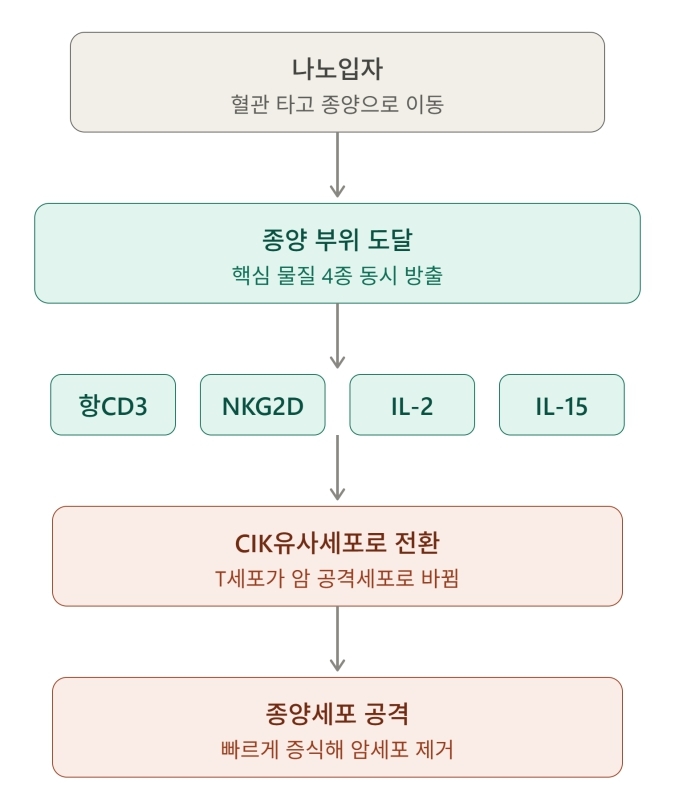
The team also proposed a new conceptual nanoparticle strategy in the review to overcome the limitations of CIK (cytokine-induced killer) cell therapy. CIK cells combine characteristics of both T cells and NK cells, allowing them to attack a wide range of cancer cells with relatively high safety. Because they are cultured outside the body and then reinjected, however, their ability to migrate to tumors and persist in the body is limited.
The team proposed loading four immune cell-stimulating substances — an anti-CD3 antibody, an NKG2D ligand, IL-2 and IL-15 — into a single nanoparticle for delivery. Under this strategy, the nanoparticle accumulates at the tumor site through the tumor's abnormal vascular structure, known as the enhanced permeability and retention effect, then releases the stimulating substances simultaneously, inducing T cells within the tumor microenvironment to take on CIK-like properties. This approach shows the potential to trigger a precise immune response inside the body without complex external culturing, though clinical applicability remains to be verified through further research.
The team also proposed two combination strategies that merge different treatment mechanisms into a single nanoparticle. One combines a tumor antigen — a marker substance that identifies cancer cells — with an immune checkpoint inhibitor antibody in a single nanoparticle. Its outer shell spontaneously breaks down in the tumor's acidic environment (pH 6.5 to 6.8), releasing both substances at once to activate T cells while blocking suppressive signals.
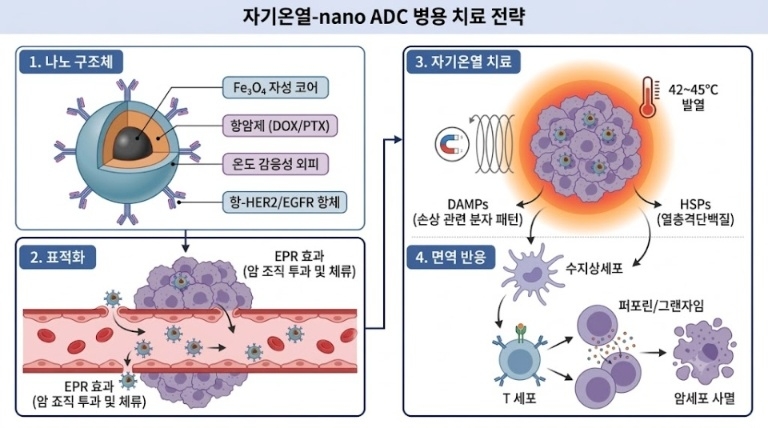
The other strategy combines magnetic iron oxide particles with anticancer drugs (doxorubicin and paclitaxel) and a tumor-targeting antibody in a single nanoparticle. Applying an external alternating magnetic field generates localized heat (42 to 45 degrees Celsius) at the tumor site, triggering drug release. Signaling molecules generated by the heat stimulus — DAMPs and HSPs — simultaneously induce an immune response, in a combined mechanism.
The team also outlined other future directions, including AI-based nanoparticle design, nanoparticles capable of crossing the blood-brain barrier, and combinations with CRISPR gene-editing and microbiome-modulation technologies. It also flagged challenges that must be resolved for clinical translation, including standardizing mass production and establishing safety evaluation frameworks.
"Nanotechnology is an innovative platform that can improve delivery precision in cancer immunotherapy and reduce side effects, and it will develop into a core technology for realizing personalized precision medicine," said Professor Baek Sun-ha of the Department of Neurosurgery at Seoul National University Hospital. "We hope this review will serve as a practical reference for developing next-generation cancer immunotherapy drugs and applying them clinically."

kty@heraldcorp.com