- Daejeon-Chicago international backbone expands from 100 to 400 Gbps, quadrupling transfer capacity
- Ultra-large research data in AI, astronomy, space and biotech to see faster global access
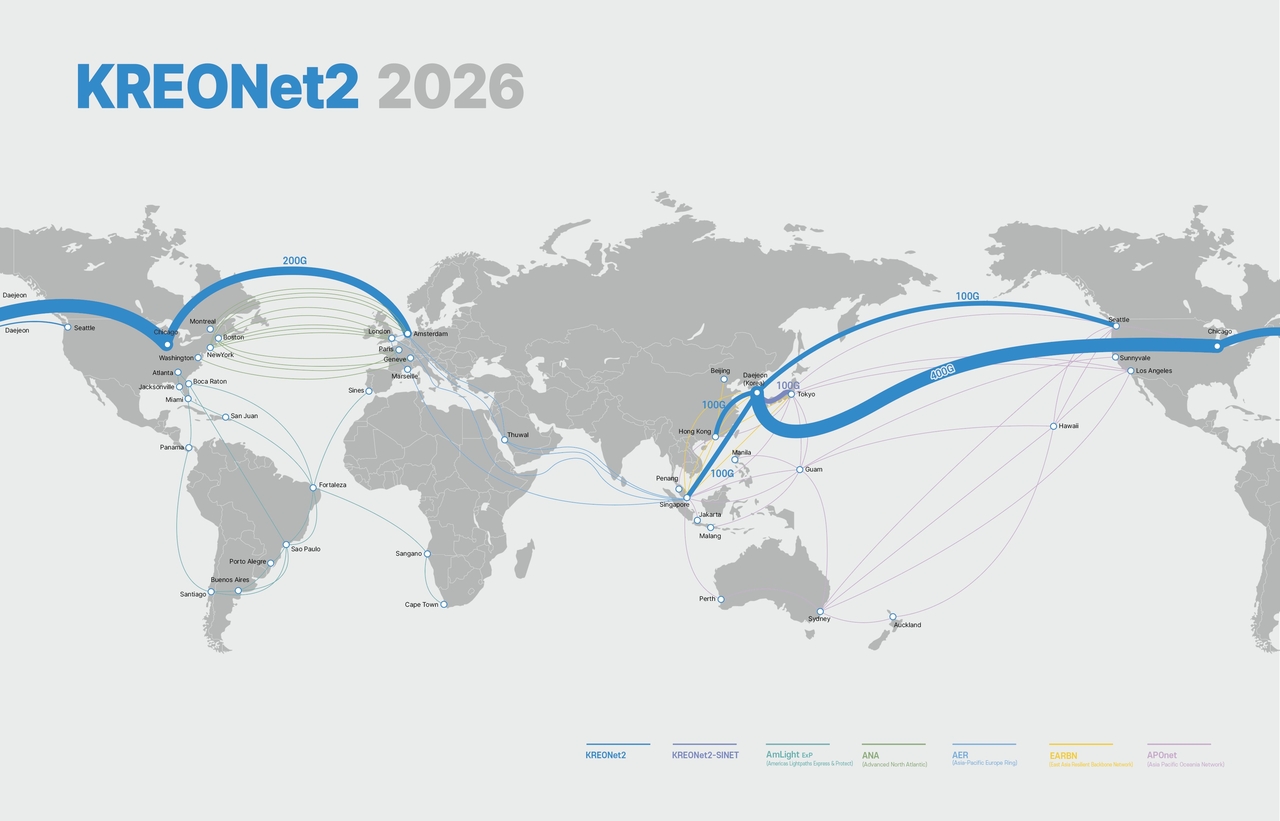
An ultra-high-speed international research network capable of transferring up to 100 terabytes of ultra-large research data from Korea to the United States in just 33 minutes has been built.
The Korea Institute of Science and Technology Information (KISTI) said Thursday that it has expanded the Daejeon-Chicago international backbone of the National Research Network, known as KREONET, fourfold, from 100 Gbps to 400 Gbps.
The new international line is the first single-wavelength 400 Gbps international circuit built in South Korea, across both private telecom carriers and the public sector. Spanning more than 10,000 kilometers across the Pacific, the link secured stable single 400 Gbps transmission quality, with its performance verified under actual research traffic conditions.
The theoretical maximum transfer capacity of the international line has quadrupled, from 12.5 gigabytes per second to 50 gigabytes per second. Transferring 100 terabytes of data, which previously took about two hours and 13 minutes under the 100 Gbps system, now takes about 33 minutes under 400 Gbps.
The upgrade will be particularly useful for research fields that handle data sets ranging from tens of terabytes to petabytes. These include AI training data, astronomy and space science, high-energy physics, and biotech. It will allow Korean researchers to access overseas supercomputers, large-scale research facilities and AI resources more quickly and reliably.
KISTI built the international backbone on an international optical circuit that includes a Korea-US submarine cable segment provided by KT Corp.
KREONET is a national research network built on 18 regional network centers across the country, capable of transmitting up to 1.2 Tbps. Through its international research network, it is connected to about 30,000 research networks worldwide.
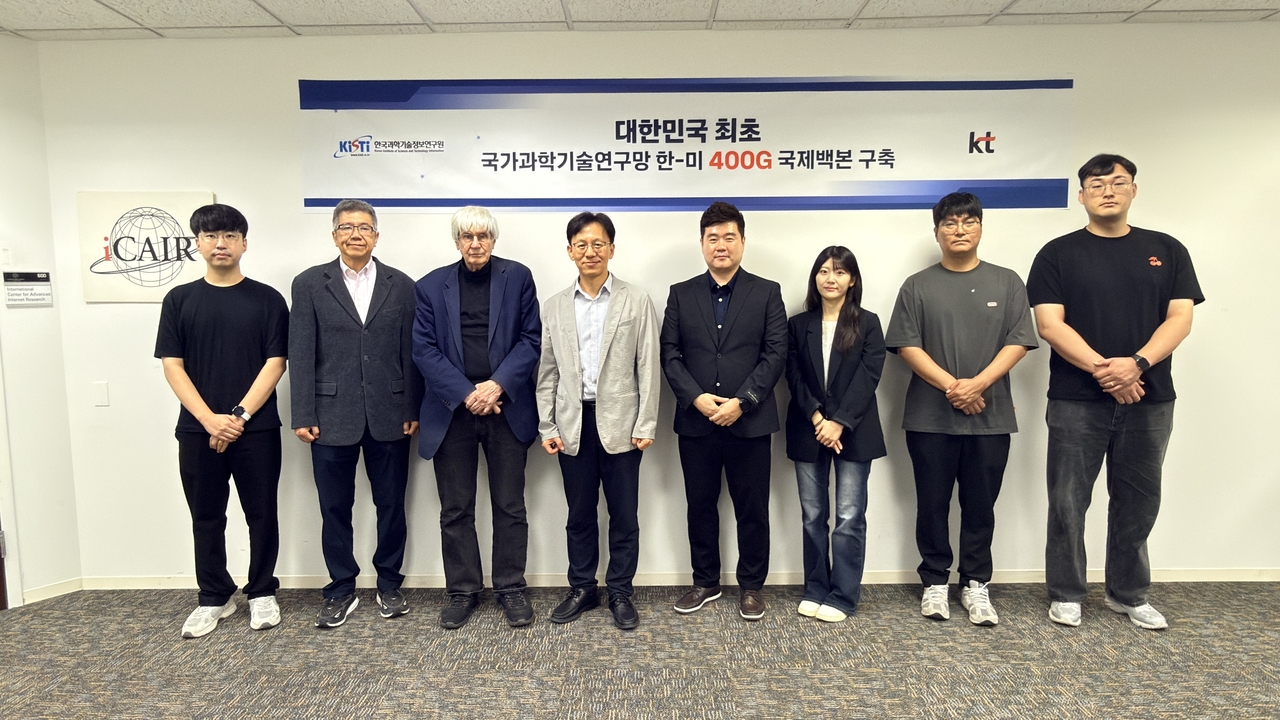
On Tuesday (local time), KISTI visited StarLight, an international research network interconnection hub operated by the International Center for Advanced Internet Research at Northwestern University in the United States, to establish the international backbone. StarLight is a key hub connecting major research networks and advanced research infrastructure across North America and the rest of the world.
Global research networks are also rapidly advancing to the 400 Gbps tier. On the North America-Europe route, major US and European research networks are building single 400 Gbps systems. On the Asia-North America route, Japan's National Institute of Informatics has upgraded to a single 400 Gbps system. With this latest expansion, Korea has secured international research network infrastructure on par with the best in the Asia-Pacific region.
KISTI plans to extend its 400 Gbps international backbone to Europe as well, to keep pace with the growing volume of large-scale research data expected from major projects. These include CERN's High-Luminosity Large Hadron Collider, the International Thermonuclear Experimental Reactor and the Square Kilometre Array radio telescope.
"This international circuit build-out goes beyond simply scaling up network capacity -- it represents an upgrade of the country's research infrastructure to a world-class level," said Jo Bu-seung, director of KISTI's Science and Technology Research Network Center. "Since research networks are core infrastructure for the future, essential to securing AI sovereignty and data sovereignty, we will continue to upgrade the Korea-Europe route going forward."
nbgkoo@heraldcorp.com