- ETRI develops 'zero-data generation AI' for making games
- 16 puzzle games launched worldwide, technology transferred to Mgame

"AI can build a game in place of a person, then play it directly to find bugs and even gauge how fun it is."
The Electronics and Telecommunications Research Institute (ETRI) said Thursday it has developed an AI-based platform that automates game production and quality verification to support small, midsize and indie game companies.
Building game content such as maps and items, along with the repeated quality assurance work required before launch, demands significant manpower and cost. Unlike large game companies with dedicated development and QA teams, small, midsize and indie studios often struggle to secure enough staff and testing infrastructure.
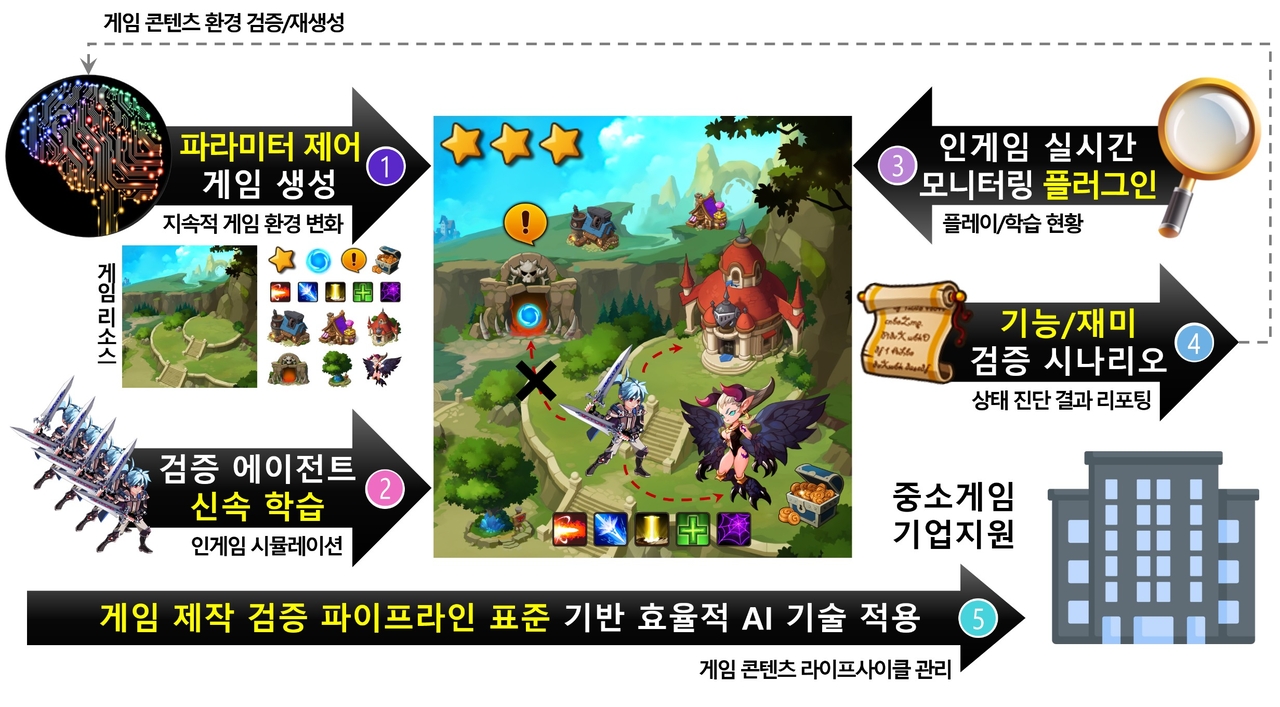
To address this, ETRI developed a "production AI engine" that automatically creates game content and a "verification AI engine" that automatically inspects finished games.
At the core of the system is what ETRI calls "zero-data content generation technology." Rather than training on data sets of human-made correct answers, the AI generates game maps on its own through trial and error. Using reinforcement learning-based procedural content generation (PCGRL), it produces content tailored to various conditions, including maze path length, the number and placement of enemies, item composition and map size.
According to the researchers, this approach cuts the cost of building large-scale training data while also easing copyright concerns tied to using existing content.
AI also handles verification. Multiple AI agents, each specialized in tasks such as exploration, combat or mission completion, play the game like real users to uncover errors that surface under a range of conditions.
In particular, an "Auto QA" function powered by a large language model detects irregular errors that are difficult to catch through standard test items alone. A separate "Fun QA" technology analyzes gameplay data to quantitatively predict how much fun users will experience before launch. This means AI is used not just to catch bugs, but also to gauge a game's commercial potential.
The platform is linked with the commercial game engine Unity, allowing it to be used in actual game production workflows.
The technology has already moved into industry use. Sublevel Games launched 16 puzzle games built with the technology in global markets. Mgame received a technology transfer and is applying it to a spinoff of Yeolhyeolgangho and its new title, NUMI HUNTERS. Goblin Games also released Mech Forge, built using the technology, on the Apple App Store.

ETRI is also providing free technology transfers and QA process support to small game companies that lack the resources to build their own AI infrastructure.
The project is the result of collaboration among industry, academia and research institutions, led by ETRI. ETRI oversaw the overall research and development, handling the creation of the production AI engine that automatically generates game content and the verification AI engine that automatically inspects games. Korea University developed multi-agent technology in which several AI systems divide roles to find game errors. Hongik University developed the Auto QA technology that automatically checks game quality and the Fun QA technology that predicts a game's fun factor numerically. Mgame took part in developing technology that analyzes problems arising during actual game service operations and recommends response scenarios.
"It is meaningful that we secured the core AI technology needed for game production and verification and made it accessible to small, midsize and indie game companies," said Jang Si-hwan, a senior researcher at ETRI. "We will advance our zero-data-based content generation and automated verification technologies to actively support Korean game companies' expansion into global markets."
nbgkoo@heraldcorp.com