Mega-cluster's high-earning managers, R&D staff eyed for 52-hour exemption
72,708 Samsung Electronics employees, 28,469 SK hynix employees affected
Actual scope hinges on job requirements; bonuses could expand exempted pool
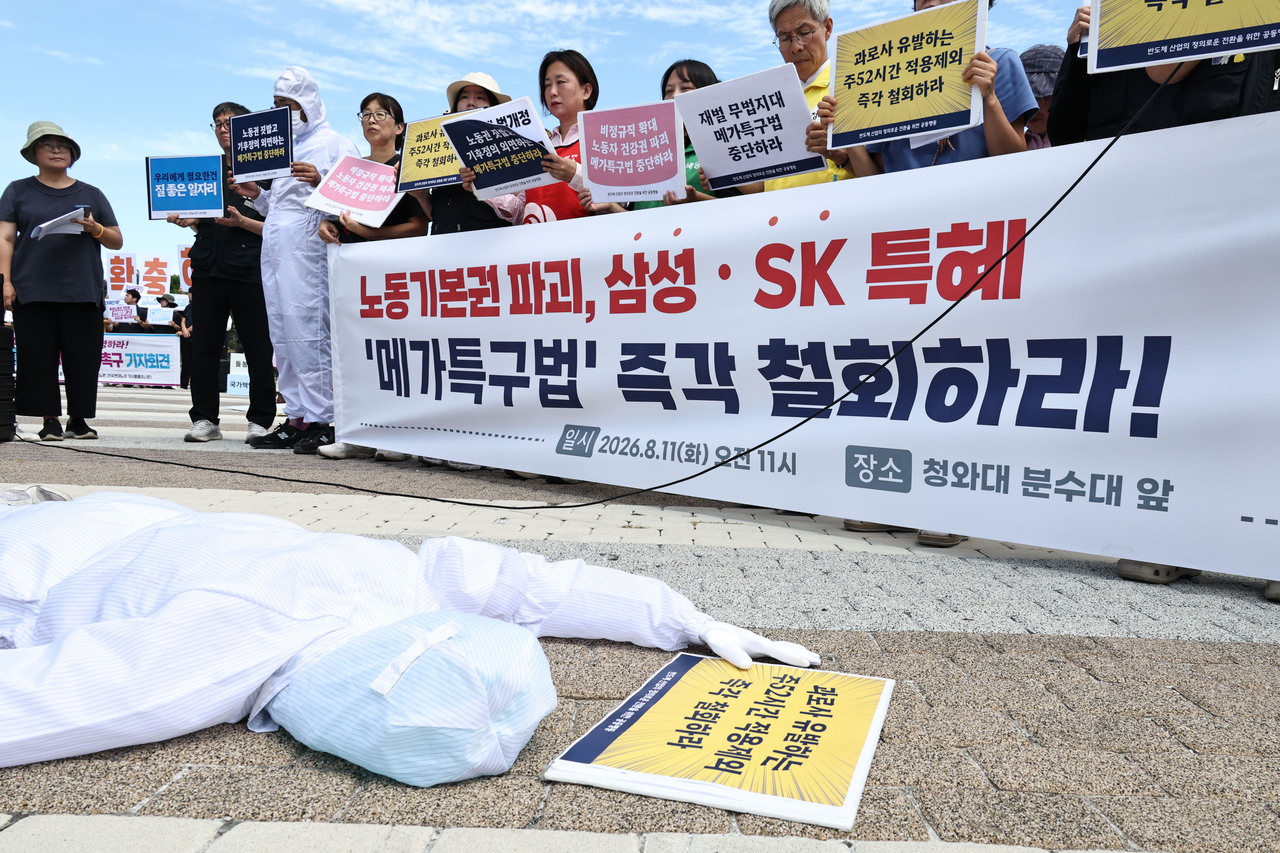
The government is considering exempting high-earning managers and researchers at chipmakers based in mega-clusters from the 52-hour workweek cap. Under an income threshold set at the top 3 percent of earned income, 56 percent of Samsung Electronics employees and 82 percent of SK hynix employees would qualify, data showed.
The actual scope of the exemption would depend on job requirements in addition to salary level. But given the high wages and bonuses at chipmakers, it could end up covering more workers than expected, observers say.
Rep. Lee Yong-woo of the Democratic Party of Korea, a member of the National Assembly's Climate, Energy, Environment and Labor Committee, released the data Thursday. The Korea Workers' Compensation and Welfare Service had submitted it to him. The data showed that 72,708 of Samsung Electronics' 128,848 employees had annual pay of 130 million won ($96,900) or more as of 2025 — 56.4 percent of the total.

At SK hynix, the ratio was even higher. Of the company's 34,569 employees, 28,469, or 82.4 percent, earned 130 million won or more annually.
Annual pay refers to earned income under the Income Tax Act minus tax-exempt earned income, and it serves as the basis for calculating employment insurance premiums.
The government and the ruling party held a policy consultation meeting Friday. They agreed to consider allowing exemptions from the 52-hour workweek cap for high-earning managers and R&D staff at companies based in mega-clusters. The income threshold is expected to be set somewhere between the top 3 percent and 7 percent of earned income nationwide.
No specific threshold was finalized at the meeting. But the Ministry of Employment and Labor's survey on employment types found that the top 3 percent of earned income last year was about 130 million won.
However, exceeding the salary threshold alone would not automatically exempt a worker from the 52-hour cap. The government is considering limiting the exemption to managerial and R&D positions at mega-cluster companies.
The question is how broadly those job categories will be defined.
The Ministry of Employment and Labor's current guidelines on special extended-hours approvals for semiconductor research and development allow semiconductor researchers to be exempted from standard working-hour limits. In unavoidable cases, research-support staff and production workers can also be included among those exempted. That is why observers warn that broadly defining the scope of managers and R&D staff could expand the number of workers actually affected.
If large performance bonuses are paid out this year amid an improving chip market, more employees could see their annual pay exceed the income threshold.
Contract workers also earned high pay. Last year, the average annual pay for Samsung Electronics' 836 contract workers was 198.18 million won — 48.13 million won more than the 150.05 million won average for regular employees. At SK hynix, the average annual pay for 178 contract workers was 145.97 million won, compared with 176.26 million won for regular employees.
Some in the business community argue that the maximum period for fixed-term workers should be extended from the current two years to four years to help build skills. But analysts note that at workplaces like Samsung Electronics, where contract workers' average pay exceeds that of regular employees, extending the contract period would not necessarily ease companies' cost burdens.
"We should not discuss this in the abstract without empirically examining what effect exemptions from the 52-hour cap and an extended fixed-term contract period would actually have in the field," Rep. Lee said. "I will call for a fundamental reexamination of the actual scope of application and the necessity of this system at the upcoming national audit."
fact0514@heraldcorp.com