
- Ministry of Science and ICT signs MOU on AI, semiconductor, quantum cooperation
- Joint research, startup projects to advance quantum computing, drug development
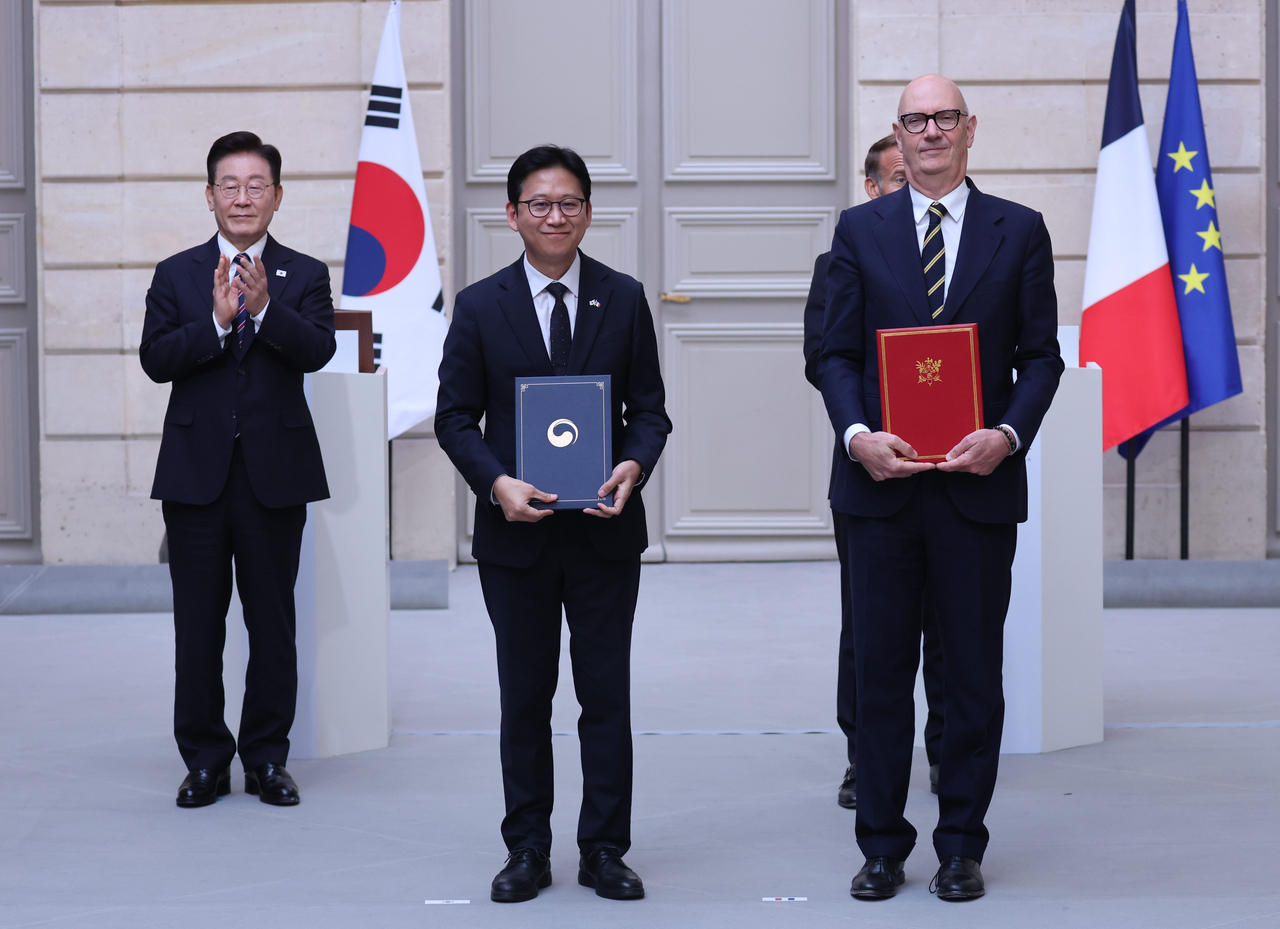
South Korea and France are strengthening cooperation in future strategic technologies, including artificial intelligence, semiconductors and quantum technology.
During President Lee Jae Myung's state visit to France, South Korea's Ministry of Science and ICT signed a memorandum of understanding in Paris on Tuesday (local time) to strengthen cooperation in AI, semiconductors and quantum technology, the ministry said.
Under the agreement, the two countries will hold regular meetings on AI and quantum technology. They also plan to cooperate on joint research between scientists, identify promising startup projects and attract investment to help each other enter each other's markets. The aim is to move beyond one-off exchanges and build a framework for sustained technology cooperation.
Bae, who also serves as deputy prime minister, met with France's minister of higher education, research and space on Wednesday to discuss expanding cooperation in AI and science and technology. The two countries agreed to strengthen ties between universities and research institutions and expand joint R&D and personnel exchanges.
In advanced biotechnology, the Korea Research Institute of Bioscience and Biotechnology will build a joint research framework with France's National Institute of Applied Sciences of Toulouse covering life science and biotechnology. It will also work with the Institute of Plant Sciences Paris-Saclay to develop next-generation crop technology using AI to address climate change.
The two countries will also pursue cooperation applying quantum technology to biotech research. The bioscience institute will conduct joint research with Quandela, a French photonics-based quantum computing company, on next-generation drug development using quantum computing.
Talent exchanges between universities will also expand. K-STAR, an alliance of science and technology-focused universities made up of KAIST, DGIST, GIST, UNIST and POSTECH, signed an MOU with Paris-Saclay University. The two sides plan to send graduate students for lab internships, support young researchers and hold joint networking events.
The Korea Institute for Advanced Study also agreed to cooperate with Paris-Saclay University on joint research in basic sciences such as mathematics and physics, as well as quantum technology and AI, and to run a student researcher program.
"The two countries have firmly established themselves as a genuine 'science and technology-digital alliance' in future strategic technology fields such as AI, quantum and advanced biotechnology," Bae said. "We will ensure this leads to tangible outcomes in joint R&D and talent exchange."
nbgkoo@heraldcorp.com




