Officer identifies fine-evading fugitive during drunk driving checkpoint
Suspect flees after officer removes handcuffs over complaint of nausea at substation
Officer chases alone, delays report of escape by 46 minutes
Disciplinary panel issues reprimand; officer sues, calling penalty unfair
Court: 'Delayed report meant to cover up lapse, discipline was justified'
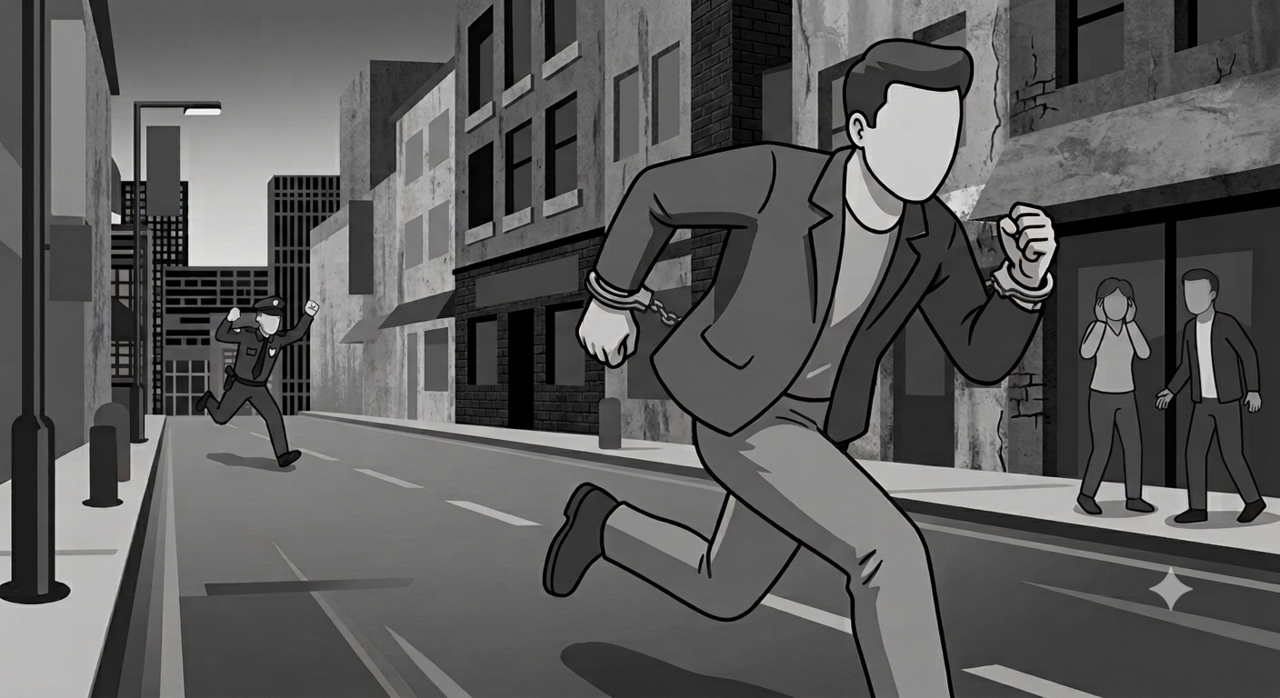
A court has ruled that a reprimand against a police officer was justified. He removed the handcuffs of a suspect wanted for unpaid fines and allowed him to escape. He then delayed reporting the incident by 46 minutes under the pretext of chasing the fugitive himself.
The officer filed a lawsuit challenging the discipline, arguing that the report was delayed only because he was pursuing the suspect who had fled. The court rejected his claim, saying the delay appeared aimed at covering up his own negligence in letting the suspect escape.
According to legal officials, the Daegu District Court's second administrative division, presided over by Chief Judge Ju Kyung-tae, ruled against the officer, identified as A, on Aug. 20. The ruling came in his lawsuit seeking to cancel the reprimand. The court also ordered A to bear the cost of the litigation.
According to facts established by the court, A confirmed in February last year that a suspect arrested for drunk driving was on a wanted list for failing to pay a fine. He arrested the suspect and brought him to a police substation.
The suspect then abruptly complained of nausea. A removed both handcuffs and took the suspect outside the substation, where the suspect slipped away amid lax supervision. The investigation found that A had neglected his duty to thoroughly manage the suspect through measures such as using handcuffs and securing entryways to prevent an escape.
Although A was obligated to immediately report the suspect's escape to the situation room, he did not do so until 46 minutes had passed. A chased the suspect alone during that time but ultimately lost him.
The disciplinary committee decided in June last year to issue A a reprimand, the lightest form of discipline, which amounts to a formal caution. Even so, it is recorded in an officer's personnel file and can restrict promotions and pay raises.
A appealed the reprimand to the Civil Service Appeals Commission, but the appeal was denied. He then filed a lawsuit with the court in February.
During the trial, A's side argued that his lax management of the suspect should not be considered dereliction of duty. He also argued that the delayed report was solely a result of chasing the fleeing suspect, not an intentional delay, and therefore should not be classified as dereliction of duty.
The court did not accept A's arguments.
The bench said, "As a police officer, A is held to a higher standard of morality, fairness and legal compliance than an ordinary worker." It added that he had a duty to faithfully carry out his responsibilities in accordance with work manuals.
The court then found that "despite this, he committed misconduct, including letting the suspect escape, through negligence in his own duties." It concluded that this amounted to a violation of his duty of good faith.
Regarding A's claim that the report was delayed because he was chasing the suspect, the court noted that he could have reported to a superior before beginning the pursuit. He could have done so by radio or verbally, but did not. It added that A made no report at all while chasing the suspect alone. Even after returning to the substation, he again attempted to catch the suspect on his own without reporting anything.
"Given these circumstances, it appears that A intentionally omitted the report in order to cover up the fact that the suspect escaped due to his own negligent management," the court said, adding that "this cannot be viewed as an unavoidable delay in reporting."
The court also found the level of discipline to be appropriate.
"This kind of misconduct is highly likely to negatively affect the work environment by lowering the morale of the many colleagues who work diligently and undermining organizational cohesion," the court concluded. "It also risks lowering public trust in the civil service, so the degree of misconduct cannot be considered minor."
The ruling has not yet been finalized, as the period during which A can file an appeal has not yet expired.
notstrong@heraldcorp.com