TrendForce data shows Samsung at 39.4%, SK hynix at 24.9%
Gap between the two widens to 14.5 percentage points
CXMT surges to 9.5% share in a single quarter
Samsung Electronics held onto its top position in the global DRAM market in the second quarter of this year as the market expanded nearly 60 percent from the previous quarter. Samsung widened its lead over second-place SK hynix by sharply increasing shipments, while China's CXMT appeared to be the main beneficiary of SK hynix's declining market share.
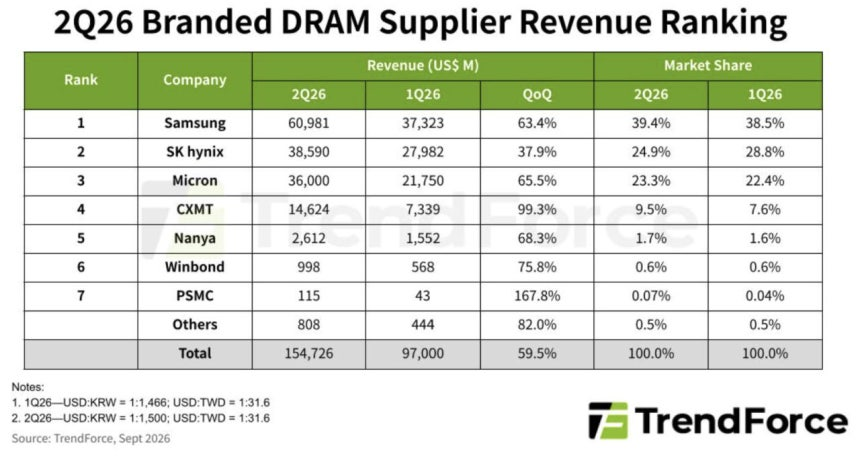
According to market research firm TrendForce, global DRAM market revenue reached $154.73 billion in the second quarter, up 59.5 percent quarter-on-quarter. The growth was driven by rising shipments across a range of memory chip products as demand for large language model training and AI inference continued to spread.
TrendForce data shows Samsung Electronics has held the top spot in the global DRAM market for three consecutive quarters, having overtaken SK hynix in the fourth quarter of last year with a 36 percent share against SK hynix's 32.1 percent.
Samsung extended that lead through the second quarter of this year, with its share climbing from 36 percent in last year's fourth quarter to 38.5 percent in the first quarter and 39.4 percent in the second — approaching the 40 percent mark.
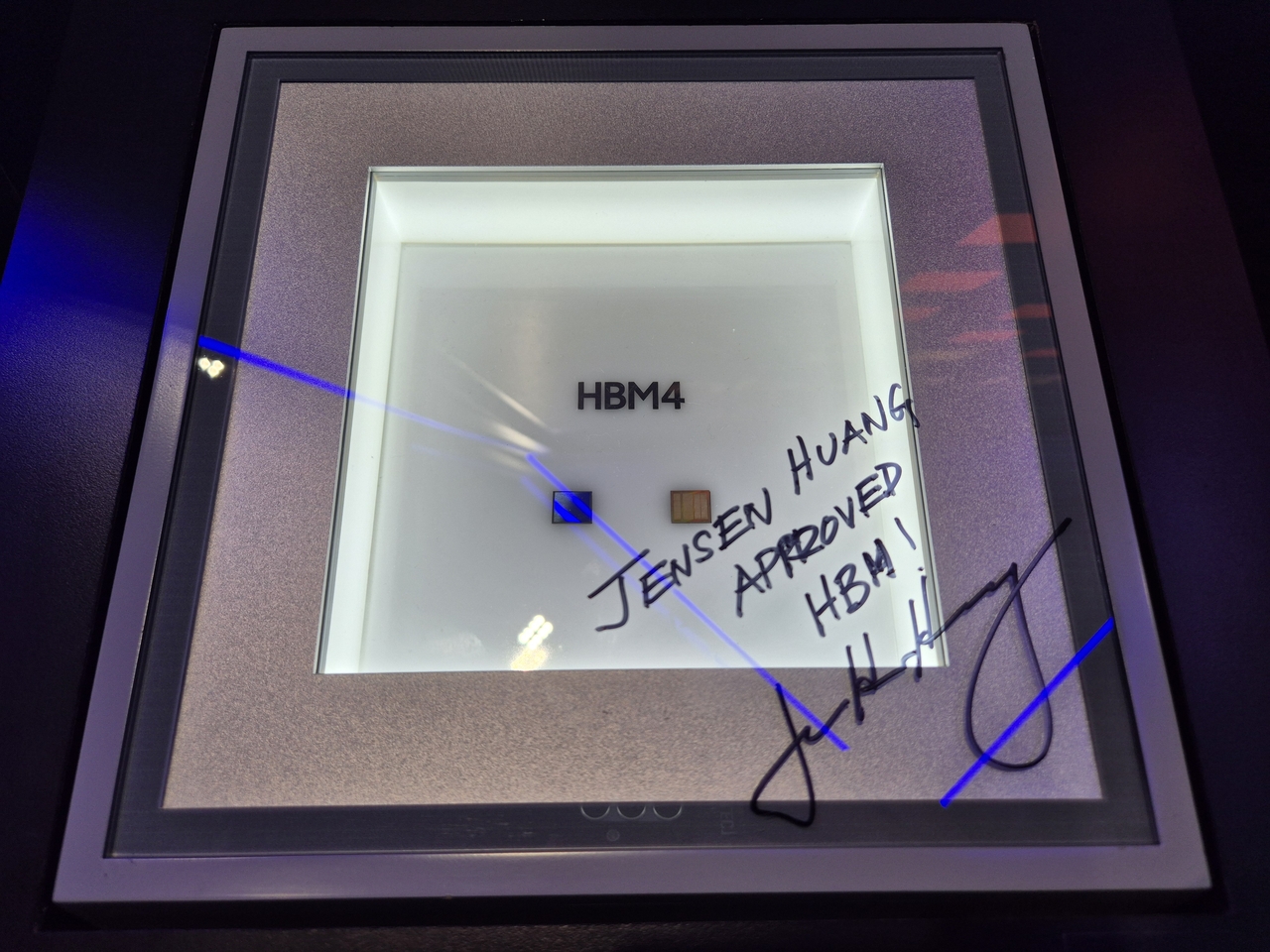
Samsung's second-quarter DRAM revenue came in at $60.98 billion, up 63.4 percent quarter-on-quarter — the largest shipment increase among the three major memory chip makers. The company further cemented its leading position through the early mass production and shipment of its sixth-generation HBM4.
SK hynix, by contrast, posted revenue growth but failed to keep pace with the overall market. Its second-quarter revenue reached $38.59 billion, up 37.9 percent quarter-on-quarter.
Its market share, however, has been on a steady decline — falling from 33.2 percent in last year's third quarter to 32.1 percent in the fourth quarter, then dropping further from 28.8 percent in this year's first quarter to 24.9 percent in the second. TrendForce attributed the trend to limited growth in average selling prices despite a high proportion of HBM shipments.
As a result, the gap between Samsung Electronics and SK hynix widened sharply, from 3.9 percentage points in last year's fourth quarter to 14.5 percentage points in this year's second quarter.
That gap should not be read as a sign of weakening DRAM competitiveness, however. TrendForce calculates market share based on revenue, and SK hynix carries a relatively high proportion of HBM shipments along with a larger share of long-term supply agreements, which limited its exposure to the sharp price gains seen in the commodity DRAM segment.
Differences in how the two companies structure their long-term agreements also appear to have played a role. According to TrendForce, Samsung took an aggressive approach in its mobile DRAM long-term contracts, implementing steep price increases all at once, while SK hynix has pursued a more gradual strategy of incremental price hikes.
CXMT climbs to 9.5%, targets server DRAM
HBM4 output eating into commodity DRAM supply
'Supply shortage to deepen next year'
![TrendForce data on global DRAM market share trends from the third quarter of 2025 through the second quarter of 2026 [produced with ChatGPT]](https://wimg.heraldcorp.com/news/cms/2026/09/08/news-p.v1.20260908.eafb8344d1704865ac755e1b2ef587ea_P1.png)
The share lost by SK hynix was picked up by Micron and CXMT. Micron posted second-quarter revenue of $36 billion, up 65.5 percent from the previous quarter, with its market share rising from 22.4 percent to 23.3 percent — narrowing the gap with SK hynix to 1.6 percentage points.
CXMT posted the steepest growth among all players, with its share jumping from 7.6 percent in the first quarter to 9.5 percent in the second — a gain of 1.9 percentage points in a single quarter, outpacing all three major memory chip makers.
Notably, CXMT's expansion is no longer confined to low-cost DRAM for Chinese smartphones.
According to TrendForce, CXMT's server DRAM revenue exceeded its mobile DRAM revenue for the first time in the second quarter of this year. Mobile products had accounted for roughly 60 percent of CXMT's revenue as recently as last year, but its product portfolio is rapidly shifting toward the higher-value server market.
The sharp rise in DRAM prices is expected to moderate somewhat in the third quarter. TrendForce forecast that DRAM price increases would slow to between 13 and 18 percent quarter-on-quarter in the third quarter.
Pricing remains the biggest concern. Some demand is shifting from high-capacity to lower-capacity products, and PC and smartphone makers are finding it increasingly difficult to absorb further memory chip price increases, squeezing demand.
Memory chip makers' inventories have remained at record lows as a result, but shipment growth in the second quarter was modest, and further expansion is expected to remain constrained in the third quarter as well.
TrendForce forecast that Samsung Electronics, SK hynix and Micron would push to expand shipments in 2026 and 2027 by accelerating the transition to leading-edge processes, but said the gains would be limited.
Taiwan-based makers including Nanya, Winbond and PSMC, meanwhile, are expected to sustain their growth by focusing on mature-process products and absorbing demand that the three major memory chip makers cannot adequately serve.
KB Securities said in a report Monday that a surge in AI infrastructure investment next year would push the memory semiconductor market into an unprecedented supply shortage. It added that the development could prompt a significant revaluation of Samsung Electronics and SK hynix.
"As of the third quarter, memory chip inventories at Samsung Electronics and SK hynix have fallen to below 10 days," said Kim Dong-won, head of research at KB Securities. "This could go beyond a simple demand recovery and become an unprecedented situation where available supply itself runs dry." Kim added that the ramp-up of HBM4 production is compounding the supply shortage by eating into commodity DRAM production capacity.

go@heraldcorp.com