Korea Aerospace Industries space division chief Seo Hyun-seok speaks at Herald Business Forum 2026
Lecture themed 'New intelligence in the space industry: Space AI'
'AI is now entering a full-fledged starting point even in space'
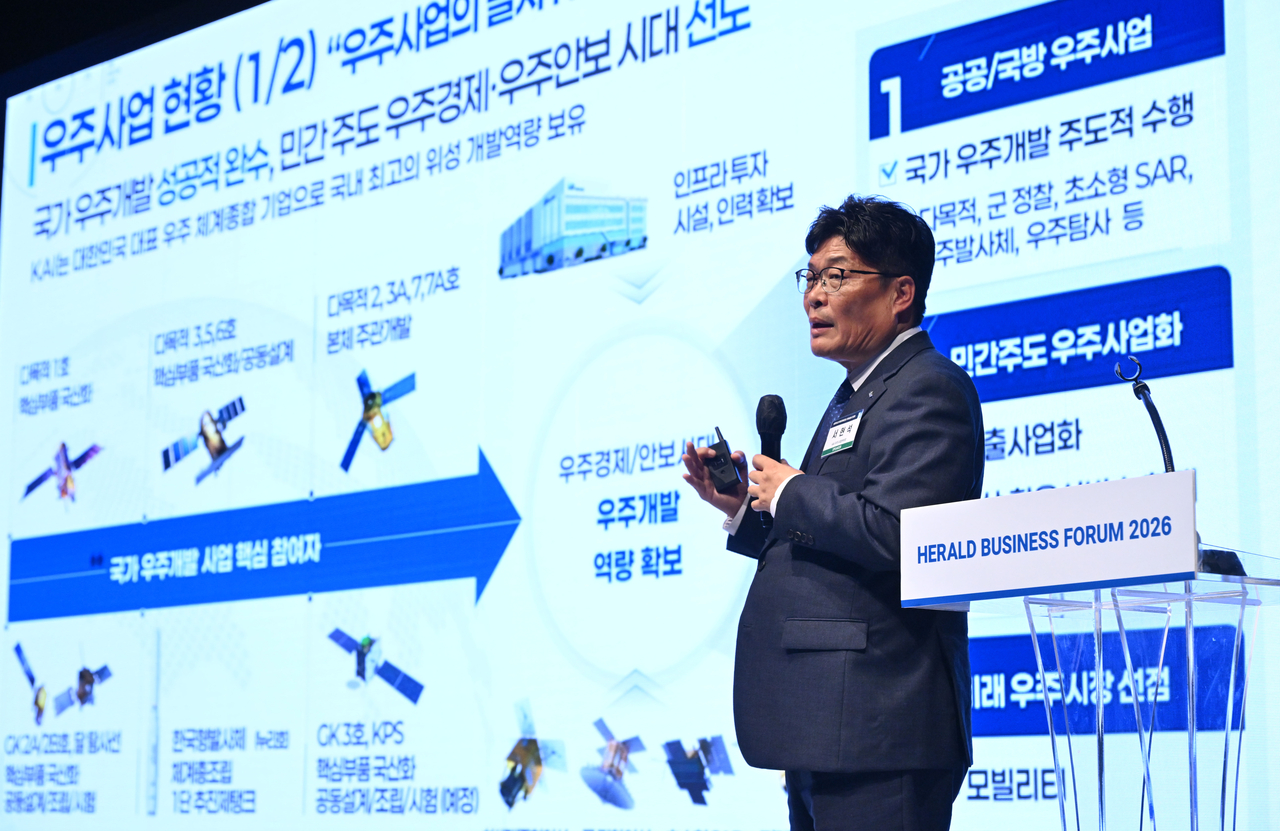
"The age has come when space, too, is bound to grow into an enormous field through AI."
As AI rapidly penetrates the space industry, new markets are opening up around autonomous satellite operations, onboard data processing and space data centers.
Seo Hyun-seok, head of Korea Aerospace Industries (KAI) space business division, said at the Herald Business Forum 2026, held Tuesday at the Dynasty Hall of the Shilla Hotel in Jung-gu, Seoul, that "unlike the perception of the space industry as a cutting-edge field, it is actually an extremely conservative technology," adding that "AI is now entering a full-fledged starting point even in space."
Seo said the emergence of reusable launch vehicles has significantly lowered launch costs, which will further accelerate growth in the space industry. "In the past, launching a single satellite required tens of billions of won, but costs have been falling sharply as Elon Musk's SpaceX commercialized reusable launch vehicles," he said.
AI is expected to play a central role particularly in the autonomous operation of satellites. Because there are limits to how many satellites humans can control individually, satellites must form networks to correct their positions and make independent judgments about their missions and services. KAI is also developing "onboard AI" technology that processes satellite data directly in space rather than sending it down to ground stations.
AI's role is also growing in satellite imagery. Currently, large volumes of data captured by satellites are transmitted to the ground for processing, but in the future satellites will be able to filter out unnecessary data — such as cloud cover — on their own and transmit only the images needed. Satellites could also improve efficiency in forest monitoring, agriculture and disaster observation by analyzing data on-site.
The combination of AI and satellites was also cited as essential on the future battlefield. The battlefield is evolving toward a "hyper-connected" environment in which unmanned aerial vehicles, manned fighter jets and ground systems are linked through satellite networks, with unmanned systems autonomously carrying out reconnaissance, surveillance and strike missions. KAI is also pursuing development of a next-generation aerial combat system integrating the KF-21 and multipurpose unmanned aerial vehicles.
For AI to operate fully in space, dedicated semiconductor development must also follow. Advanced semiconductors used on the ground — such as HBM — are difficult to apply directly in the space environment, where radiation and extreme temperature swings are constant. HBM in particular, with its three-dimensional stacked structure, requires redundancy and multi-layered design to ensure stability in space conditions.
Seo said that if the market expands to include space data centers and lunar and Mars exploration, AI semiconductors for space use will grow into a major new business. "The space market will grow enormously going forward," he said. "For humans to travel to space, chips that can make their own judgments and carry out repairs when systems fail will also become necessary."
"Building a system that can gather all satellite data in one place and operate it as an integrated solution is the future vision we have in mind," he added.
go@heraldcorp.com