
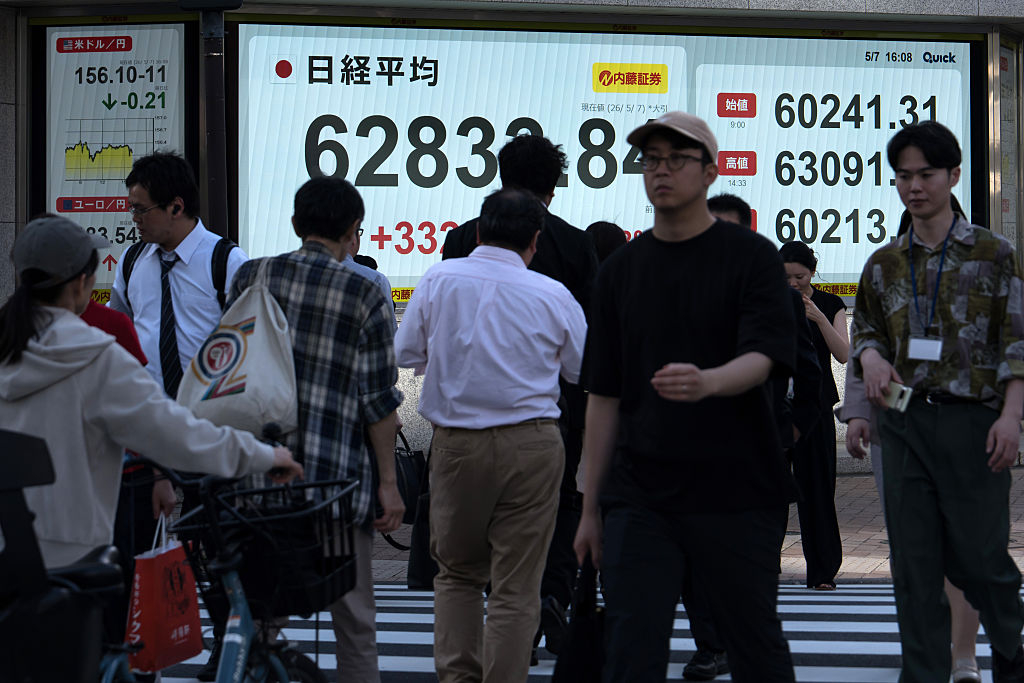
Japan appears set to notch its longest postwar economic expansion, having maintained an upward trend for 74 consecutive months since 2020. But a record weak yen and high prices have kept real wages in negative territory for a fourth straight year, leaving personal consumption sluggish. Some observers say the growth is not one consumers can actually feel.
The Nikkei reported Tuesday that the coincident index in the Cabinet Office's July business conditions index (2020=100), released Monday, came in at 120.6 -- the highest level since October 2018.
The coincident index reflects the economy's current state, and Japan's Cabinet Office determines the overall business trend based on its movement. Based on the latest reading, the Cabinet Office's assessment is that the economy is "showing improvement."
A panel of experts, known as the Business Conditions Index Research Committee, will later assess the coincident index. Based on that data, it will determine whether the economy is in an expansion or a contraction phase. Given how high the index currently stands, the panel is expected to conclude that the expansion is continuing.
If the expansion is confirmed to be ongoing, it would mark 74 consecutive months of growth since the rebound in May 2020, early in the COVID-19 pandemic. That would surpass the longest postwar expansion on record, set during the so-called Izanami boom.
The Izanami boom refers to the 73-month expansion that ran from February 2002 to February 2008. Takahide Kiuchi, a senior researcher at Nomura Research Institute, said the historically weak yen and high prices are the defining features behind the current prolonged expansion.
Japan has emerged from nearly three decades of deflation, with consumer prices rising 2 to 3 percent year-on-year since 2022, exceeding the Bank of Japan's target. Earnings have remained strong, led by large corporations, and wage increases have stayed in the 5 percent range for three consecutive years through this spring's labor-management negotiations.
However, the Nikkei said much of the prolonged expansion reflects high nominal growth driven by inflation, making it difficult for consumers to actually feel the benefits.
Despite the record price increases, real wages have stayed negative for four consecutive years since 2022. Personal consumption's share of gross domestic product (GDP) remains lower than its peak before the COVID-19 pandemic.
Japan's real growth rate has hovered around 1 percent since 2021 -- far below the 11.5 percent recorded during the high-growth era from 1965 to 1970. It is also lower than the 1.6 percent real growth rate posted during the Izanami boom, from February 2002 to February 2008.
kate01@heraldcorp.com



