Labor and management representatives from six urban rail operators nationwide, including Seoul Metro, met with Democratic Party of Korea Floor Leader Han Byung-do to deliver a joint petition calling for legislation to cover free-ride transport losses with national funds and establish a sustainable support regime.
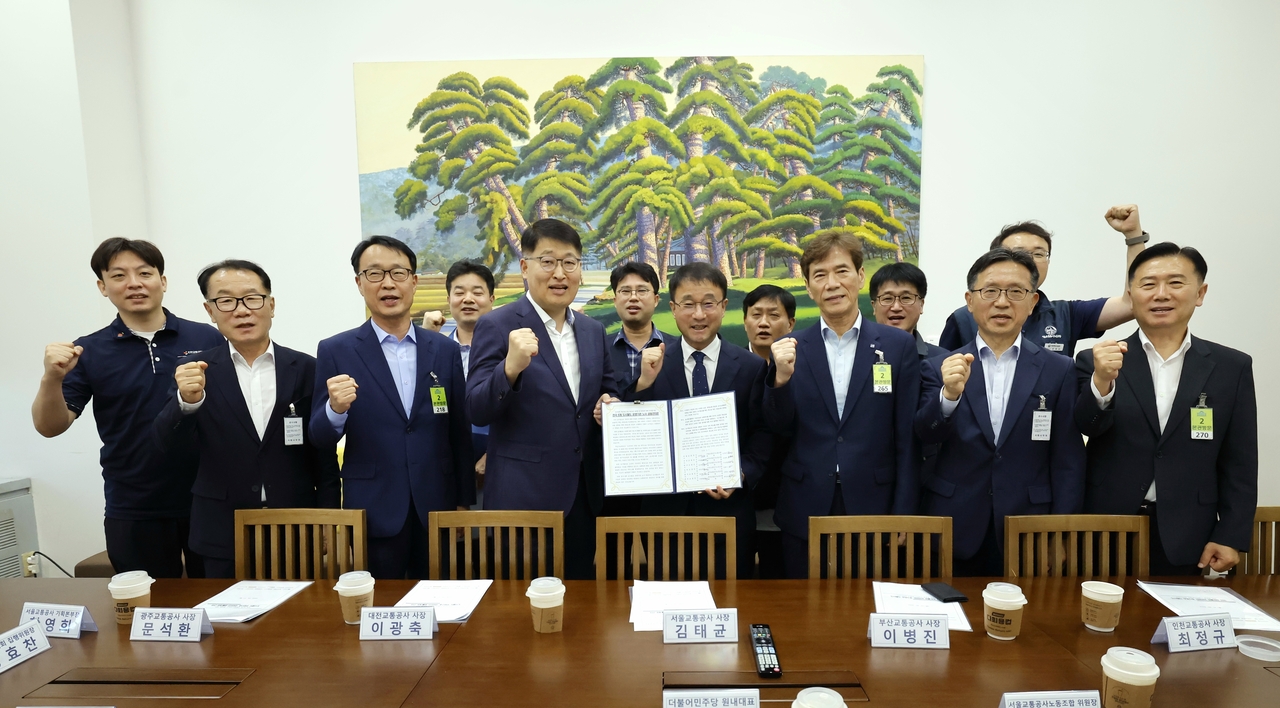
Seoul Metro met Monday with Democratic Party of Korea Floor Leader Han Byung-do alongside urban rail operators from across the country, calling on the National Assembly to institutionalize national-level responsibility and financial support for losses incurred from free-ride transport services.
Six urban rail operators from Seoul, Busan and other cities gathered to discuss the surge in free ridership accompanying South Korea's entry into super-aged society status and to chart a path toward sustainable operations, adopting a joint petition in the process.
The petition calls for legislation to cover free-ride transport losses with national funds, the establishment of a rational cost-sharing framework among the central government, local governments and operators, and institutional support to ensure the long-term viability of urban rail services.
Labor and management representatives from the six operators have been pressing for such legislation since last year, repeatedly submitting joint petitions to the National Assembly and the government as part of an ongoing campaign for systemic reform.
The representatives met Han at the Democratic Party's floor leader's office and handed over the joint petition. At the meeting, they said they were asking for "active discussion and cooperation so that the state's responsibility for providing stable transportation welfare to the public is clearly defined, and so that the amendment to the Urban Railway Act that underpins that responsibility can be passed as soon as possible."
Several bills are currently before the 22nd National Assembly that would establish a legal basis for national support for free-ride transport, including proposed amendments to the Urban Railway Act, the Welfare of Older Persons Act and the Act on Welfare of Persons with Disabilities.
Han expressed agreement with the need for national funding to cover free-ride losses. "Free-ride transport is a transportation welfare regime designed to guarantee the mobility rights of senior citizens, people with disabilities and national merit recipients, yet the problem has repeated itself for years on the grounds that there is no legal basis for support," he said. He added that he would "make every effort to closely examine the difficulties on the ground so that the relevant bills can be discussed in the National Assembly as soon as possible."
Free-ride transport on urban rail is a nationwide transportation welfare program mandated by national law for senior citizens, people with disabilities and national merit recipients. As the population ages rapidly, the scale of free ridership — and the resulting revenue shortfall for operators — has grown steadily, raising mounting concerns about long-term sustainability.
In 2025, the six urban rail operators recorded combined free-ride-related revenue losses of 775.4 billion won ($572 million), equivalent to 52 percent of their net losses for the period. Last year, free riders accounted for 21 percent of total ridership — a share projected to climb to 24 percent by 2030 and 29 percent by 2040 if current trends continue.
Seoul Metro President Kim Tae-gyun said the issue of free-ride transport on urban rail "is not confined to the fiscal burden on operators or the economic circumstances of users," and that the government and other parties must establish a rational support framework in which costs are shared in light of "the broad public value that urban rail provides to the people — in transportation, welfare, the environment and beyond."
seouldream01@heraldcorp.com