
'Rapid blocking system for financial transactions in deceased persons' names' to launch fully on Friday
Families can still access emergency funds for medical and funeral costs through an exception withdrawal regime
![[123RF]](https://wimg.heraldcorp.com/news/cms/2026/09/06/news-p.v1.20260906.c113a9d198824e6284c7e0b9579df4aa_P1.jpg)
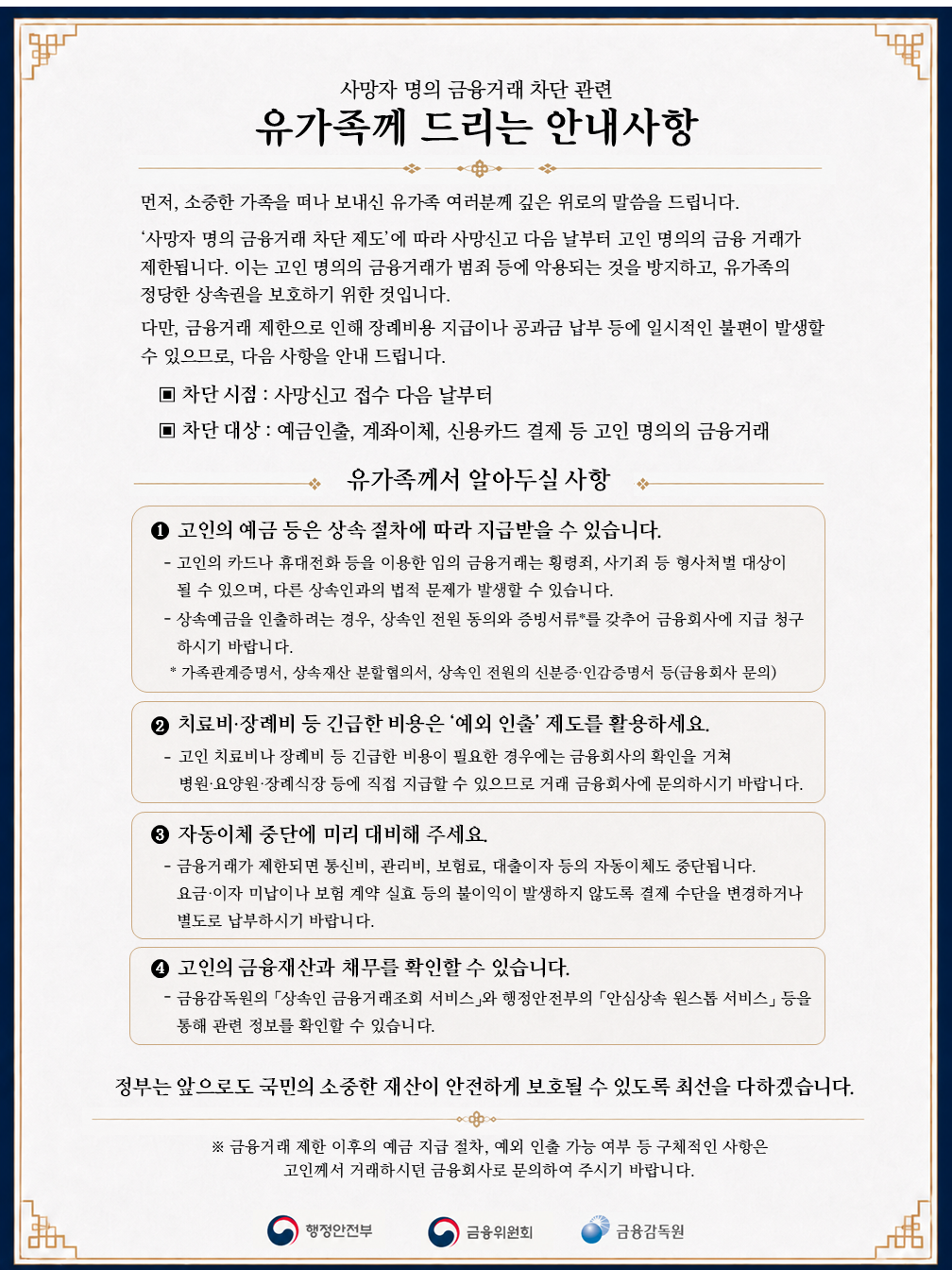
Once a death is reported, all financial transactions in the deceased person's name will be blocked the following day. The measure is designed to prevent the fraudulent use of deceased persons' identities in illegal financial transactions, and bereaved families will need to be aware of the change and plan accordingly.
The Ministry of Interior and Safety, the Financial Services Commission, the Financial Supervisory Service and Korea Credit Information Services announced Sunday that the "rapid blocking system for financial transactions in deceased persons' names" will launch fully on Friday.
Until now, some financial institutions have received death records from the Ministry of Interior and Safety through Korea Credit Information Services once a month, using that information to block financial transactions.
However, given the one-month window allowed for filing a death report and the monthly information-sharing cycle, it could take up to two months for a financial institution to confirm a person's death. Coverage was also limited to banks and a handful of other financial companies, leaving gaps in the system's ability to block fraudulent transactions carried out in a deceased person's name.
To address these shortcomings, the government and financial regulators spent more than a year consulting with relevant agencies and financial institutions to build a public-private integrated response framework — the rapid blocking system — that links every step of the process, from generating and sharing death records to blocking financial transactions.
The system will go into full operation on Friday.
The Ministry of Interior and Safety will shorten the cycle for sharing death records from once a month to once a day. Financial institutions will query that information in real time during both in-person and non-face-to-face transactions, and will immediately block any transaction once a party's death is confirmed.
The expansion covers all 4,890 financial companies — including banks, insurers, card companies, securities firms, savings banks and mutual finance institutions — that will now use death records. Once a person is confirmed deceased, all financial transactions except essential ones such as incoming deposits will be blocked immediately, minimizing gaps in the system.
Exceptions have been built in to reduce inconvenience for heirs, who would otherwise need to set up separate debt-collection procedures. Deposits into a deceased person's account remain permitted. In urgent and unavoidable cases — such as covering the deceased's medical or funeral costs — withdrawals are allowed when the relevant family documents, including a family relations certificate, are submitted to the financial institution, provided the funds are transferred directly to a hospital or funeral home.
Once the system is running, bereaved families will not need to separately apply to block financial transactions. When a death is reported, the information is automatically linked to Korea Credit Information Services and financial institutions, and the entire process through to the transaction block is handled automatically.
An internal control framework will also be established to protect death records securely.
Korea Credit Information Services will revise its credit information management rules to prohibit the use of death records for any purpose other than blocking financial transactions, and to bar their disclosure to third parties.
Financial institutions will be required to electronically record and manage the handling of death records and related transaction histories. The Financial Supervisory Service plans to work with relevant agencies to conduct ongoing inspections of how financial institutions manage death records and maintain internal controls.
Bereaved families must follow lawful inheritance procedures for any financial transactions, and those who need urgent funds for medical or funeral costs can use the "exception withdrawal" regime that banks and other institutions already operate.
Families should also note that automatic transfers linked to a deceased person's account may be suspended, and should update payment methods in advance to avoid missed utility bills, insurance premiums and other recurring charges.
The deceased's estate can be confirmed through the Financial Supervisory Service's "heir financial transaction inquiry service" or the Ministry of Interior and Safety's "safe inheritance one-stop service."
The Ministry of Interior and Safety, the FSC and the Financial Supervisory Service said they expect the improvements to help protect citizens' assets and prevent fraudulent financial transactions, adding that they will continue to work closely with Korea Credit Information Services and financial institutions to minimize inconvenience for bereaved families and ensure the stable rollout of the new regime.
thlee@heraldcorp.com




