Gold trades above $4,400 per ounce, up more than 20% from a year ago
China buys gold for 21st consecutive month; Bank of Korea resumes gold investment after 13 years
Gold banking accounts rebound after 7 months; physical gold bar sales also rise
![Oh My Girl member Mimi. [Newsis]](https://wimg.heraldcorp.com/news/cms/2026/09/05/news-p.v1.20260905.d53ec4719f7f43a184ddd487847ab4d1_P1.jpg)
"I prefer tangible physical assets over stocks."
Mimi, a member of K-pop group Oh My Girl, shared that investment philosophy on a radio program Monday. She said stocks do not feel like her own money until she sells them, which is why she prefers visible assets like gold. She had previously revealed in April on a YouTube entertainment show that she had been gradually accumulating gold — and said that after prices climbed, people around her started telling her she had made a lot of money.
The asset Mimi chose is now drawing not only retail investors but also central banks and financial institutions worldwide. A confluence of high interest rates, a widening US fiscal deficit and anxiety over the dollar's value has pushed gold back to the fore as the ultimate safe-haven asset. China has expanded its gold reserves for 21 consecutive months, and the Bank of Korea has resumed gold-related investment for the first time in 13 years. Large sums are also flowing into gold ETFs and bank gold accounts.
International gold prices are trading above $4,400 per ounce, according to the financial investment industry. Gold futures on the Comex division of the Chicago Mercantile Exchange settled at $4,429.80 per ounce Friday.
Gold prices have recently alternated between sharp rallies and pullbacks. After bottoming out in mid-July, prices surged about 15 percent through Aug. 25, climbing to around $4,600 per ounce. They then retreated to the $4,300 range Tuesday after concerns emerged over rising US Treasury yields and the possibility of a Federal Reserve rate hike, before recovering to hover around the $4,500 level again.
The one-month gain has moderated to about 4 percent, but prices remain more than 20 percent above year-ago levels. Even after a sharp correction from the record high set at the start of the year, gold's renewed rebound has focused market attention on the potential for further gains.
Gold is regarded as an alternative asset that hedges against volatility in traditional holdings such as stocks, bonds and the dollar, as well as a refuge from inflation. Its trading volume dwarfs that of other commodities, which is why major central banks and institutional investors classify it as a separate asset class within their portfolios.
Gold typically loses investment appeal when interest rates rise, since it pays no interest — the recent short-term pullback following higher long-term US Treasury yields reflects exactly that dynamic. Even so, buying has continued, underpinned by concerns about deteriorating US fiscal health and a declining purchasing power of the dollar.
A so-called "debasement trade" has spread, in which investors reduce their exposure to nominal assets such as the dollar and government bonds and shift into alternatives like gold and bitcoin. The more concerns grow that America's widening fiscal deficit could erode confidence in the dollar, the more attractive non-dollar assets like gold become.
Structural buying by central banks worldwide is considered the single most powerful support for gold prices. The People's Bank of China held 76.08 million ounces of gold at the end of July, up 640,000 ounces — about 20 metric tons — from a month earlier. That monthly increase was the largest since October 2023. China has now expanded its gold reserves for 21 consecutive months.

Analysts attribute China's buying to a combination of factors: diversifying foreign exchange reserves, reducing dependence on the dollar and strengthening the international standing of the yuan. Gold still accounts for only about 8 percent of China's reserve assets — relatively low compared with major central banks globally — and markets widely expect China to continue purchasing.
The Bank of Korea has also resumed gold-related investment for the first time in 13 years. As of the end of the second quarter, the central bank held 679,765 shares of SPDR Gold Shares, the world's largest gold ETF listed on US exchanges. The holdings were valued at approximately $250.41 million, or about 355 billion won. It is the first confirmed gold-related investment since the Bank of Korea purchased 20 metric tons of physical gold in 2013.
However, because gold ETFs are classified as securities within foreign exchange reserves, they are not included in the Bank of Korea's official gold holdings of 104.4 metric tons. The central bank is also pursuing a plan under which domestic gold producers that wish to export can propose the volume and timing, with the Bank of Korea then reviewing its management plan and market conditions before deciding whether to purchase.
The central bank gold rush is likely to continue for now. A World Gold Council survey of 76 central banks found that 89 percent of respondents expected global central bank gold holdings to increase over the next year. A record 45 percent said they planned to expand their own institution's gold reserves directly.
Annual gold purchases by central banks worldwide have averaged about 1,000 metric tons over the past four years — double the roughly 500-ton annual average of the preceding decade. This year, central banks of emerging economies including Poland, Uzbekistan and Kazakhstan are leading the buying.
Retail investor enthusiasm for gold is equally intense. South Korea's largest physical gold ETF, ACE KRX Gold Spot, attracted 693.5 billion won in inflows from the start of the year through Aug. 24. Retail investors accounted for net purchases of 211.6 billion won, with more than 65.5 billion won flowing in from individual investors in August alone. Net retail purchases over the past year have exceeded 1 trillion won.
Demand for gold investment through banks is also reviving. The combined gold banking balance at KB Kookmin, Shinhan and Woori Bank stood at 1.78 trillion won as of Aug. 19. The balance had swelled to more than 2 trillion won when gold hit a record high earlier this year, then declined alongside the price correction, but it has turned back to growth for the first time in about seven months as gold prices rebounded. Hana Bank and NH NongHyup Bank do not offer gold banking products.
Gold banking works by crediting a won deposit into an account and buying or selling gold at a price that reflects the international gold rate and the won-dollar exchange rate. Because physical gold does not need to be stored and transactions can be made in units as small as 0.01 grams, the product is accessible to small investors. Some banks also offer automatic transfers for periodic purchases, target return and loss-rate alerts, and limit-order repeat-trading services.
Despite the word "account" in the name, gold banking differs from ordinary deposits or savings accounts. Principal losses can occur depending on gold prices and exchange rates, and the product is not covered by deposit protection. Trading gains are subject to a 15.4 percent dividend income tax, and investors should also factor in each bank's transaction fees and the spread between buying and selling prices. In short, gold price gains do not translate directly into investment returns.
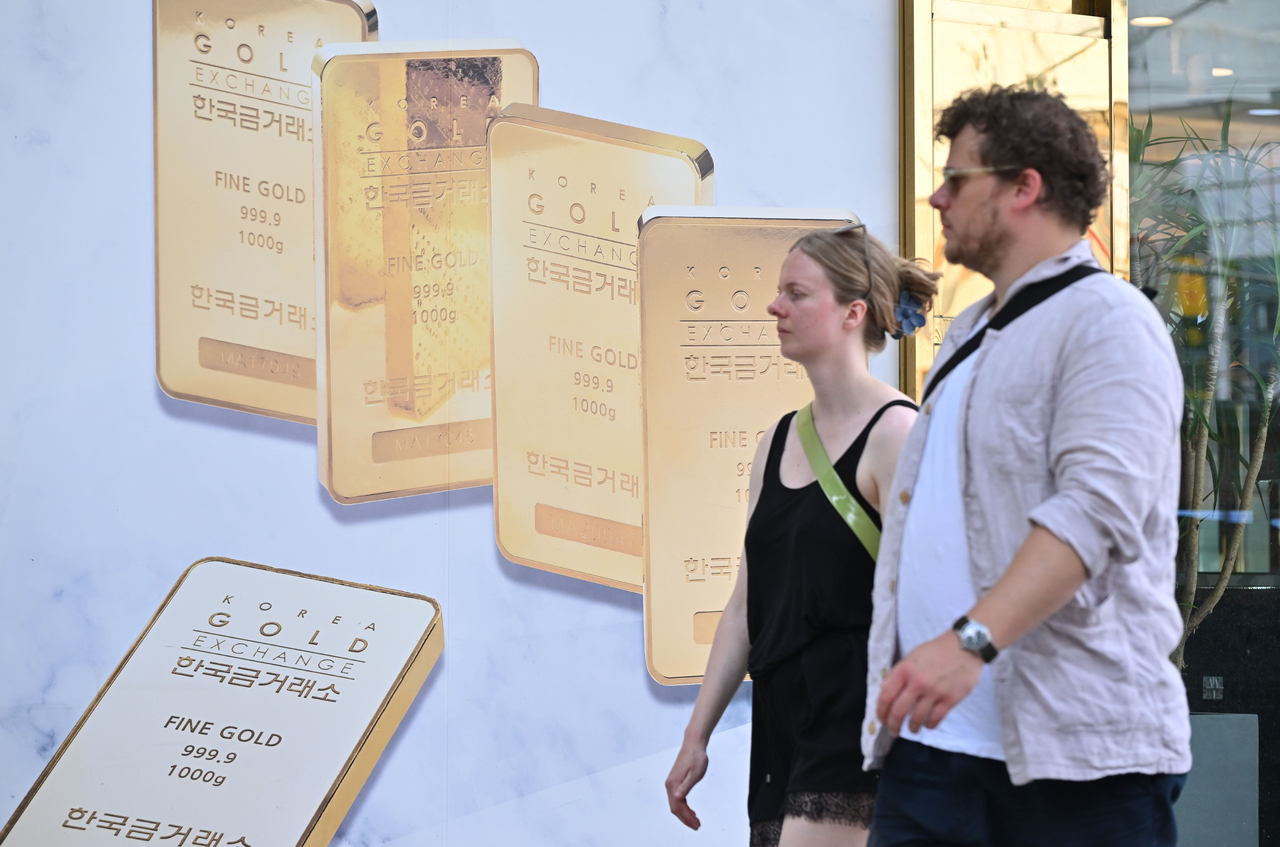
Sales of physical gold bars through banks are also rising. The five major banks sold about 20.1 billion won worth of gold bars from Aug. 1 through Aug. 19. Average daily sales on business days came to 1.83 billion won, up 26.2 percent from 1.45 billion won in July. As gold prices have climbed sharply, demand has concentrated on smaller 10-gram bars, which carry a relatively lower price burden.
Gold bars offer the advantage of direct physical ownership, but buyers pay a 10 percent value-added tax on top of the gold price, plus a sales commission. Storage costs and the risk of theft or loss also fall on the investor. The structure means gold prices must rise by a certain margin before the initial costs are recouped.
Tax treatment also varies by gold investment product. Gains from bank gold accounts and domestically listed gold ETFs are subject to dividend income tax, whereas direct trading through a securities firm account on the Korea Exchange gold market is exempt from capital gains tax and VAT on in-market trading profits. However, withdrawing gold purchased on the KRX gold market as physical metal does incur a 10 percent VAT and withdrawal fees.
Experts say that while high interest rates and a strong dollar may weigh on gold prices in the short term, the medium- to long-term drivers remain intact. UBS forecast that gold will reach $5,000 per ounce in the first half of next year, citing falling US real interest rates, a weaker dollar and steady central bank buying. It estimated that global central bank gold purchases this year will total between 750 and 1,000 metric tons.
Investment demand is also spreading to silver and platinum, which are classified alongside gold as precious metals. Silver prices rose more than 12 percent over the past month, while platinum gained about 5 percent over the same period. Silver functions both as a safe-haven asset and an industrial material used in solar panels and electronics, giving it larger price swings than gold.
Copper — known as "Dr. Copper" for its role as a barometer of economic conditions — is also hovering near historic highs. Copper prices climbed to $6.83 per pound last month, hitting a record high. That translates to more than $15,000 per metric ton. Prices have pulled back somewhat this month but remain more than 40 percent above year-ago levels.
The US government, citing copper as an essential resource for national security and advanced industries, has imposed a 50 percent tariff on semi-finished copper products and similar goods. As demand grows to bring copper into the United States ahead of tariffs and potential additional regulations, Comex warehouse inventories have jumped.
Structural supply-side problems are also pushing copper prices higher. Weather disruptions and operational setbacks have hit major copper mines concentrated in South America, and the timeline for normalizing Indonesia's Grasberg mine — which halted production after a landslide last year — has been pushed back. With copper demand surging, driven by AI data centers and power grid investment, supply growth has been unable to keep pace.
The TIGER Copper Physical ETF, which tracks the physical copper price, has posted returns of around 40 percent over the past year. Shares of Freeport-McMoRan, the largest US copper producer, have also climbed to a 52-week high of $80.24.
Choi Jin-young, a researcher at Daishin Securities, forecast that copper prices will break through $16,000 per metric ton before the end of the year.
Analysts caution, however, that gold, silver and copper have all risen sharply in a short period, and investors should be careful about chasing prices higher. Prices can move sharply in either direction depending on US interest rates, the dollar's value and geopolitical developments. Even gold — often called the ultimate safe-haven asset — is not an asset whose price is safe.
attom@heraldcorp.com