The hero's face changes with each era — and so does his music
From Rameau's harpsichord to Debussy's Sirens nocturne, each age reimagines the epic
Göransson blends ancient instruments with modern genres to score a traumatized Odysseus
![A still from "Odyssey" [Universal Pictures]](https://wimg.heraldcorp.com/news/cms/2026/09/05/news-p.v1.20260819.fca8484b83c84c22bd209479c7a9a724_P1.jpg)
The moment Odysseus draws his bow, a short, hard twang tears through the vast IMAX screen and fills the theater.
Twang —
What produced that swift, lethal sound was neither a sweeping orchestral swell nor a brass fanfare proclaiming victory. It was the pluck of a lyre — the ancient Greek string instrument — made manifest as the deadly snap of Odysseus's bowstring.
Music director Ludwig Göransson said in a Universal Pictures documentary that the idea came directly from director Christopher Nolan.
That brief, sharp twang has a strange addictive quality. Audience members have been heard saying they want to hear the bow sound again. It is one of the most important keys to understanding the music of "Odyssey."
Nolan asked Göransson for something entirely original — music unlike anything he had done before. The directive was clear: do not coat a film set in ancient Greece with the familiar grandeur of a large-scale orchestra, because orchestras did not exist in that era. In practice, today's orchestras play music from the past but use modern instruments refined for the acoustics of large concert halls, which can fall short when evoking the raw texture of antiquity.
To meet the challenge of creating genuinely new music, Göransson sought out instruments that modern cinema had abandoned. He restored the ancient Greek aulos and lyre, sourced 35 bronze gongs of varying sizes and shapes suited to the Bronze Age setting and layered them with synthesizers, and roamed his surroundings — striking metal railings, walls, scrap metal and even outdoor air-conditioning units — to harvest unfamiliar percussive timbres.
![A scene from "Odyssey" [Universal Pictures]](https://wimg.heraldcorp.com/news/cms/2026/09/05/news-p.v1.20260823.06b35864fb424e0e9287ee5d6a88652e_P1.jpg)
Stripped entirely of orchestral grandeur, the score's cold, violent metallic strikes hit the audience at a cellular level. For viewers who came expecting the romantic spectacle of a hero's journey, it is a terrifying and mesmerizing sonic declaration of war.
Homer's "Odyssey" — the vast wellspring of Western literature — has been dressed in entirely different musical clothing each time the world's paradigm has shifted. Artists have willingly projected their own aesthetic desires and the deficiencies of their age onto the epic. Every time the face of the hero changed, the musical form changed with it. Ludwig Göransson — hailed as the Beethoven of the 21st century and known to Korean fans as "Go Seo-bang" because of his Korean violinist wife — stands at the far end of that long musical lineage.
If Homer were alive today, what sounds would he use to tell the story of Odysseus? The answer can be glimpsed across the long journey from Western classical music history to Nolan's film.
Odysseus has been, by turns, a painfully ordinary husband, a romantic hero and now a trauma-scarred human being bowed under the weight of memory. Each time, music has dismantled the hero and reassembled him anew.
The 17th-century Odysseus: no romance for a real husband
Reborn in 1640 Venice as the opera "Il ritorno d'Ulisse in patria" (The Return of Ulysses to His Homeland), Odysseus descended from mythic hero to the human world. He was brutally, unsentimentally real. This was the world woven by Monteverdi, who laid the foundations of Western opera.
The opera reflects the secular and philosophical ideology of the Accademia degli Incogniti, the Venetian intellectual circle of the day, focusing on human endurance and moral triumph rather than divine intervention.
Monteverdi's Odysseus is less a warrior who won a war than a man returning home after a long absence. Penelope waits; suitors have seized the palace; he returns in disguise.
Monteverdi's music draws fine distinctions between speech and song to trace the emotional life of each character. Through his "second practice" — the principle that music must be subordinate to the syntactic and semantic structure of the text — he relentlessly probes the depths of human psychology rather than staging heroic spectacle. The long elegy Penelope sings in Act I, "Di misera regina non terminati mai dolenti affani" (The suffering of a wretched queen shall never end), with its chromatic progressions and unexpected dissonances, vividly renders the deep despair of a woman who has waited 20 years for her husband.
The bloody revenge scene in which Odysseus, disguised as a beggar, infiltrates the court of Ithaca and slaughters the suitors with his bow (Act II, Scene 12) is a relentless torrent of sound — the moment where Monteverdi's Stile Concitato (the agitated style) reaches its peak. Furious, rapid string tremolos and sixteenth-note rhythms surge forward, violently unleashing the pent-up rage and brutality of a man reclaiming his household.
Odysseus is portrayed not as a demigod slaying supernatural monsters but as a grimly realistic ruler willing to be drenched in blood to reclaim his shattered home and political power. Monteverdi scholar Ellen Rosand has observed that in this work, rather than music existing as a single transcendent protagonist, the distinction between speech-like recitative and song-like expression reveals the inner lives of the characters.
In the 18th and 19th centuries: hero among heroes
As time passed, the narrative surrounding Odysseus grew larger. The Enlightenment's emphasis on reason and Romanticism's exploration of individual emotion intersected, and the journey of Odysseus changed shape accordingly — moving away from a political revenge drama set in human society toward an inward voyage against the forces of nature and the transcendent. Composers of this period sought not to recreate specific narrative events but to render in sound the essential nature of the terror embodied by the mythic obstacles the hero faced.
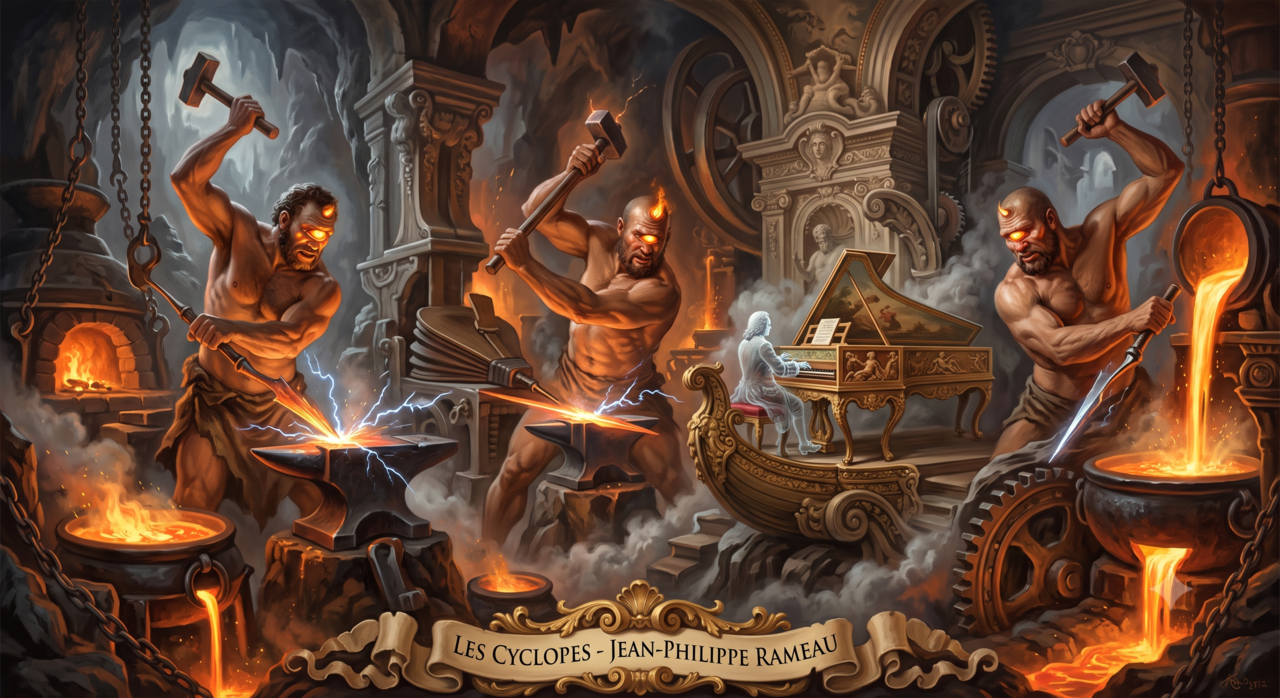
French composer Jean-Philippe Rameau's 1724 harpsichord solo "Le Cyclope" (The Cyclops) expressed the physical terror threatening Odysseus through extreme keyboard virtuosity. Rameau was an innovator of his time. He shattered the conventions of French keyboard music, with its emphasis on elegance, by writing passages that sent the performer's two hands lurching violently from one end of the keyboard to the other. The heavy, blunt strikes grounded in his theory of the basse fondamentale (fundamental bass) give physical and sonic shape to the lumbering mass of a club-wielding cannibal giant. Amid cascading dissonant swirls, Odysseus emerges as a fragile yet intelligent romantic subject confronting the overwhelming physical force of nature.
Moving into the 19th century, the vast orchestras and choruses of the Romantic era expanded Odysseus's personal adventure into a national and heroic narrative.
German composer Max Bruch's "Odysseus, Op. 41" is the prime example. Composed in 1871–72 and premiered in 1873, it is a large-scale secular oratorio for soloists, mixed chorus and orchestra. Bruch selected the most dramatic scenes from Homer's epic and filled a symphonic canvas with musical contrasts.
The reason Bruch was drawn to the work is itself revealing. He found in Homer's epic the grandeur of primordial poetry and shaped it into a series of lyrical scenes. It remained one of the most successful works of his lifetime.
Heinrich von Herzogenberg also wrote an "Odysseus, Op. 16" for orchestra in 1872. Its four movements — titled "Wandering," "Penelope," "Circe's Garden" and "The Banquet of the Suitors" — trace the arc of the hero's journey in sweeping terms.

The moonlit image of the Sirens belongs to Debussy
The figure who demands the most attention at this juncture is by far Debussy. Through "Sirènes" (Sirens), the third movement of his orchestral suite "Nocturnes" published in 1899, he dismantles the Romantic narrative structure.
In the Parisian musical world of the late 19th century, Richard Wagner's massive orchestral forces and the teleological harmony of late Romanticism held sway. Debussy's music was a revolt against the prevailing tide. He appears to have grown deeply weary of the ostentatious German orchestration of his day.
Debussy is the artist responsible for the image of the Sirens that has felt natural ever since the 20th century. He sought a new musical language that stripped away clear narrative plot and thematic statement in favor of momentary timbre and nuance. In "Sirènes," the waves softly breaking in moonlight and the mysterious, seductive call of the Sirens rising from within them are translated into a synesthetic impression. For Debussy, the sea was not a physical obstacle to be overcome but the abyss of the unconscious.
He made a very particular demand of his 16-voice women's chorus: he gave them no words at all, instead asking them to hum using only vowel sounds — "ah" or "la" — in a technique known as vocalise. He further instructed them to suppress vibrato and project a straight, unadorned tone. Stripped of narrative meaning, the human voice exists as a single instrument alongside the oboe or clarinet, rendering the Sirens' supernatural allure in full.
Another defining feature of the work is its dismantling of the major-minor tonal system at the heart of Western music. Debussy's whole-tone and pentatonic scales destroy the traditional gravitational law of Western harmony — the principle that a leading tone must resolve to the tonic. Music no longer moves toward a destination; it drifts without direction. It was a perfect device for evoking the rolling waves of the sea and the hallucinatory state of seduction. This music became the key that opened the door to 20th-century modernism.

The Sirens' temptation that Odysseus had to endure lashed to the mast is sublimated, within Debussy's aimlessly drifting Impressionist soundscape, into a dreamlike and existential dread without fixed form. The Odysseus of this era was no longer an ancient man pressing forward toward the clear goal of Ithaca but an emblem of the modern self adrift on a sea of uncertainty.
After Debussy, works returning to grand orchestral forces also appeared — attempts to repaint the Odysseus who had become a symbol of wandering humanity in the language of Romanticism once more. German composer Ernst Boehe's "Aus Odysseus' Fahrten" (From the Voyages of Odysseus), Op. 6, is a symphonic poem composed between 1901 and 1904. It moves through departure and shipwreck, Circe's island and the lament of Nausicaa before arriving at the homecoming. The late-Romantic orchestration, shaped by the influence of Richard Strauss and Wagner, paints Odysseus's journey with the sweeping grandeur of a classic film score.
The modern Odysseus: a man carrying trauma
Behind cold percussive strikes, an ominous synthesizer crawls like a snake. A steady metallic friction, ticking like a clock, accompanies Odysseus and his men as they approach the gates of Troy. The movement accelerates gradually. The moment the gates open, the metallic sound cuts out entirely, and an eruption of furious drumming explodes alongside vocals like the roar of fanatics — the track "Zeus's Law."
"A Face! A Fleet! A War! A Man! A God! A Trick!"
The invasion of Troy. Six minutes of unbroken battle madness plunge into a swamp of ear-splitting percussion and accelerating rhythm. Odysseus, drenched in blood — was he a just and righteous hero? Göransson's sonic design forces a chilling reckoning with human complexity and seizes the film by the throat from the very first moment.
![A scene from "Odyssey" [Universal Pictures]](https://wimg.heraldcorp.com/news/cms/2026/09/05/news-p.v1.20260724.7cab85d55a894f30a0538b3bab5d5106_P1.jpg)
Twenty-three tracks. One hundred eighteen minutes and 15 seconds. The music that permeates Nolan's relentless visual lens in 2026 is newly woven through Ludwig Göransson. In Göransson's innovative score, audiences encounter an Odysseus who is devastatingly dark and broken. In Nolan's world, Odysseus is not the glorious architect of Troy's fall. He is a combat veteran carrying the indelible memory of massacre and guilt — a wounded human being suffering from serious post-traumatic stress disorder. Göransson follows Odysseus's psychological journey, tearing the musical texture apart and stitching it back together again and again.
Göransson deliberately excluded the safe, brass-heavy orchestral soundscape in the manner of Hans Zimmer — the approach Hollywood had followed like a formula, and one that Zimmer himself had used across multiple collaborations with Nolan.
In its place, he grotesquely distorted the strikes of 35 heavy bronze gongs through synthesizers and beat industrial waste and outdoor air-conditioning units to create a savage texture. To that he added the cool pastoral vocals of Albanian iso-polyphony — a UNESCO Intangible Cultural Heritage — and the ancient Greek wind instrument the aulos, completing a music that provokes physical friction rather than flowing beauty.
Classical scholar Emily Wilson criticized Nolan's film for "cheaply distorting the worldview of the original by replacing the gods' literal presence with psychological phenomena." Göransson's music, however, offers a complete and overwhelming sonic rebuttal to that charge.
![A scene from "Odyssey" [Universal Pictures]](https://wimg.heraldcorp.com/news/cms/2026/09/05/news-p.v1.20260904.6f3b599be88f4749a644b5e1c8ef7a84_P1.jpg)
The longing for home begins with warm woodwinds and strings, only for a low synthesizer to gut the hope and cast a melancholic shadow. The encounter with the Cyclops maximizes the visual creature-feature terror through sonics — dissonant pulsations and bursting string sounds in the track "Cyclops," capped by a ferocious crescendo. Deep, low vocals and an eerie ambient soundscape underscore the dread of the ancient underworld in "Hades," while "Sirens" opens with sharp, seductive choral voices before spiraling into neurotic chaos — all sonic translations of the text's terror.
In the bloody slaughter of the suitors — Odysseus's theme, "The Trial of the Bow / Vengeance" — bronze gongs, destructive electronic music and a taut lyre fill the screen. At around the two-minute-and-39-second mark, the moment Odysseus successfully draws the bow and releases the string, the sound of an ancient bow and a modern explosion lock together with stunning precision.
The gods' harsh, unseen wrath is rendered as the oppressive weight of an ultra-modern 808 sub-bass, while Odysseus's psychological collapse is translated through a fusion of the Shepard tone — an auditory illusion in which pitch appears to rise infinitely — and the Risset rhythm, an acoustic effect in which tempo appears to accelerate without end.
Göransson's music is not passive background sound. It gives sonic form to the destructive violence and helpless loss Odysseus would have experienced on the battlefield, functioning as a psychological weapon that makes audiences feel his pain through their ears before their minds can process it rationally.
![A scene from "Odyssey" [AP]](https://wimg.heraldcorp.com/news/cms/2026/09/05/news-p.v1.20260816.e553e2ef3acf4b9cb374787e6ff5f432_P1.jpg)
The ancient bard becomes a rapper: restoring the oral epic
The musical achievement that crowns this 3,000-year journey is the original song "When I'm Home," which plays over the film's end credits.
Co-written by British electronic musician James Blake and hip-hop artist Travis Scott, the track proves that contemporary popular music and ancient epic can find a perfect, organic harmony.
Homer's "Odyssey" was not an ancient text passed down on parchment. It was oral poetry, chanted in strict meter and carried from mouth to mouth. Nolan and Göransson entrusted that tradition to the rapper — the modern bard who freely dismantles and reassembles the rhythm of language.
Travis Scott also appears early in the film as a bard reciting the tale of the Trojan War before the suitors. He draws on the classical motifs of Troy's devastation, the Sirens' seduction and the trauma of the battlefield to rap out emotional numbness, guilt and the true meaning of homecoming.
His weary, dry delivery declares that returning home is no happy ending. The return to Ithaca is not the start of a life of shelter but the beginning of the punishment the war has left behind. James Blake's incantatory falsetto, floating above a spare beat, gives the solitude of a blood-soaked hero a weightless, mournful form.
Across this long musical journey from antiquity to the present, each era has draped the intimate soul of what humanity craved or feared over the outer shell of the hero. The aging husband who endured on Monteverdi's narrow stage became, in the virtuosic scores of Rameau and Debussy, a romantic hero walking through ambiguous fantasy — and through Göransson, he stands before us now as a modern person moving forward in silence, carrying a trauma that can never be washed away.
"When you consider that Homer's text is a mirror reflecting each era's deepest lacks, Göransson's score starkly voices the horrifying reality of violence and trauma that modern people have tried so hard to look away from," a music industry insider said. "Portraying Odysseus — once clad in a hero's armor but now a true human being — by combining ancient music with modern genres is a significant achievement."

shee@heraldcorp.com