Budget up 11.2% from previous year
Ten historic private estates to become overnight stays
Conservation and safety investment sharply increased
Infrastructure expanded to draw 7 million foreign visitors to royal palaces
![Gyeongbokgung Palace [Korea Tourism Organization]](https://wimg.heraldcorp.com/news/cms/2026/09/04/news-p.v1.20260904.13b520f0d23c45bea0a5018d9b2205a2_P1.jpg)
The Cultural Heritage Administration has set its 2027 budget and fund management plan at 1.66 trillion won ($1.22 billion), a 167.4 billion won increase representing an 11.2 percent rise from the previous year. The government proposal cleared the Cabinet on Tuesday.
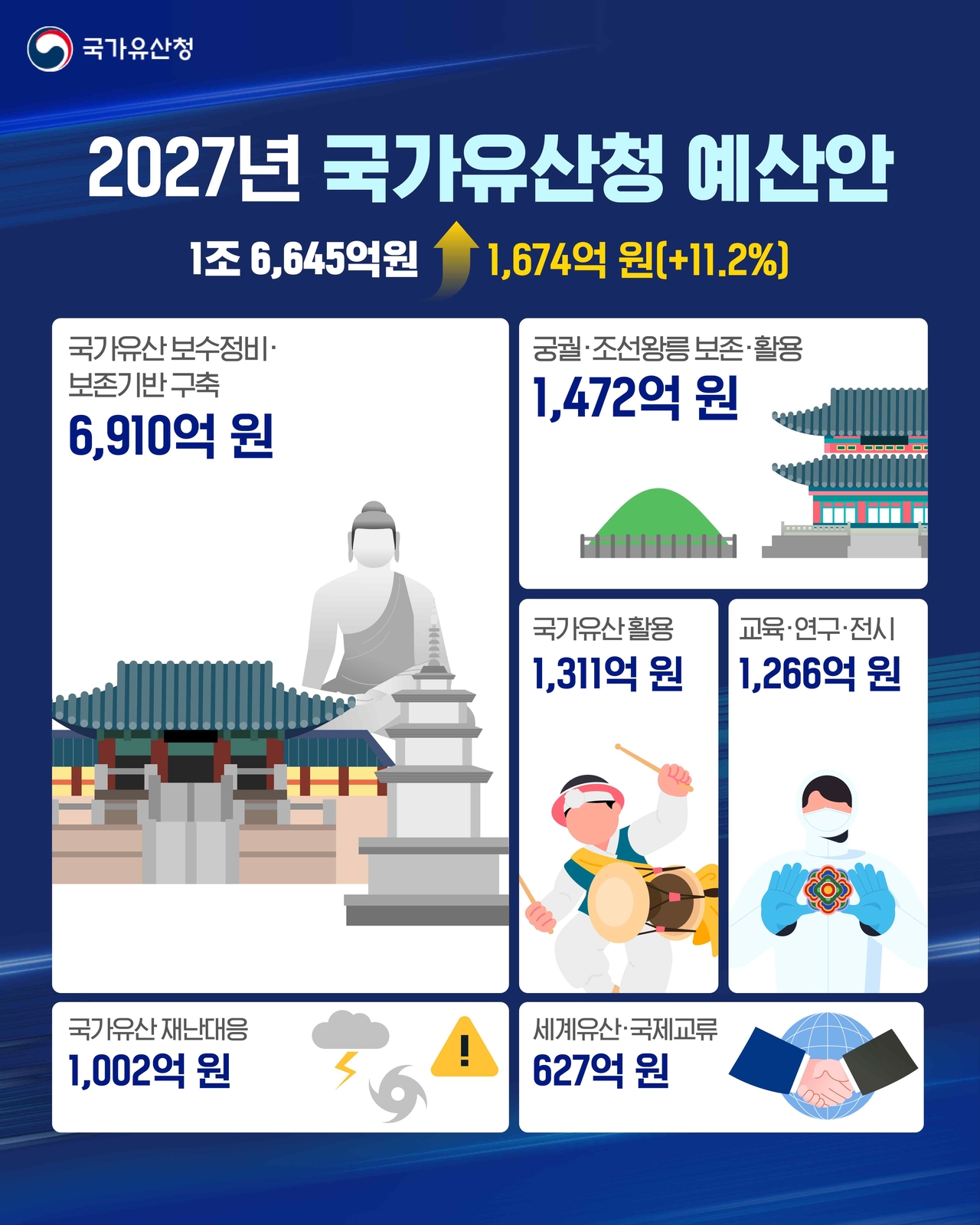
Funding is distributed across key areas including conservation, disaster prevention and global outreach. Repairs and conservation infrastructure account for the largest share at 691 billion won, followed by the preservation and utilization of palaces and Joseon royal tombs at 147.2 billion won, heritage utilization at 131.1 billion won, education, research and exhibitions at 126.6 billion won, heritage disaster response at 100.2 billion won, and World Heritage and international exchange at 62.7 billion won.
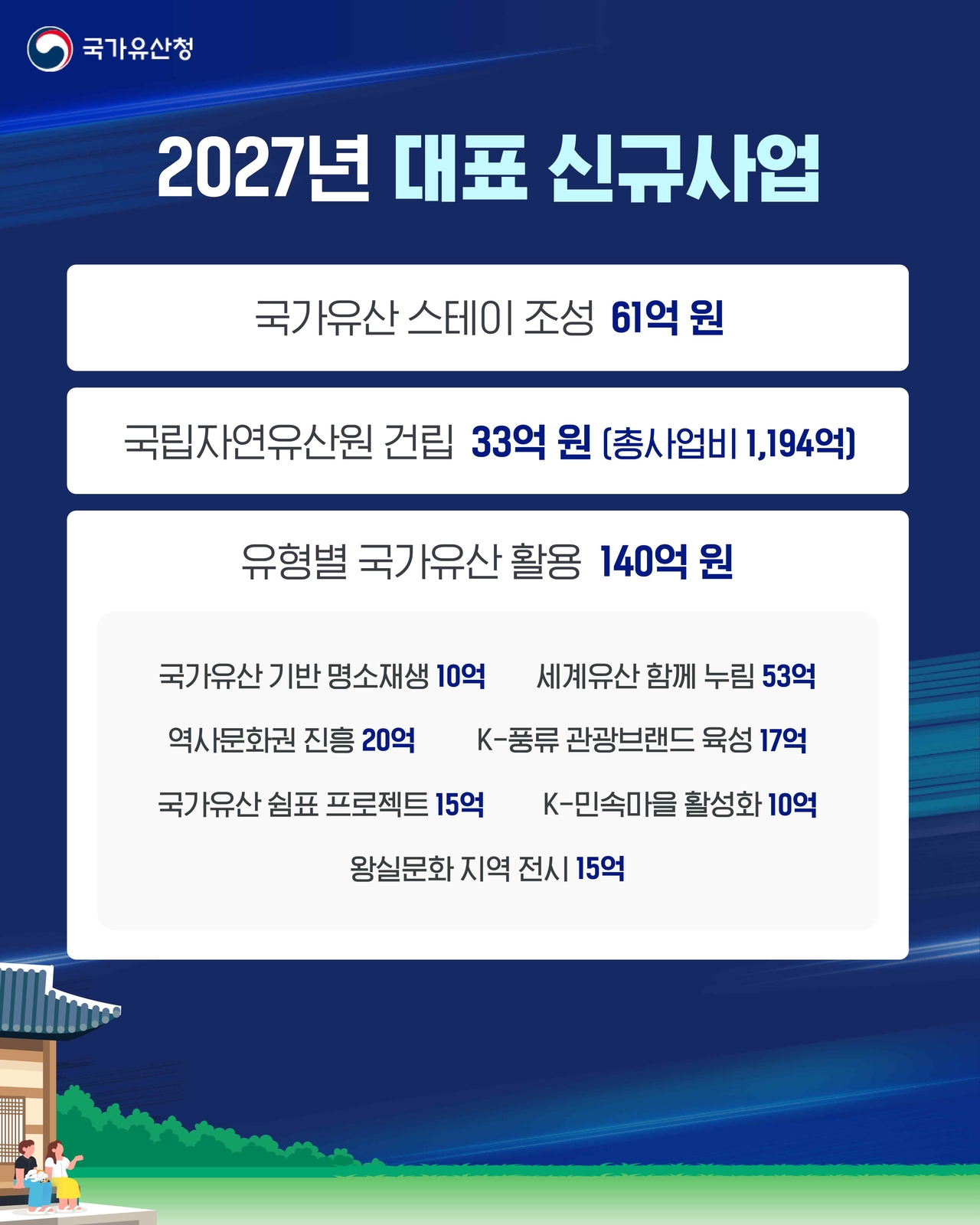
A wave of new initiatives will also be launched to create fresh growth engines, with investment focused on shifting from day-visit tourism to extended stays and on building future heritage infrastructure.
The centerpiece new project is a heritage stay program, allocated 6.1 billion won, which will renovate aging facilities at 10 nationally designated historic private estates across the country and upgrade them into modern overnight accommodations. A unified brand will be established to standardize service quality, with the aim of encouraging both foreign and domestic visitors to spend more time in local communities.
Another new initiative, a heritage rest-stop project that transforms historically and naturally significant sites into public relaxation spaces, received 1.5 billion won. The five inaugural sites are Hyeonchungsa Shrine in Asan, Chilbaekuichong in Geumsan, Manineuitchong in Namwon, Gwangneung in Namyangju and Uireung in Seoul.
Other new projects include 3.3 billion won for a national natural heritage institute, 2 billion won to promote historical and cultural zones, 1.7 billion won to develop a K-pungnyu tourism brand, 1.5 billion won for regional exhibitions of royal heritage, 1.5 billion won to operate a national historical and cultural zone promotion institute, 1 billion won to revitalize traditional folk villages, 800 million won to develop a flagship standing performance program for intangible heritage, 1 billion won to build a physical AI and robot-based intelligent disaster prevention system for cultural heritage, and 300 million won for a feasibility study on establishing a modern and contemporary heritage center.
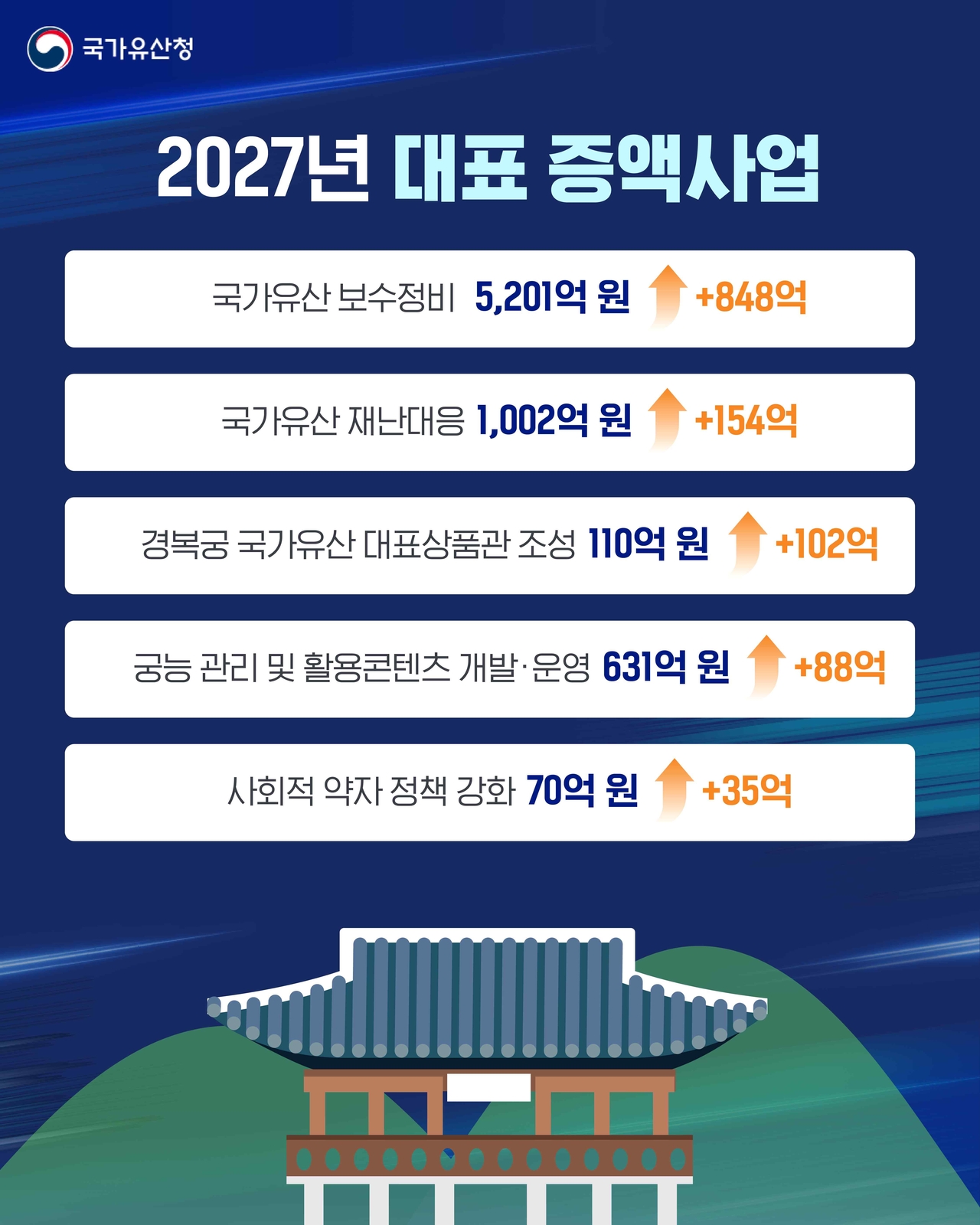
Investment in preserving cultural heritage in its original form and strengthening safety management has increased sharply. The measures aim to protect sites from climate change and compound disasters and reinforce the transmission of vulnerable categories such as natural and intangible heritage. The two largest increases go to heritage repair and maintenance, which receives 520.1 billion won — up 84.8 billion won — and conservation infrastructure, which receives 170.9 billion won, up 35.1 billion won. Additional allocations include 35.3 billion won for disaster safety management, 26.5 billion won to build a palace and royal tomb disaster prevention system, 22.1 billion won for a heritage care program and 13.9 billion won for emergency repairs.
Programs to extend cultural heritage access beyond the Greater Seoul area are also accelerating, with a focus on dispersing inbound tourists across the country, nurturing local historical and cultural assets, and revitalizing areas experiencing population decline. Specific allocations include 9.9 billion won for a national heritage visit campaign, 7 billion won for heritage education targeting vulnerable and marginalized groups, and 1 billion won for heritage-based landmark regeneration.
Infrastructure to support the development of regional landmarks includes 24.4 billion won for historical and cultural zone improvements, 8.2 billion won to develop historic cities, 3.7 billion won for excavation surveys of major sites in historical and cultural zones, 2.6 billion won to create heritage exploration hubs, and 900 million won to cultivate locally rooted heritage brands for historic cities.
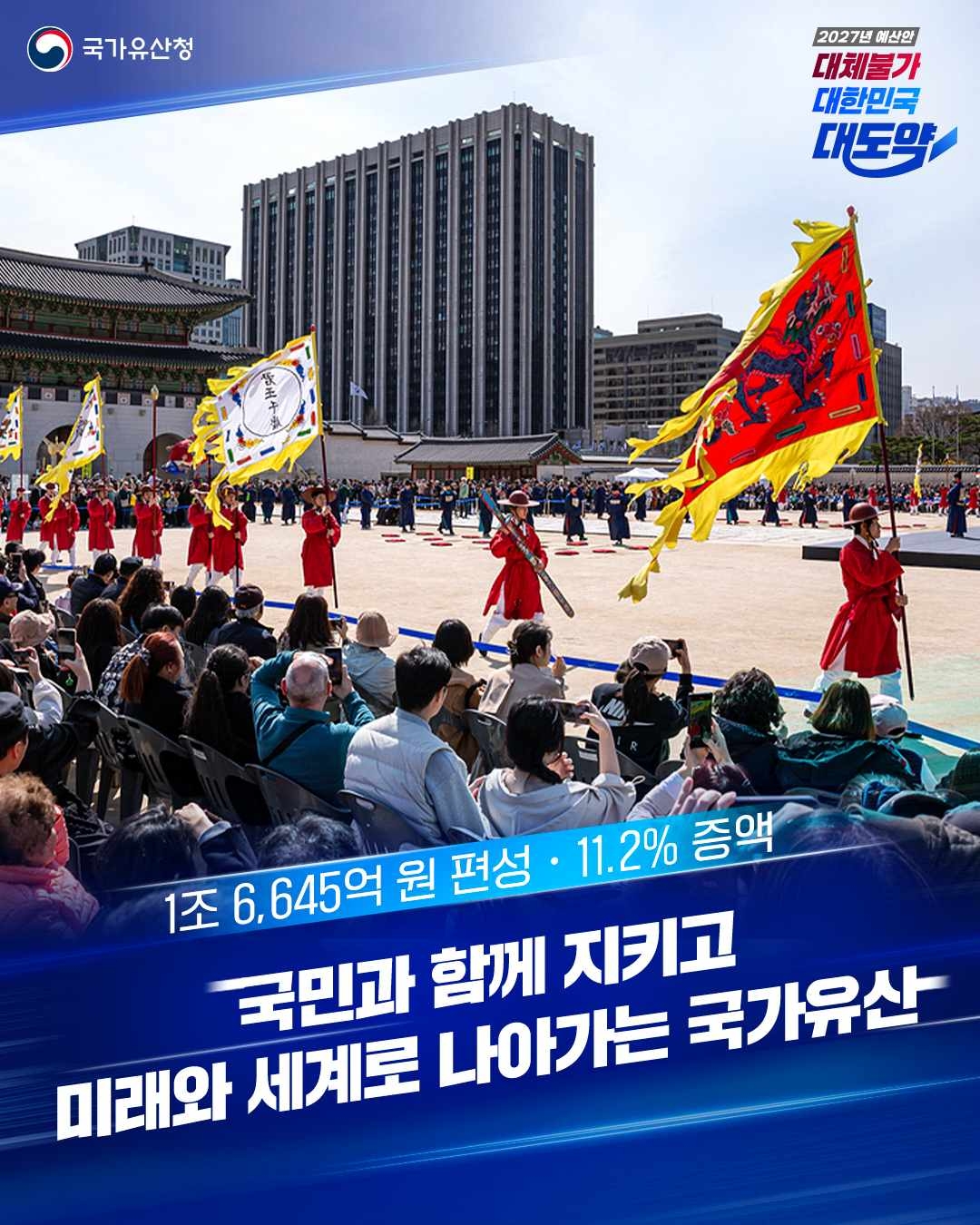
Budgets for global branding and international cultural heritage exchange have also been sharply expanded, with the goal of drawing 7 million foreign visitors to Korea's royal palaces. The strategy is to improve visitor services at the palaces and Joseon royal tombs — which set an all-time record for foreign visitors last year — and cement them as a flagship cultural brand for inbound tourists.
To that end, 11 billion won has been allocated to build a flagship heritage product hall at Gyeongbokgung Palace, up 10.2 billion won; 100.9 billion won for the management and utilization of palaces and Joseon royal tombs, up 7.8 billion won; and 12.4 billion won for the operation and management of the Palace Museum, up 6.7 billion won. Detailed line items include 10 billion won for the Royal Palace Culture Festival, 6.3 billion won for the royal guard-changing ceremony, 5.1 billion won to improve visitor infrastructure at palaces and royal tombs, 5.1 billion won for nighttime palace exploration experiences, 3.2 billion won for traditional culture programs, 2.9 billion won for palace and royal tomb exhibition content development, and 1.6 billion won for community-linked utilization.
International cooperation funding covers 10.1 billion won to build a UNESCO World Heritage interpretation center, 9.1 billion won for heritage development cooperation through official development assistance, 5.3 billion won for shared World Heritage enjoyment programs, 1.1 billion won for an exhibition showcasing outcomes of the Korea-Mongolia summit, 1 billion won to support the Busan World Heritage International Forum, 800 million won for underwater heritage exchange cooperation with Vietnam, and 550 million won for the preservation and utilization of Memory of the World inscriptions.
Field-oriented spending to ease the public's financial burden and create jobs for young people has also been expanded. The national subsidy for small-scale excavation surveys — which helps offset the cost of heritage excavations — rises to 22.3 billion won, extending support from 517 cases to 660 cases. To help the next generation enter the heritage industry, 1.6 billion won has been set aside for an industry internship program targeting 100 participants over six months, and 1.7 billion won for the preservation and utilization of unprocessed excavated artifacts, supporting 60 workers.
The 2027 budget proposal will be finalized after deliberation and a vote in the regular session of the National Assembly.
terry@heraldcorp.com