
Yanggu-gun, in Gangwon Province, sits roughly midway between the Chuncheon area to the west and the East Sea coastal city of Sokcho to the east.
Its in-between location makes the challenge of finding a breakthrough sharper than for most other border counties. The county's proximity to the foothills of Geumgangsan — the closest point accessible from South Korea — gives it a distinct identity as a potential peace-tourism destination.
County Chief Kim Wang-gyu is widely regarded as one of the three most active and diligent local leaders among the 18 cities and counties of Gangwon Province.
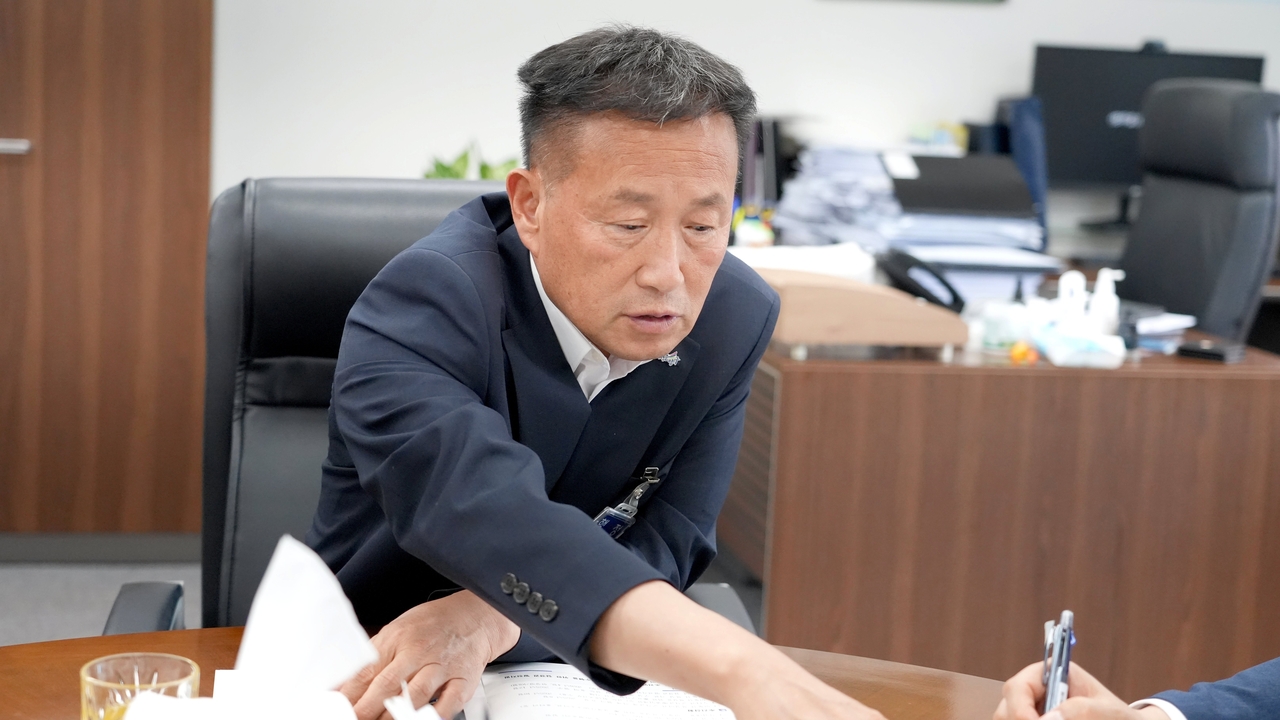
Kim, who has been tending to local affairs, made another trip to Sejong, where central government ministries are concentrated. On Wednesday morning, he visited the Ministry of Interior and Safety's Balanced Development Promotion Division and the Ministry of Planning and Budget's Investment Project Management Division in succession, holding working-level consultations on the direction of key pending projects and options for securing national funding.
At the Ministry of Interior and Safety, Kim proposed revisions to the project plans for two initiatives being pursued as special-circumstances area development projects: the "Cheongchun Yanggu Navel Water Play Park" and the "Paro Lake Flower Island Sky Bridge."
He explained that proceeding with the original plans would bring the combined project cost to 36 billion won ($26.3 million), and that covering the funding shortfall for the Paro Lake Flower Island Sky Bridge project alone with county funds would require close to 25 billion won — an excessive fiscal burden. Taking into account future operating costs, project viability and benefits to residents, he said a rational adjustment to the project scope was necessary.
Kim then asked the ministry to actively cooperate in facilitating the plan revisions.

Kim then visited the Ministry of Planning and Budget to request national funding for the bridging of the Yonghari–Yachonri section, the fourth construction zone of the Chuncheon–Sokcho east-west high-speed railway.
He stressed that the section had already been the subject of mediated negotiations following persistent requests from local residents and intervention by the Anti-Corruption and Civil Rights Commission, and that government-level support was needed to honor the spirit of that agreement without placing an undue burden on the county's already strained finances.
In the afternoon, Kim met with Ministry of Interior and Safety Vice Minister Kim Min-jae to brief him directly on the realities facing Yanggu-gun — including population decline, the threat of regional extinction and difficult local fiscal conditions — and to request the government's attention and support.
He also requested special local allocation tax grants to fund the construction of a county public library and a healing forest in Yanggu.
"For a community of 20,000 people trying to overcome the threat of extinction, passive administration has its limits," Kim said. "Wherever there is an issue to resolve, I will go directly to the relevant ministry, explain the realities on the ground, and keep knocking on doors until I find a way forward."
He added that even issues without immediate visible results would ultimately yield change through repeated visits and persistent persuasion. "I will run — regardless of distance or place — for results that residents can actually feel," he said. Kim is, by all accounts, a county chief who is rarely found sitting at his desk.
abc@heraldcorp.com




