Average merger review period reaches 64.5 days in first half of 2026
Surge in document-correction requests effectively pauses official review clock
Deal-closing uncertainty grows as M&A market bears the cost
![[Yonhap]](https://wimg.heraldcorp.com/news/cms/2026/09/01/ams.V01.photo.HDN.P.20210413.202104130000001698549377_P1.jpg)
The Korea Fair Trade Commission has taken significantly longer to complete merger reviews this year, with processing times stretching well beyond historical norms. Repeated requests for supplementary documents have pushed the period from initial filing to final approval to its longest on record.
In the mergers and acquisitions market, industry participants warn that deal-closing timelines have become increasingly difficult to predict as the Fair Trade Commission tightens its scrutiny — a trend they say is compounded by a broader regulatory crackdown targeting private equity funds and foreign capital.
According to data obtained through People Power Party lawmaker Cho Jeong-hun of the National Assembly's Political Affairs Committee, the average processing time for merger reviews in the first half of this year — measured from the date of filing to the date of disposition — reached 64.5 days. The figures cover only standard reviews, which involve detailed examination of market definition and competitive effects, and exclude simplified reviews.
That figure marks the first time the 60-day threshold has been breached since at least 2021. Processing times had consistently remained in the 40-to-50-day range over the preceding five years, making the 17.4-day jump compared with last year a sharp acceleration in delays.
Analysts attribute the surge past 60 days largely to a rise in time spent on document correction. The average document-correction period in the first half of this year came to 42.5 days — 16.2 days longer than last year and well above the range seen over the past five years. The average number of document-correction requests also climbed, reaching 2.45 per case in the first half of this year, compared with a range of 1.26 to 1.77 over the previous five years.
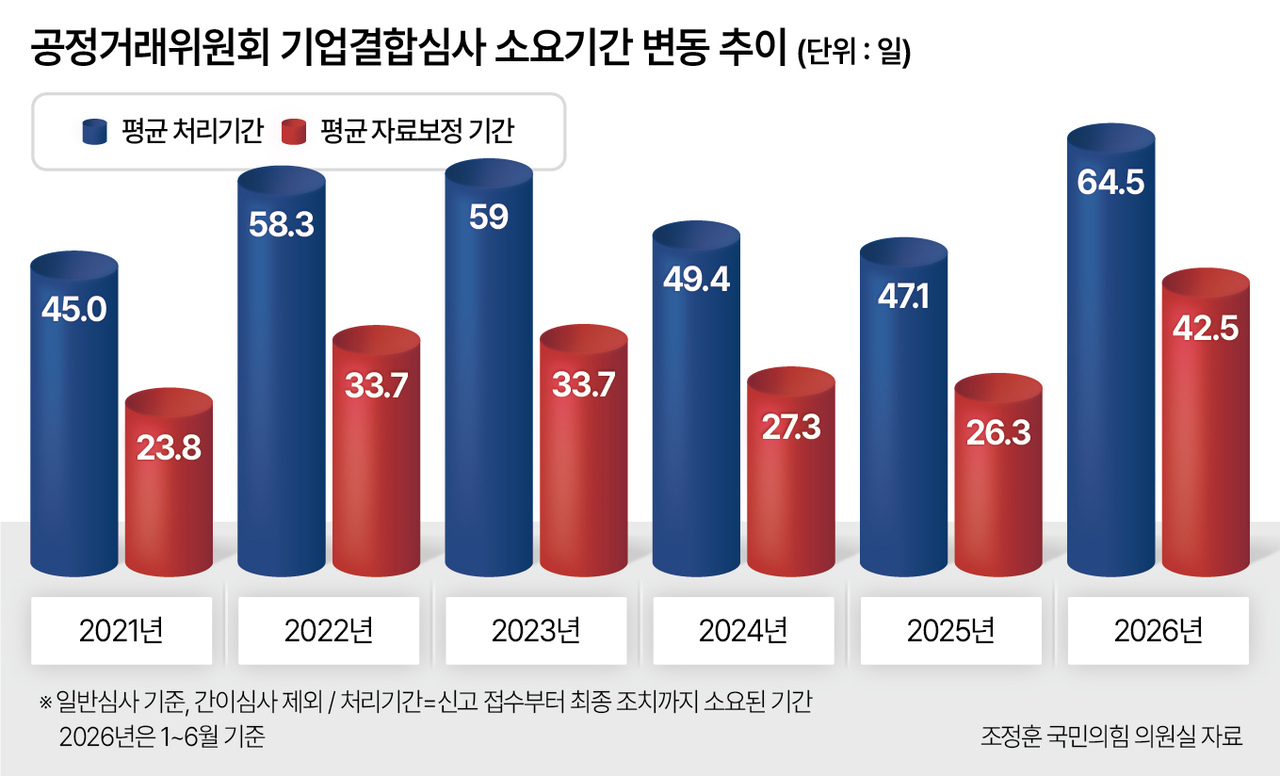
Capital market participants say the shift in the Fair Trade Commission's review posture is being felt acutely on the ground. Reviews that once wrapped up within one to two months now routinely take three to four months or more, throwing deal-closing schedules into disarray.
"The number of items the Fair Trade Commission demands has grown far beyond what it used to be, and sometimes we are asked to submit documents that are not really necessary," said one M&A industry official. Another practitioner said foreign companies have at times refused to hand over materials and clashed with the commission after being asked for documents subject to corporate confidentiality policies, including information on affiliates.
Delays are already disrupting real transactions. Han & Company, a private equity fund manager, signed an agreement in March to sell its stake in Korean Air C&D Services to Korean Air, but is still awaiting merger approval. A deal by Affirma Capital to acquire the flexible copper-clad laminate business unit of Toray Advanced Materials Korea has also been stuck at the merger review stage for more than a year.
Under the current Fair Trade Act, the statutory merger review period runs 30 days from the filing date, extendable by up to 90 days for a maximum of 120 days. Statistics for the past five years and the first half of this year show that the statutory review period — total processing time minus document-correction time — has held at an average of roughly 20 to 25 days per year.
While that figure technically stays within the legal deadline, industry participants say there is a wide gap between the statutory clock and what companies actually experience, because document-correction periods are excluded from the statutory count. "When the Fair Trade Commission issues a correction request, the statutory review clock stops — so document correction has in effect become a tool for extending the official review period," one M&A industry official said. "The result looks like strict compliance with the legal deadline on paper, but the time the market actually has to wait keeps growing."
Behind the rise in correction requests and the lengthening reviews, analysts say, lie concerns over technology and data leakage and a stricter stance toward private equity funds. Public anxiety has grown that core technologies or consumer data could flow overseas when foreign private equity firms or foreign companies acquire domestic firms, and calls for tougher standards on private equity broadly have grown louder.
"It seems the commission is scrutinizing deals more rigorously than before, conscious of the social mood and the gaze of politicians and the media," said one capital market official. An investment banking official said the commission faces particular pressure when technology leakage or national security concerns arise in M&A deals involving defense or energy companies, adding that repeated correction orders have in some cases pushed approval back by six months or more.
The fallout from review delays is spreading across capital markets and corporate management more broadly. Industry observers warn that missing the critical window for restructuring and M&A could erode industrial competitiveness. Investors face a more complicated calculus as well: deal-closing uncertainty and financing costs have risen, and lengthening reviews are reducing the number of investments that can be executed in a given year.
"While approval is being delayed, the target company faces paralyzed decision-making and finds it difficult to conduct normal business operations, making operational disruption inevitable," said one investment banking official. The official added that buyers risk missing the optimal investment window and face the threat of value erosion, while sellers must continue bearing the burden of maintaining the contract and managing the company until they receive the final payment.
Merger review delays are no longer seen as a variable specific to certain transactions but as a fixed cost that every deal must absorb. "When advising on M&A, we now have to structure contracts on the assumption that the merger review could run three to four months longer than expected, and proceed while accepting the extended timeline and the risk of closing delays," said one M&A attorney.
Lawmaker Cho said merger reviews must be rigorous to protect market competition, but warned that unpredictable timelines caused by repeated document-correction requests could chill legitimate investment and corporate restructuring. "The Fair Trade Commission should request all necessary documents comprehensively and clearly at the outset, and provide transparent guidance on the reasons for corrections and the expected review schedule," he said, and went on to say that "rigorous review and swift, predictable administration are not an either-or choice."
an@heraldcorp.com