KB Real Estate analysis of jeonse prices and income-bracket PIR
Top-quintile jeonse PIR hits 7.5, highest in 44 months
Warning signs flash for middle- and low-income housing ladder
![A real estate agency in Gangnam-gu, Seoul, displays listings marked as jeonse contracts already signed. [Yonhap]](https://wimg.heraldcorp.com/news/cms/2026/09/01/rcv.YNA.20260817.PYH2026081704730001300_P1.jpg)
Even Seoul's highest earners would need to save every won of their income for seven and a half years to secure a jeonse lease on an apartment in a prime location, new data shows — a sign that soaring jeonse prices have far outpaced income growth.
Jeonse barrier at its highest in 44 months
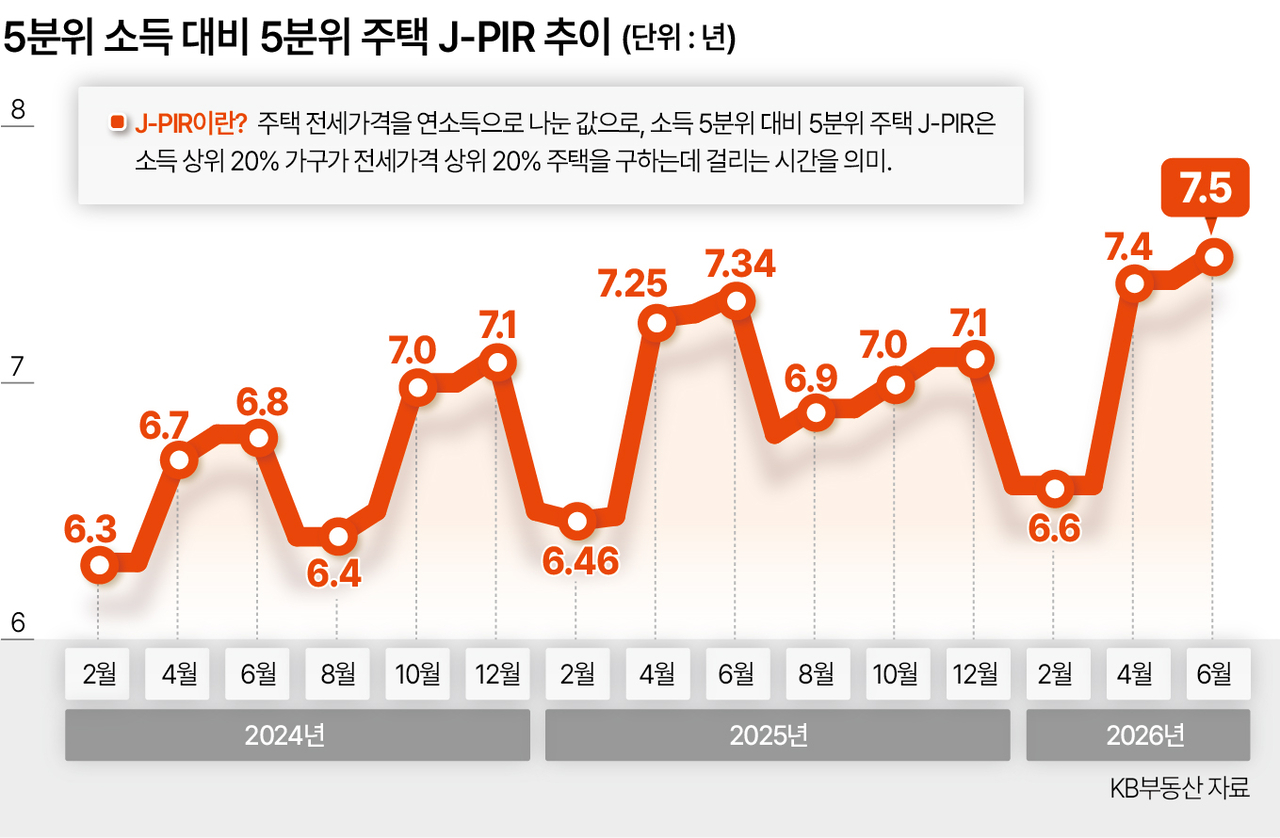
According to KB Real Estate, the J-PIR — the ratio of jeonse deposit to annual income — for Seoul households in the top income quintile (the top 20 percent, two-or-more-person urban households) stood at 7.5 in the second quarter of this year, based on the top 20 percent of jeonse deposit prices. The J-PIR, or price-to-income ratio, measures how many years of total income a household would need to save to cover a jeonse deposit, meaning top earners must set aside their entire salary for seven years and six months to afford a prime-area apartment on jeonse terms.
That figure is the highest since December 2022, when it reached 7.7 — a 44-month peak that reflects how steeply jeonse prices have climbed. After the government introduced the three-part lease reform law in July 2020 — covering contract renewal rights, rent increase caps and a lease registration system — jeonse prices surged all at once, pushing the ratio as high as 8.5. It gradually stabilized after that, but has been rising again as tightened owner-occupancy requirements have reduced the supply of jeonse listings and pushed prices higher.
The affordability gap becomes even starker when top-tier jeonse prices are measured against median incomes. A median-income household in Seoul — the third quintile — would need to save all of its earnings for about 16 years (J-PIR: 15.6) to afford a top-quintile apartment jeonse in a sought-after school district or well-connected neighborhood.
For low-income households in the bottom quintile, the housing ladder has in effect collapsed. Securing a top-quintile apartment jeonse would require saving their entire income for 40 years (J-PIR: 39.9).
Middle-tier jeonse deposits jump 11.5% in a year
Actual jeonse deposit increases are outpacing both income growth and inflation. According to KB Real Estate, the average jeonse price for top-quintile apartments in Seoul reached 1.33 billion won ($964,000) in August, up 6 percent from 1.25 billion won a year earlier. The mid-market third-quintile jeonse price, which reflects what middle-income households typically seek, surged 11.5 percent over the same period, from 566.42 million won to 631.69 million won.
The average jeonse price across all Seoul apartments also rose to 711.78 million won, up nearly 10 million won from 704.58 million won the previous month. In the 14 districts north of the Han River, the average climbed from 586.85 million won to 593.51 million won, while the 11 districts in Gangnam rose from 811.04 million won to 818.77 million won.
Jung Jae-hoon, an assistant professor in the Department of Urban Planning and Real Estate at Dankook University, said the rising J-PIR signals that jeonse price increases have overtaken household income growth, pushing housing costs to a critical threshold. "This intensifies financial pressure on genuine end-users and could ultimately trigger a downward shift in housing, with jeonse demand being pushed into semi-monthly or full monthly-rent arrangements," he said.
Jung added that rising jeonse prices could also destabilize the home-purchase market by stimulating buying demand. "To ease the current anxiety, the government must go beyond short-term loan support and send a clear signal that quality housing will be continuously supplied in the locations buyers want and prefer," he said.
The surge in jeonse prices is already driving more people to buy instead. An analysis of first-time home purchase data for collective residential buildings — apartments, row houses and officetels — from the Supreme Court Registry Information Plaza showed that 8,443 first-time buyers purchased property in Seoul in July, as of Monday. That is the highest monthly figure since November 2021, when 7,886 transactions were recorded.
hss@heraldcorp.com