Policy forum on inclusive finance held at National Assembly Library
Lending volume more than doubles last year's figure
50 billion won support fund to be established
Reform of Credit Union Act to allow investment in other entities urged
Chairman Ko Young-chul says rational policy framework must follow
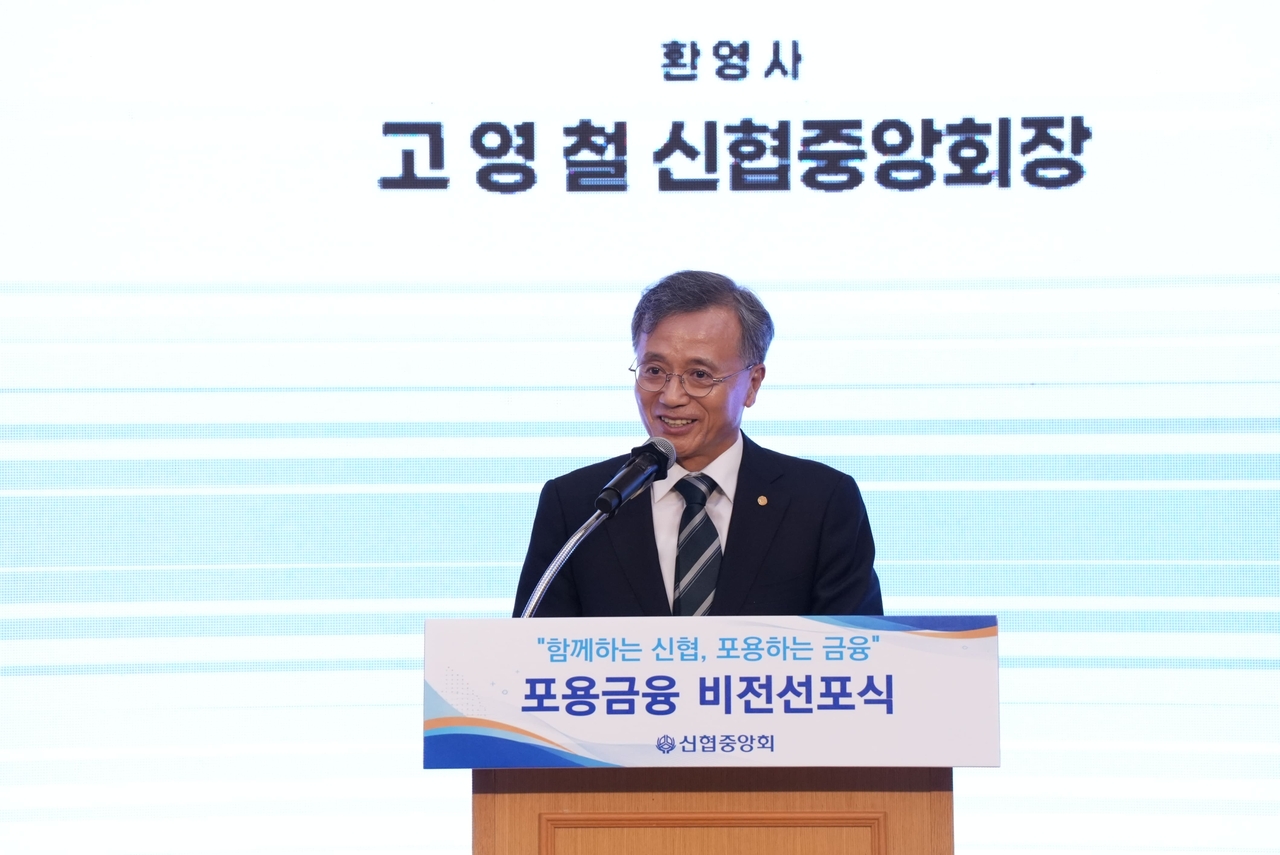
The National Credit Union Federation of Korea said it will expand annual lending to financially vulnerable groups — including low- to mid-credit and low-income borrowers — to 1 trillion won ($724 million), more than double the volume handled last year.
The federation said deregulation of related rules, including the loan-to-deposit ratio calculation and the lending cap for non-members, must accompany the expansion to make inclusive finance sustainable.
The plan was unveiled Friday at a policy forum on inclusive finance held at the National Assembly Library. Chairman Ko Young-chul said inclusive finance "is not something new for credit unions — it is the reason credit unions were born," adding that "rational systems and policies must provide support, as the efforts of credit unions alone are not enough."
The plan centers on 200 billion won in mid-rate private loans, 300 billion won in loans for low- to mid-income borrowers, 200 billion won in preferential loans for non-metropolitan regions, and 100 billion won in social solidarity finance. The federation also plans to launch new non-face-to-face credit loan products, including online versions of the Saitdol and Haetsal-lon programs. The total is roughly double the 459.8 billion won in inclusive finance handled by local credit union branches as of end-2025. Last year's figures included 179 billion won in loans to low- to mid-credit borrowers, 132.5 billion won to low- to mid-income borrowers, 22.2 billion won in social solidarity finance, 4.2 billion won in non-metropolitan preferential loans, and 121.9 billion won in policy-backed microfinance.
Default risk from the expanded lending will be absorbed by a dedicated internal fund. The federation plans to establish a 50 billion won inclusive finance support fund to cover principal losses and interest subsidies. The central body will contribute more than 5 billion won annually, with participating credit union branches also contributing a portion of the interest income generated from eligible loans. The loss coverage rate will be applied on a sliding scale of around 50 percent, adjusted for the default rate of each product. Through this mechanism, the federation set a target of reaching about 100,000 borrowers with inclusive finance products by 2030.
The federation also put forward specific regulatory reform requests. Kang Hyeong-min, head of the federation's credit support division, proposed at the forum that only 90 percent of inclusive finance loan volumes be counted as loans when calculating the loan-to-deposit ratio; that non-metropolitan, low-income and mid-rate new loans be counted at 150 percent when calculating the non-member lending cap of 33 percent; that amendments to the Credit Union Act allow investment in other legal entities; and that asset soundness exemptions be applied to loans made to social enterprises and cooperatives. He also noted that credit unions are the only mutual finance institution without a legal basis for investing in other entities.
Calls for deregulation at the federation level were also raised. These included allowing the central body to extend loans independently without linking them to individual branch loans, converting the single-borrower lending limit to a ratio-based system, easing the cap on large loans, and excluding loans to the central body's subsidiaries from the corporate lending limit. A request was also made to allow branches under financial improvement or structural weakness measures to participate in central body-linked lending.
Behind the push lies the weakened financial condition of the credit union sector. According to Kim Yong-gi, chairman of the Production and Inclusive Finance Research Society, who presented at the forum, credit unions had a nationwide network of 862 branches, 6.63 million members and total assets of 160.5 trillion won as of end-2025 — but roughly 87 percent of collateral was real estate-related and policy-funded loans accounted for just 0.3 percent of the total. The sector posted a net loss of 344.2 billion won in 2025.
Kim defined the role of credit unions not as a substitute for banks but as a "community touchpoint," and proposed a service delivery model linking discovery, diagnosis, referral, execution and management. He said that connecting borrowers to debt restructuring, welfare and business support services — rather than direct lending — should also be recognized as an achievement of inclusive finance.
Oh Tae-rok, a research fellow at the Korea Institute of Finance, said that while building a credit scoring system and a risk-sharing framework at the federation level is a prerequisite, supervisory principles to prevent reckless lending by individual branches must also be established. He raised the need to consider differentiated regulation that accounts for regional disparities and differences in business models among branches.
Financial Services Commission Chairman Lee Eok-won said in a congratulatory address that "the mutual finance sector has faced considerable difficulties in terms of soundness in recent years, including the expansion of bad debt in real estate project financing," but added that "firmly maintaining the basics of soundness and internal controls is the starting point for sustainable inclusive finance."
won@heraldcorp.com