Seoul to recruit applicants for apartment-type Mirinaezip next month
Gangnam-area deposits reach 1 billion to 1.4 billion won
Jeonse prices climb while asset eligibility threshold barely moves
Seoul city says it is reviewing separate classification for high-priced units
![Cheongdam Le El apartment complex in Cheongdam-dong, Gangnam-gu, Seoul. [Provided by Lotte Engineering & Construction]](https://wimg.heraldcorp.com/news/cms/2026/08/28/news-p.v1.20260224.3dc89d60fb2343bba00ca723771adaa9_P1.jpg)
Rising Seoul housing prices have pushed deposits for Mirinaezip — a long-term jeonse housing program for newlyweds — past 1 billion won ($724,000) in Gangnam-area units. Yet the total asset ceiling that applicants must meet to qualify remains fixed at 662 million won for a dual-income couple, leaving the threshold far behind surging home prices. Critics warn that with mortgage regulations tightening and interest rates rising, even high-earning newlyweds struggle to bridge the gap, making the program, in effect, a windfall for households that can tap parental wealth.
'Public rental at 1 billion won': Raemian Firstige 84㎡ deposit approaches 1.4 billion won

According to the eighth recruitment notice for the Long-Term Jeonse Housing 2 program, which the Seoul Housing & Communities Corporation (SH) will open for applications next month, about 90 units across seven complexes carry deposits exceeding 1 billion won. These include Cheongdam Le El (59 square meters, 1.17 billion won), Raemian Daechi Palace (59 square meters, 1.17 billion won) and Raemian One Pentas (59 square meters, 1.15 billion won).
The apartment-type Mirinaezip program, introduced by the Seoul Metropolitan Government in 2024 for prospective newlyweds without homes, is a public rental housing scheme that offers incentives including up to 20 years of residency upon childbirth after move-in, with asset and income requirements waived at contract renewal. Households with three or more children receive a priority purchase right to buy the unit at 80 percent of market price after 10 years, making the program widely regarded in the industry as one of the key pathways to homeownership for the middle class.
"Mirinaezip rents are set based on market prices, so they inevitably rise when home prices go up," a Seoul city official said. "New recruitment units undergo an appraisal before the announcement to reflect current market values."
Home prices surge, but asset threshold barely budges — up just 1% in two years
The core problem is that while rising home prices have pushed up jeonse costs, the asset eligibility threshold for Mirinaezip has failed to keep pace.
For units under 60 square meters in exclusive use area, the monthly household income ceiling is 7.04 million won — equivalent to 120 percent of the average for a childless couple of two — and the total asset limit is 662 million won. Compared with two years ago, when the figures stood at 6.5 million won and 655 million won respectively, income eligibility has risen about 8 percent while the asset threshold has grown by only about 1 percent. That contrasts sharply with deposit increases for the program itself: the deposit on a 59-square-meter Mirinaezip unit at Cheonggyesan SK View in Seongdong-gu climbed about 7 percent over the same period, from 503.1 million won to 537.42 million won.
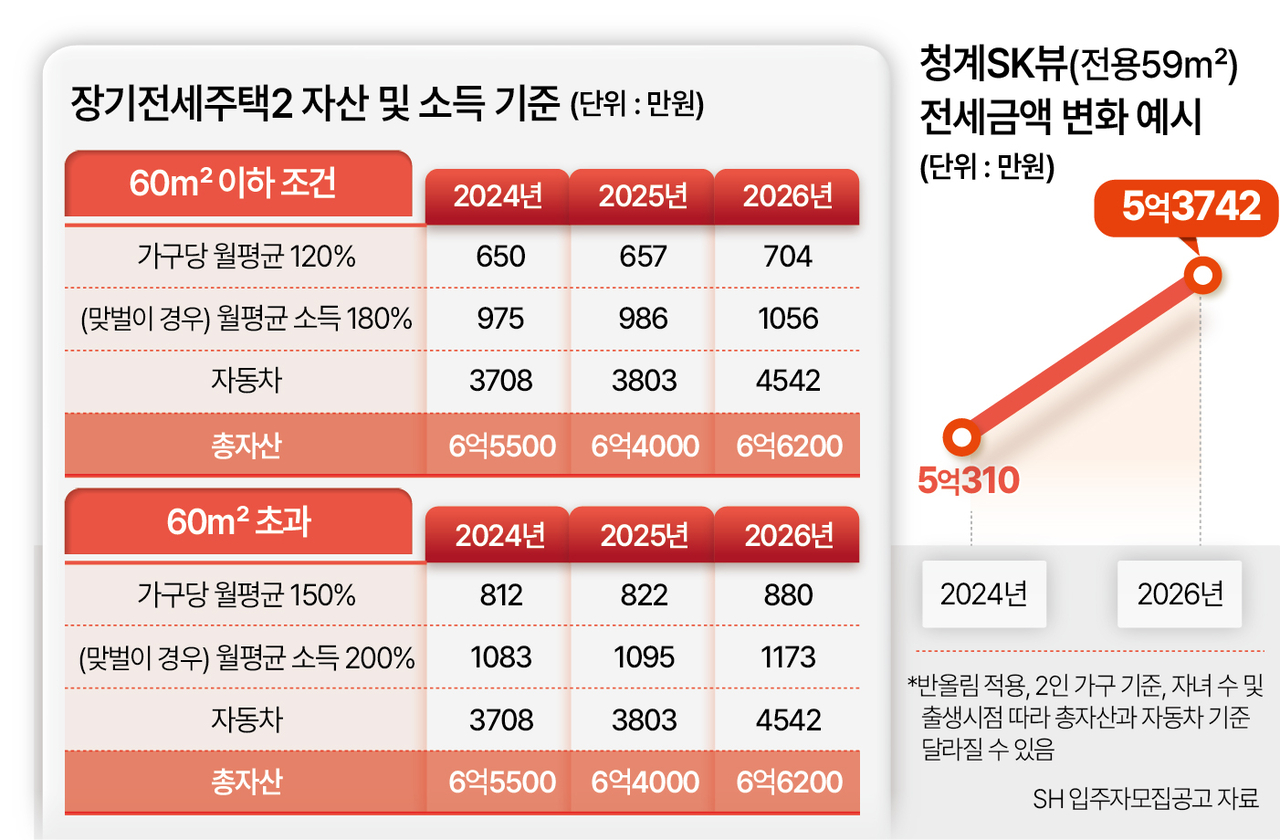
The gap looks even wider against average jeonse prices. According to KB real estate data, the average jeonse price for Seoul apartments stood at 615.85 million won in August 2024 and has since risen about 16 percent to 711.78 million won this month.
In general, the Ministry of Land, Infrastructure and Transport sets the total asset threshold for long-term jeonse housing annually, drawing on indicators including household income trends and consumer price surveys. Mirinaezip, as Seoul's own variant of the program, already applies a higher asset ceiling to reflect the city's above-average wages and wealth relative to the national average. "This year the national base asset figure is 345 million won, but Seoul applies a regional coefficient of 1.92, which brings the Mirinaezip asset threshold to 662 million won," an SH official said.
![Raemian Firstige in Banpo-dong, Seocho-gu, Seoul. The Long-Term Jeonse Housing 2 deposit for an 84-square-meter unit is around 1.4 billion won. [Herald Business DB]](https://wimg.heraldcorp.com/news/cms/2026/08/28/news-p.v1.20260828.465a7ae7263e45af8abc142086415dee_P1.jpg)
A program meant to build assets — but only a few can get in
As the gap between deposits and the asset ceiling widens, applying for a Mirinaezip unit in prime locations has become virtually impossible without securing hundreds of millions of won from outside sources. Analysts say this structurally favors households that can access large sums on favorable terms — through parental support or loans. With commercial bank mortgage rates forecast to reach 8 percent a year, financing through loans looks out of reach for most households outside the top income bracket, putting the program at odds with the government's broader push to curb household debt by restricting jeonse loans.
There are also administrative blind spots. SH evaluates eligibility in principle as of the date of the applicant recruitment announcement. This means that even if an applicant meets the asset threshold on the announcement date, there is nothing to stop them from receiving gifts or arranging intra-family loans to cover the remaining deposit after being selected. Because the eligibility review is based on assets held at a specific point in time, controlling how applicants actually finance the deposit at the move-in stage is difficult.
"This is a point where upper-middle-class households — those who can meet the asset requirement and then arrange financing later — can strategically target these units," one industry official said. "Asset checks cannot be conducted on an ongoing basis due to personal data protection constraints."
Such an approach is not illegal. Similar use of structural features is common in public pre-sale housing as well, and timing asset and income assessments strategically is widely understood in the industry as a legitimate tactic. "It is similar to adjusting the timing of a gift to qualify for an apartment subscription, or choosing not to own a vehicle and using a rental car instead to stay within the asset limit," one real estate expert said.
Why can't the asset threshold keep up with home prices?
The rapid pace of home price increases and the widening price gap between districts are seen as the root causes of the problem.
Ham Young-jin, head of the real estate research lab at Woori Bank, said the asset threshold's slow rise relative to income criteria in recruitment notices does reflect a failure to track the speed of asset appreciation. "But underlying this is probably the assumption that people with assets above a certain level are simply not the intended beneficiaries of public rental housing policy," he added.
Park Ji-min, head of Wolyong Apartment Subscription Research Institute, said the asset threshold needs to move more in line with inflation and rising taxes. "The fact that high-priced Mirinaezip units — which can be converted to ownership — could become a strategic homeownership tool for a specific segment of the population is something that needs to be thought through carefully," Park said.
The bigger question is what comes next. Redevelopment projects are actively advancing across Gangnam and the Han River belt, where project viability is highest. At current price levels, it is only a matter of time before the number of Mirinaezip units priced above 1 billion won grows further. The 59-square-meter unit at Otiere Banpo in Seocho-gu, offered this year at 998.4 million won, is widely expected to exceed 1 billion won if re-listed next year. Units set to come from Banpo DH Claist, scheduled for move-in next year, and from the Apgujeong Hyundai reconstruction project currently under way are also virtually certain to surpass the 1 billion won mark.
Why Seoul and the land ministry are treading carefully on easing the asset cap
The Ministry of Land, Infrastructure and Transport is cautious about loosening the asset threshold. "Because the supply of public rental housing is currently limited, raising the asset ceiling could trigger a surge in demand for certain units," a ministry official said, adding: "If vacancy rates rise or competition falls, there would be room to reconsider, but absent a request from Seoul city, we have no plans to ease the criteria further."
In practice, if the asset cap on lower-priced Mirinaezip units were lifted, the program would likely tilt toward a different set of applicants who have already accumulated a degree of wealth. The ministry's concern is that under the current combination of tight lending rules and a strained jeonse market, low-income, low-asset households could be squeezed out entirely.
Given the wide variation in home prices across Seoul's 25 autonomous districts, the city government also has reason to move carefully before adjusting the asset threshold.
"We are aware that the number of high-deposit Mirinaezip units approaching 1 billion won is growing, and we recognize the limitations of the current asset criteria," a Seoul city official said. "Over the long term this could also lead to vacancy problems, so we are reviewing alternatives — including creating a separate classification for high-priced long-term jeonse housing — that would accommodate demand from the middle class and above."
hope@heraldcorp.com