VIG Partners signs SPA to acquire Yulgok
Aviation demand recovery set to benefit parts makers
Strong earnings outlook draws crowded PE field
![Yulgok, an aircraft and mechanical parts manufacturer founded in 2000. [Yulgok website]](https://wimg.heraldcorp.com/news/cms/2026/08/28/news-p.v1.20260828.f9b3ab3b4f414bac97210037fb625f7d_P1.png)
Aircraft parts manufacturer Yulgok is set to change hands to VIG Partners after a fiercely contested bidding process among private equity fund managers. JKL Partners and WJ Private Equity, which took a direct hit from the COVID-19 pandemic shortly after their initial investment, are now poised to recoup more than three times their principal after holding on to the company for over six years.
Invested at peak earnings — then held firm through COVID-19
VIG Partners signed a share purchase agreement last week to acquire a 47.09 percent stake held by the JKL-WJ consortium as well as a portion of the shares held by founder and Chief Executive Wi Ho-cheol, according to investment banking industry sources Saturday. Yulgok's total enterprise value was assessed in the low-to-mid 400 billion won ($290 million) range.
The relationship between Yulgok and the JKL-WJ consortium dates to 2019, when the consortium secured a 31.25 percent stake through the acquisition of existing shares. At the time, Yulgok was posting record earnings on a standalone basis — sales of 110.3 billion won and operating profit of 16.3 billion won. In hindsight, the consortium invested when the company's valuation was at its highest.
Almost immediately after the acquisition, the COVID-19 pandemic struck. Border closures caused passenger demand to collapse, prompting airlines to defer orders for new aircraft. Boeing and Airbus sharply cut their output, and the impact rippled beyond the planemakers to the entire parts supply chain.
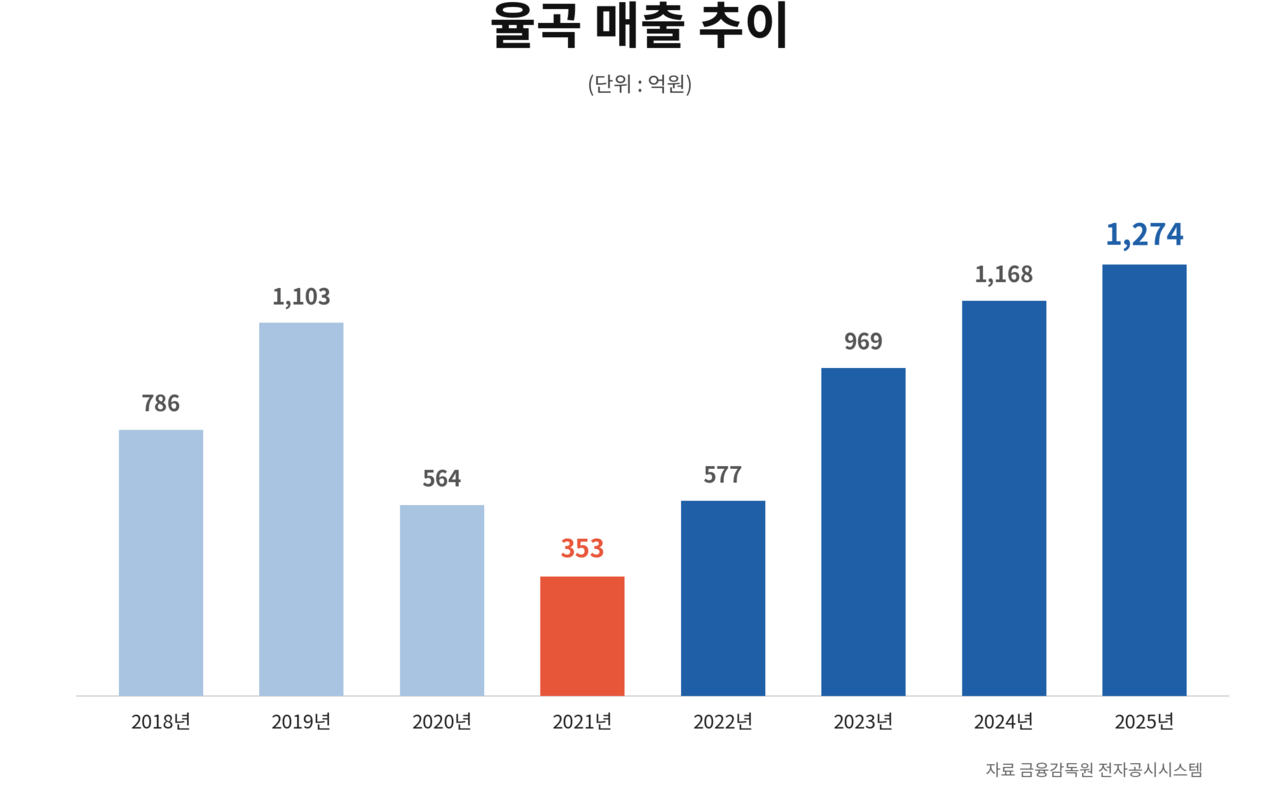
Yulgok's sales were cut nearly in half within a year, falling to 56.4 billion won in 2020, and the company swung to an operating loss of 6.9 billion won. The consortium was no longer focused on investment returns — it was worried about the company's survival. It responded by making additional investments, raising its stake to 47.09 percent through preferred share subscriptions to help the company weather the crisis.
Recovery took years. Sales slid further to 35.3 billion won in 2021. Around the same time, rival aircraft parts maker Ast, unable to absorb the COVID-19 shock, saw its share price and earnings tumble. The company was ultimately acquired by Uamco (United Asset Management Corp.) for 110 billion won in 2023 and entered a workout program.
Yulgok began to turn around in 2022. By 2024, sales and operating profit had recovered to 116.8 billion won and 16.8 billion won, respectively — back to 2019 levels. Last year, the company posted sales of 127.4 billion won and operating profit of 15.4 billion won.
Valuation soars as passenger and defense demand converge
The JKL-WJ consortium is believed to have committed a total of between 50 billion and 60 billion won to Yulgok. With the company's enterprise value now in the low-to-mid 400 billion won range, the consortium's 47.09 percent stake is worth roughly 200 billion won — implying a return of more than three times the original investment.
The key dynamic is the lag between the recovery in passenger demand and the improvement in aircraft parts makers' earnings. The aircraft parts industry is structured as a pyramid, with major planemakers such as Boeing and Airbus at the top, followed by large structural component manufacturers and precision machining and assembly firms in successive tiers. Even after Boeing and Airbus ramp up orders, it takes considerable time to source and deliver engines, fuselages, wings, cabin equipment and other components before a finished aircraft can be completed and handed over.
That is why analysts say Yulgok's current earnings do not yet fully reflect the recovery in passenger demand or the recent expansion in defense orders. The analogy is water heated to 99 degrees Celsius — just before it boils, little visible change is apparent on the surface. Aircraft parts makers similarly show limited earnings improvement until output crosses a certain threshold.
![Yulgok's manufacturing facility in Sacheon, South Gyeongsang Province, one of the company's main production sites. [Yulgok website]](https://wimg.heraldcorp.com/news/cms/2026/08/28/news-p.v1.20260828.0400ccd229c840fa889b84df5b6dda7d_P1.png)
In a report published in January titled "The Era of an Aviation Industry Supercycle: New Opportunities for Parts Makers," Samil PwC said South Korean mid-sized parts manufacturers had significantly raised their profile in the global supply chains of major planemakers. The firm forecast that a short-term earnings slowdown among aviation parts stocks stemmed from supply chain disruptions, and that earnings were likely to normalize once bottlenecks eased.
The heavy participation of private equity funds in the Yulgok bidding process reflects that outlook. The final round attracted a number of prominent domestic and foreign funds, including VIG Partners, Stic Investments, Anchor Equity Partners and KCGI.
Because private equity funds typically need to exit investments within five to seven years, they commit capital only when they are confident they can grow a company and sell it at a higher price. Unlike strategic investors, who can price in synergies with existing businesses, private equity funds must generate returns solely from Yulgok's own cash generation and near-term growth potential. The funds appear to have concluded that the moment when expanded commercial aircraft production and rising defense orders translate into stronger earnings for Yulgok is fast approaching.

park.jiyeong@heraldcorp.com