This year's growth outlook raised to 3.3%
IT manufacturing reshaping economic structure
Stock market correction weighing on consumption
![Bank of Korea Deputy Governor Lee Ji-ho speaks at an economic outlook briefing Thursday afternoon. [Bank of Korea]](https://wimg.heraldcorp.com/news/cms/2026/08/27/news-p.v1.20260827.17dc8763af1849bf970135762c2ef967_P1.jpg)
The Bank of Korea raised its economic growth forecasts for both this year and next year, citing a structural shift toward IT manufacturing led by semiconductors. The central bank said this transformation is set to lift the economy's growth trajectory to a higher level. While growth this year has been driven mainly by exports, the bank expects domestic demand to play an increasingly larger role going forward.
"The economic structure is being reorganized in a direction where IT manufacturing accounts for a larger share of the overall economy," Lee Dong-ryeol, head of the bank's research department, said Thursday at an economic outlook briefing.
The Bank of Korea's Monetary Policy Board, in its revised economic outlook released that day, raised its forecast for real GDP growth this year to 3.3% from 2.6% — an upward revision of 0.7 percentage points. The growth forecast for next year was lifted by 0.8 percentage points, to 2.9% from 2.1%.
Lee said the bank expects the semiconductor cycle's expansion to continue and its ripple effects to spread well beyond exports and investment next year to the broader economy. "In particular, the share of IT manufacturing, including semiconductors, in nominal GDP is expected to expand significantly next year, meaning IT's contribution to growth will be even greater than this year," he said. He added that this represents "an opportunity for the economy's growth rate to rise to a higher level."
Lee also projected that while this year's growth has been export-led rather than driven by domestic demand, domestic demand's contribution to growth next year will rise to a level comparable to that of exports.
According to the Bank of Korea, the net growth contribution of domestic demand is expected to rise from 0.9 percentage points in the second half of this year to 1.3 percentage points in the first half of next year and 1.8 percentage points in the second half.
On how long the semiconductor cycle's expansion will last, Lee said the bank's current forecast horizon extends through next year, and that within that window, "we expect the expansion trend driven by supply shortages to continue at least through the first half of next year, and we have reflected that in this forecast." He added that the timing of the peak will depend on how long AI demand holds up and how quickly chipmakers can ramp up supply.
The bank also said the recent stock market correction has begun to weigh on consumer spending. In its economic outlook report released Thursday, the bank said an analysis of credit card spending by category showed that since share prices began falling in June, growth in spending on department stores and semi-durable goods relative to essential goods has slowed more noticeably than in previous years.
"The impact of the stock market correction was observed in categories with high exposure to equity wealth effects, including department stores, durable goods, semi-durable goods and travel," the bank said.
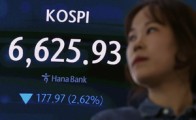
Kospi fell 19.2% from the start of the third quarter through mid-August — the sixth-largest quarterly decline since 1995. The KOSPI 200 volatility index, known as the VKOSPI, hit its highest level since records began.
As household equity investment has expanded, households' net share purchases from the start of this year through Thursday came to about 150 trillion won ($108 billion) — far exceeding the scale seen during previous market corrections.
Even so, the consumer sentiment index remained above its historical average after the correction began, and overall card spending growth did not slow sharply. The bank attributed this resilience to several factors: the correction occurred during an economic expansion, share prices remain higher than a year ago, and the market has seen repeated bouts of decline and recovery since the initial plunge.
The bank warned, however, that household net share purchases were concentrated in the second quarter when prices peaked, and that stock ownership has spread to groups with higher marginal propensities to consume — including young people and low- to middle-income households. "If the stock market correction persists, it could act as an additional downside factor for consumption with a time lag," the bank said.
kimstar@heraldcorp.com